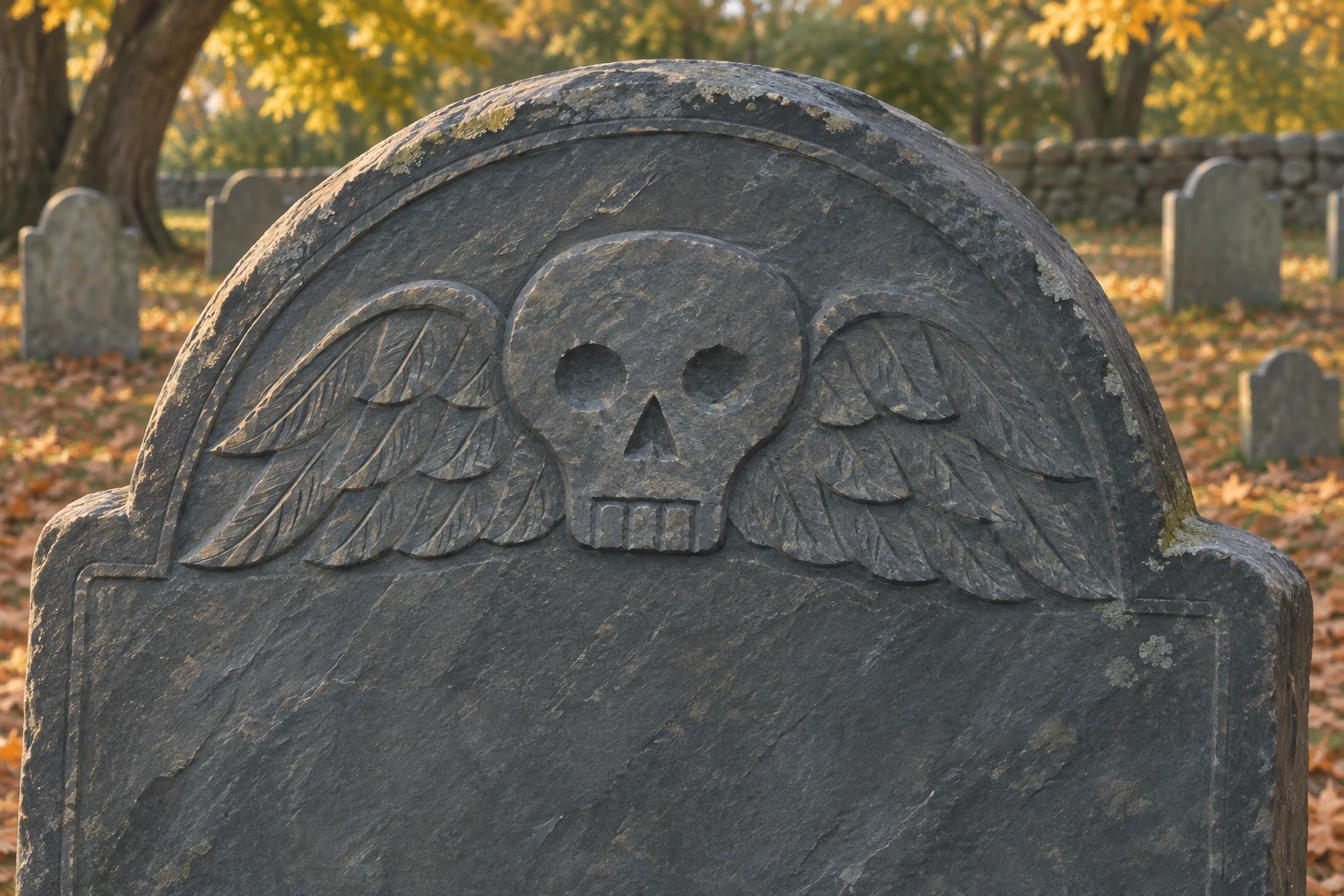
A winged skull gravestone usually carries a reminder of mortality: earthly life ends. Often called a death’s head, the carving may also suggest the soul’s flight beyond the body. That second reading is an interpretation, and the stone’s date, wording, and local carving tradition matter.
The image can look startling now. Yet in a colonial New England burial ground, it belonged to a familiar language of remembrance. A closer look also reveals that the boundary between a skull and a living face was sometimes surprisingly hard to draw.
What a Winged Skull Gravestone Can Suggest
The skull places death in plain sight. Boston’s guide to its historic burying grounds describes death’s heads accompanied by wings, crossed bones, or both. Epitaphs and other carvings could ask visitors to consider how quickly life passes.
The wings make the image harder to pin down. Heritage Museums & Gardens describes the departing spirit as a common interpretation, while cautioning that we cannot know exactly how every viewer understood the design.
It helps to separate the two levels of meaning. Mortality is a well-supported reading of the skull. A more detailed claim about a particular person’s beliefs needs evidence beyond the shape. Religious ideas formed part of the setting, but a stone is not a complete statement of someone’s faith.
A Death’s Head and a Soul Effigy Are Different Designs
Wings alone do not tell you which kind of head you are looking at. Study the eyes, nose, mouth, and outline of the face.
| Design | Features to look for | Useful distinction |
|---|---|---|
| Winged skull or death’s head | Skull-like outline, exposed teeth, and hollow-looking eye or nose spaces | The head emphasizes the mortal body. |
| Winged face or soul effigy | Fleshy cheeks, lifelike eyes, a nose and lips, sometimes hair or a crown | The face is often interpreted as representing the soul. |
| A design combining both | A skull with eyebrows, pupils, or a mouth above its teeth | A simple skull-or-angel label may miss the carver’s mixture of features. |
In her introduction to the Farber Gravestone Collection, Jessie Lie Farber describes these blended forms. A mouth could appear above a skull’s teeth. Teeth could sit so low that they began to resemble decoration around a neck. Small changes gave an established design a more lifelike expression.
That makes “soul effigy” a useful term when the carving is a winged human face. “Cherub” is also used in gravestone literature, but the word should follow a careful look at the object. It should not be applied automatically to anything with wings.
Two Plymouth Stones Show the Difference
The National Register documentation for Old Burial Hill in Plymouth, Massachusetts, provides a helpful comparison. Its descriptions and photographs connect the designs to named people.
Hannah Bartlet, Who Died in 1710
Bartlet’s marker has a skull motif, an hourglass, and a distinctive heart-shaped inscription panel. The decorated head occupies the arched area above the words. The surrounding curves and ornament show how much design could accompany a reminder of death.
Isaac Lothrop, Who Died in 1743
Lothrop’s marker has a more lifelike head, with carved hair, facial features, and clearly shaped wings. The registration document describes the face as three-dimensional and cautions that it is not literally a portrait.
Seen together, the two stones make the visual difference easier to recognize. Their recorded death years provide context; those dates alone do not establish the exact year each stone was carved. Nor do two examples establish a timetable for every New England burial ground.
A Minister’s Stone Puts Skull and Hope Together
The memorial for Reverend Joseph Crocker, who died in 1772, makes a tidy story about grim skulls giving way to hopeful faces difficult to maintain.
A rubbing held by Heritage Museums & Gardens shows the winged skull above Crocker’s inscription. Crossed bones and digging tools fill the space above the head. An hourglass and a tree appear beside the wings. The Cape Cod Gravestones photographic record identifies the marker in Orleans Cemetery.
Read below that cluster of mortality symbols and the message changes in tone. The inscription identifies Crocker as a pastor and includes the words “to be present with the Lord.” The memorial’s skull and its religious hope occupy the same piece of stone.
Skull and crossbones on gravestones belong to this vocabulary of mortality in these colonial examples. Crocker’s marker shows why the surrounding words matter: a severe-looking image could share a memorial with language of consolation.
Why the Timeline Is Messier Than It Looks
A familiar summary runs from skulls to winged faces as attitudes toward death became more hopeful. That can describe broad changes, but local evidence makes the sequence less orderly.
Boston’s Parks and Recreation Department notes that winged faces appeared there by the 1690s. It also reports that death’s heads and cherubs remained widely used into the late 1700s. In Boston, the cherub did not simply replace the skull, and the changing designs did not line up neatly with particular religious movements.
Crocker’s 1772 memorial is a useful reminder to keep those exceptions visible. A skull does not automatically make a stone earlier than every nearby winged face. Place, workshop habits, available designs, and family choices all deserve consideration.
The Letters Belong to the Story Too
The face above the inscription is only part of the carver’s work. Farber also describes changing lettering and opening phrases: forms of “Here lies the body” appeared alongside wording such as “In memory of.” Those shifts offer another way to compare memorials, with the same need to allow for local variation.
Watch for repeated wing patterns, similarly shaped eyes, and familiar lettering on nearby stones. They may point toward a shared carving tradition. They do not, by themselves, identify the maker. A winged face should not be treated as a reliable likeness of the person named below it, either.
Our guide to cemetery symbols explains how names, dates, inscriptions, and local records help test a reading. For a death’s head, start by describing the actual features before deciding how much meaning the evidence can support.
The skull may be what stops you beside the grave. The words bring you back to the person remembered there. Read both, and a design that first seemed merely unsettling becomes part of a human effort to face death and leave a lasting name.
We hope you enjoyed our little trip down the rabbit hole.
We’ll keep digging, and you keep reading.
Keep digging into more Gravestone Symbols and Epitaphs stories.
Sources and Further Reading
- Boston Parks and Recreation, “Iconography of Gravestones at Burying Grounds”: death’s heads, winged faces, and Boston’s overlapping chronology
- Heritage Museums & Gardens, “Symbolism of Gravestones”: interpretations and the illustrated Joseph Crocker rubbing, accession 1974.316.10
- Cape Cod Gravestones, “Joseph Crocker 1772”: the Orleans Cemetery marker and its carved details
- Old Burial Hill, National Register of Historic Places registration form, pp. 7–8 and 36 (PDF): descriptions and photographs of the Hannah Bartlet and Isaac Lothrop markers
- Jessie Lie Farber, Early American Gravestones (1997), American Antiquarian Society (PDF): mixed skull-and-face designs, lettering, and interpretive limits
- Association for Gravestone Studies, “Symbolism on Gravestones”: why interpretations need historical context