
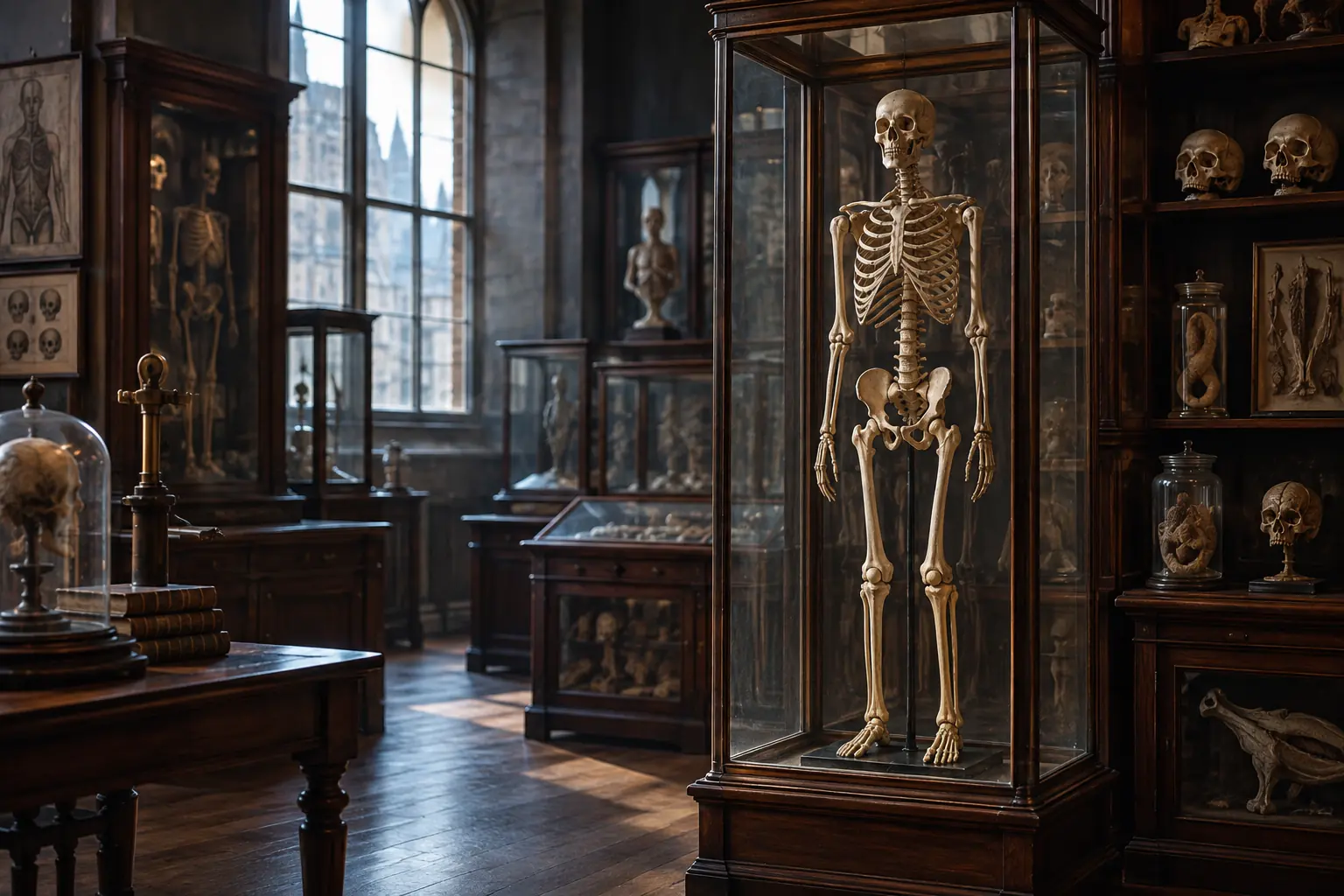
William Burke’s skeleton is still in Edinburgh. Burke was hanged on January 28, 1829, and the court ordered his body delivered to Professor Alexander Monro at the University of Edinburgh for public dissection. His bones were preserved afterward, and nearly two centuries later the skeleton remains in the University’s Anatomical Museum.
That outcome was no accident. When Burke was sentenced, the Lord Justice Clerk said he hoped the skeleton would be preserved so future generations would remember Burke’s crimes. The formal sentence required dissection, not permanent museum display, but the judge made his wish unusually clear.
The story creates a grim circle. Burke and William Hare had made money by selling murder victims to an anatomy school. After Burke was convicted, his own body became an anatomy specimen.
Why Was William Burke’s Body Sent for Dissection?
Burke and Hare murdered at least 16 people in Edinburgh during 1827 and 1828 and sold the bodies for dissection. Dr. Robert Knox’s anatomy school was their buyer. Burke was eventually convicted of murdering Margaret Docherty and sentenced to hang.
At the time, dissection could also be part of the punishment for murder. The law commonly called the Murder Act allowed the bodies of executed murderers to be denied an ordinary burial and given to anatomists. Dissection carried a strong social stigma, so it was meant to add punishment after death as well as provide legal bodies for medical study.
This matters because Burke’s body did not simply end up in an anatomy school because of his connection to the corpse trade. The court specifically ordered it there.
It also did not go to Robert Knox. Knox had bought the bodies supplied by Burke and Hare, but Burke’s sentence named Alexander Monro, Professor of Anatomy at the University of Edinburgh, as the man who would publicly dissect and anatomize him.
The Judge Wanted Burke’s Skeleton Preserved
One of the strangest details appears in the published 1829 account of Burke’s trial and sentence. Before recording the formal sentence, the Lord Justice Clerk considered an even harsher display of Burke’s body but rejected it as too offensive for public view.
He then said, “I trust that if it is ever customary to preserve skeletons, yours will be preserved.”
The judge explained why: he wanted future generations to remember Burke’s crimes.
That statement is important, but it needs one small qualification. The legal sentence ordered Burke’s body to be publicly dissected. It did not separately command the University to keep his skeleton forever. The judge hoped it would be preserved, and that is exactly what happened.
What Happened to Burke’s Body After the Hanging?
Burke was hanged in Edinburgh’s Lawnmarket on the morning of January 28, 1829. The execution drew a huge crowd. Interest did not end when they cut him down.
A contemporary account says people gathered around the College hoping to see the body. To avoid another large crowd during the transfer, the corpse was moved from the lock-up house to the University early the next morning.
Before the general dissection, medical men examined the body. A sculptor also made a cast or bust, and took sketches. Professor Monro then carried out the court-ordered public dissection before a packed audience.
The contemporary report describes Monro removing the scalp, sawing through the skull, and exposing the brain during his lecture. More students tried to get inside, police were called, and a disturbance broke out around the anatomy theatre.
The following day, the public was allowed to file through and view Burke’s remains. The same account says many thousands took the opportunity. The section of skull that had been removed during the dissection was put back in place for the viewing.
Another unusual object survives from these events. The University of Edinburgh’s archives hold a letter said to have been written by Monro using blood taken from Burke’s head. The archive describes the attribution cautiously, so it is safer to call it a remarkable contemporary relic rather than unquestioned proof of exactly who wrote it.
How Did William Burke’s Skeleton End Up in a Museum?
The surviving sources are much clearer about the beginning and end of the story than every step in between. Burke was sentenced to dissection, Monro dissected him, and the University of Edinburgh says the skeleton then became part of its anatomical collection.
The sources checked for this article do not give a detailed day-by-day record of who prepared, cleaned, assembled, and mounted every bone after the dissection. There is no reason to fill that gap with a neat story the records do not actually provide.
We can say with confidence that the William Burke skeleton was retained as an anatomical specimen and became part of the University’s collection. The Anatomical Museum opened in 1884, decades after Burke’s execution, so the skeleton predates the building where it is now displayed.
Where Is William Burke’s Skeleton Today?
William Burke’s skeleton remains at the University of Edinburgh’s Anatomical Museum in the Old Medical School. The University still lists it as one of the museum’s best-known objects.
The museum contains about 12,000 objects connected with anatomy, pathology, zoology, phrenology, forensics, and the history of medical teaching. Burke’s skeleton sits inside that much larger teaching collection rather than in a museum devoted only to crime.
The museum is not open like a normal tourist attraction every day. The University currently opens it to the public on selected open days and events. At other times, it remains a study and teaching space for medical students.
Burke’s remains have also left the museum temporarily. The skeleton was conserved before being displayed at the National Museum of Scotland in the 2022 exhibition A Matter of Death and Life.
The Skeleton Was Cleaned and Photographed Again
That 2022 exhibition marked a new chapter in the skeleton’s history. The University of Edinburgh’s Cultural Heritage Digitization Service reported that Burke’s remains were conserved and cleaned for the first time since the 1800s.
A University photographer then spent several days documenting the skeleton in great detail. The skull was removed from the torso so the inside could be photographed for the first time. The collection number I.C.28 comes from a 19th-century numbering system used for the museum’s skull collection.
The team paid special attention to Burke’s neck because people had long wondered whether the hanging broke it. The University photographer reported that the cervical bones appeared intact. The team’s interpretation was that Burke probably died by strangulation or suffocation during the hanging rather than from a broken neck.
That finding should be treated as an institutional interpretation of the preserved bones, not as a complete modern forensic examination. Still, it shows why Burke’s skeleton is more than a macabre display. Almost 200 years later, the remains can still reveal details about his execution and the way 19th-century anatomists handled his body.
What Else From William Burke Still Survives?
The skeleton is not the only physical object connected with Burke’s final days. The University of Edinburgh also holds life and death masks of his face, along with an endocranial cast made in 1829.
Surgeons’ Hall Museums in Edinburgh displays Burke’s death mask and a pocketbook said to be made from his skin. That pocketbook has its own questions about provenance and deserves a separate evidence check rather than a rushed answer here.
Together, these objects help explain why Burke’s physical afterlife has lasted almost as long as the story of the murders themselves. Hare disappeared from the reliable historical record after his release. Burke, by contrast, remained physically present in Edinburgh’s medical collections.
The Short Version
William Burke was hanged in Edinburgh on January 28, 1829, for the murder of Margaret Docherty. His sentence ordered that his body be delivered to University of Edinburgh anatomy professor Alexander Monro for public dissection.
The judge went further, saying he hoped Burke’s skeleton would be preserved so future generations would remember his crimes. The formal sentence required the dissection rather than permanent display, but the skeleton was preserved and entered the University’s anatomical collection.
It remains in the University of Edinburgh’s Anatomical Museum today. In 2022, conservators cleaned and conserved the skeleton, then photographed it in unusually great detail. The work included new images of the inside of the skull and close examination of the neck bones.
For a man who helped turn other people’s bodies into anatomy specimens for money, Burke’s own final fate carried an uncomfortable symmetry: the murderer became the specimen.
We hope you enjoyed our little trip down the rabbit hole.
We’ll keep digging, and you keep reading.

Keep digging into more Body Snatching & Resurrectionists stories.
Sources and Further Reading
- University of Edinburgh Anatomical Museum – William Burke
- University of Edinburgh – Anatomical Museum Open Days 2026 and 2027
- University of Edinburgh – Burke and Hare
- University of Edinburgh Cultural Heritage Digitization Service – Documenting I.C.28
- University of Edinburgh Library Heritage Collections – Burke and Hare scrapbook, c1829
- UK Parliament – Body snatching
- Project Gutenberg – West Port Murders (1829)
- University of Edinburgh – Medical history on display
- Surgeons’ Hall Museums – History of Surgery Gallery