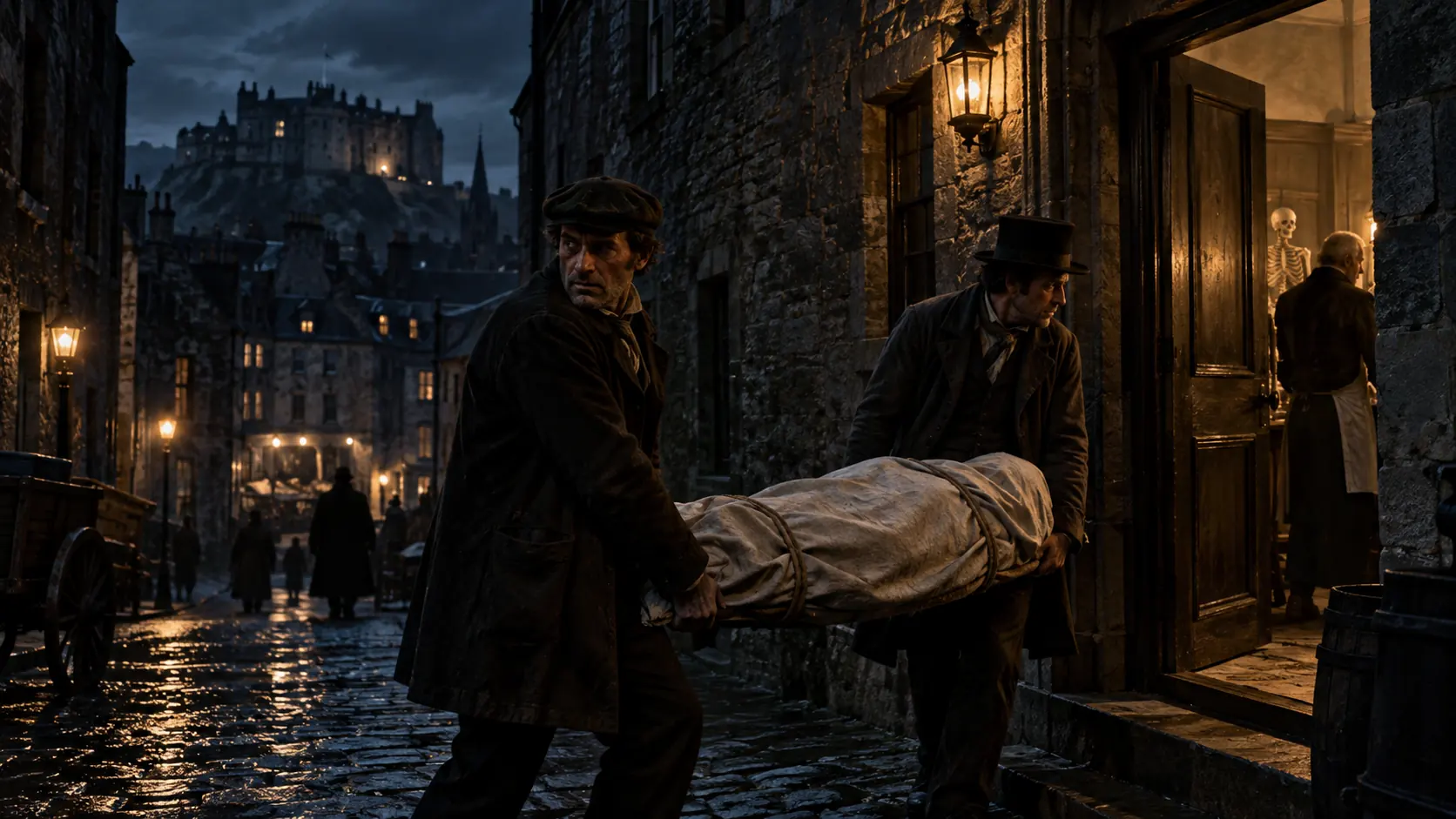
Burke and Hare in Edinburgh were not ordinary grave robbers. William Burke and William Hare murdered at least 16 people in 1827 and 1828 and sold the bodies to the anatomy school of Dr. Robert Knox. Their crimes grew out of a real shortage of legal cadavers, but they crossed a line that professional body snatchers usually did not: instead of stealing corpses, they created them.
The scheme did not begin with murder. It began when a lodger died naturally while owing Hare money. Burke and Hare sold the body to Knox and discovered that a fresh corpse could bring in cash. Before long, they stopped waiting for people to die.
What Happened With Burke and Hare in Edinburgh?
The murders took place in Edinburgh during a period when anatomy teaching was expanding faster than the legal supply of bodies. Medical students needed human cadavers for dissection, but the law provided very few. That shortage helped create a black market in stolen bodies.
Burke and Hare found a more direct and far more criminal way to supply that market. They lured or took advantage of vulnerable people, killed them, and delivered the bodies to Knox’s anatomy school. Modern University of Edinburgh accounts put the number of victims at at least 16.
The crimes became known as the West Port murders because Burke and Hare lived and operated around Edinburgh’s West Port area, near the Grassmarket. Their names became so closely tied to the case that the phrase “Burke and Hare” still suggests murder for profit nearly two centuries later.
Why Were Human Bodies Worth Money?
Edinburgh was one of Britain’s leading centers for medical education. Anatomy teachers competed for students, and students expected hands-on dissection. The problem was supply.
Only a limited number of bodies could legally be used for anatomy. As medical classes grew, illegal suppliers stepped in. Grave robbers could dig up a fresh corpse and sell it to an anatomist. That trade already existed before Burke and Hare began killing.
The murders therefore did not create the market. They exploited a market that was already paying for bodies. That distinction matters because it explains why an anatomy school could become the buyer at the end of a chain that began in a lodging house rather than a graveyard.
How Did the Scheme Begin?
According to modern University of Edinburgh accounts and later historical records, the first body Burke and Hare sold was not a murder victim. An elderly lodger named Donald died naturally while owing Hare rent.
Hare saw a way to recover the money. He and Burke removed the body from its coffin and sold it to Robert Knox. University records say they received about £8 for it – enough money to show them that a body had real cash value.
That first sale changed the nature of the scheme. Waiting for another convenient death was slow and unpredictable. Burke and Hare began killing instead.
Burke and Hare Were Not Ordinary Resurrectionists
This is one of the biggest points that gets blurred in retellings of the story. Burke and Hare were not ordinary resurrectionists. Resurrectionists stole bodies that were already dead, usually by opening fresh graves and selling the corpses for dissection.
Burke and Hare did something different. They killed living people specifically so the bodies could be sold. The medical demand was the same, but the crime was not.
That is why calling them simply “body snatchers” understates what happened. Their story belongs to the body trade, but they were murderers supplying that trade rather than grave robbers stealing from it.
How Were the Victims Killed?
The pair generally tried to avoid leaving obvious injuries that might make a fresh body suspicious. University of Edinburgh records describe victims being suffocated after being restrained. Alcohol was often used to make victims easier to control.
The method became so strongly associated with the case that the word “burking” entered the language as a term connected with killing by suffocation. The important point is not the mechanics. It is that the killers were trying to deliver bodies that could pass as recent natural deaths.
Burke later said no one in the medical world had taught them the method. His confession claimed that the choice of suffocation developed within the partnership itself.
Who Were the Victims?
The victims were not one neat group. Many were poor, transient, elderly, isolated, or otherwise unlikely to trigger an immediate investigation. Some were lodgers or people met in Edinburgh’s streets and drinking places.
Three names appear directly in the surviving High Court case papers against Burke: Mary Paterson or Mitchell, James Wilson – commonly called Daft Jamie – and Margery or May Campbell or Docherty. The indictment accused Burke of killing all three with the intention of selling their bodies to a physician or surgeon.
Burke was not ultimately tried to verdict on all three murders. The proceedings narrowed, and the conviction that sent him to the gallows was for the murder of Docherty. That legal detail is one reason the number of known murders and the number proved in court are not the same thing.
How Were Burke and Hare Caught?
The last murder brought the operation down. On October 31, 1828, Margaret Docherty was killed in Burke’s lodging. Other lodgers grew suspicious, and James Gray reported it to the police.
By the time police searched the lodging, the body had been moved. Police later connected it to Knox’s anatomy school. Burke, Helen McDougal, Hare, and Hare’s wife were taken into custody as investigators tried to work out what had happened.
The problem for prosecutors was evidence. Suspicion was enormous, but proving a murder beyond the testimony of people involved in the crime was another matter. That problem led directly to the deal that saved Hare and doomed Burke.
Why Did Hare Testify Against Burke?
Prosecutors offered Hare protection from prosecution if he disclosed what he knew and testified. The surviving 1829 account of the proceedings records that the Lord Advocate chose Hare as a witness because the case against Burke needed inside evidence.
Hare accepted the offer. His testimony helped the Crown build the case against Burke. In modern terms, he became the cooperating accomplice – the man who avoided the gallows by giving evidence against his partner.
That decision made Hare one of the most hated men in Britain, but his later life is uncertain. His escape, the public reaction, and the stories about what happened afterward are better treated separately than by turning this article into a biography of Hare.
What Happened at Burke’s Trial?
The High Court of Justiciary trial began in Edinburgh on December 24, 1828. Burke and Helen McDougal pleaded not guilty. The formal indictment contained three murder charges, but the trial proceeded on the Docherty charge.
Burke was found guilty. The case against McDougal received Scotland’s “not proven” verdict, and she was released. Burke was sentenced to hang on January 28, 1829.
The sentence carried a grim symmetry. Burke had sold bodies for dissection; after his execution, his own body was given over for anatomical dissection. What happened to his remains afterward is its own Graveosity rabbit hole and does not need to be crammed into the murder story.
What About Dr. Robert Knox?
Robert Knox was the anatomist who bought the bodies. He was one of Edinburgh’s best-known anatomy teachers, and his school needed a steady supply of cadavers.
Knox was never tried for participation in the murders. The scandal, however, badly damaged his reputation. The harder question – what Knox knew, what he should have suspected, and what happened to his career afterward – deserves its own article rather than a few rushed paragraphs here.
Did Burke and Hare Cause the Anatomy Act of 1832?
Not by themselves. Britain had been struggling with the shortage of legal bodies and the resurrectionist trade long before the West Port murders became public.
The murders did make the danger of the corpse market impossible to ignore. They showed what could happen when a fresh body had a cash value and anatomy schools had too few legal ways to obtain one. Public outrage added pressure to an already underway reform movement.
The Anatomy Act of 1832 eventually widened the legal supply of bodies and helped undermine the market that supported professional body snatching. Burke and Hare became the most notorious example of why the old system had become dangerous, but they were not the sole reason Parliament changed the law.
The Short Version
Burke and Hare in Edinburgh were murderers who supplied bodies to the anatomy school of Dr. Robert Knox during 1827 and 1828. Their scheme began after they sold the body of a lodger who had died naturally. Once they saw how much a corpse could be worth, they began killing people instead of waiting for deaths or digging up graves.
They murdered at least 16 people. Hare escaped prosecution by giving evidence against Burke. Burke was convicted of the murder of Margaret Docherty and hanged on January 28, 1829. Knox was not prosecuted, although the scandal damaged his career.
Their importance goes beyond the horror of the murders. The case exposed the dangerous economics behind Britain’s illegal corpse trade: medical schools needed bodies, the law supplied too few, and people were willing to pay cash for the difference.
We hope you enjoyed our little trip down the rabbit hole.
We’ll keep digging, and you keep reading.
Keep digging into more Body Snatching & Resurrectionists stories.
Sources and Further Reading
- University of Edinburgh – Burke and Hare
- National Records of Scotland – Trial papers relating to William Burke and Helen McDougal (JC26/1828/469)
- University of Edinburgh Anatomical Museum – William Burke
- Project Gutenberg – West Port Murders (1829)
- Open Library — Trial of William Burke and Helen M'Dougal (1829)