
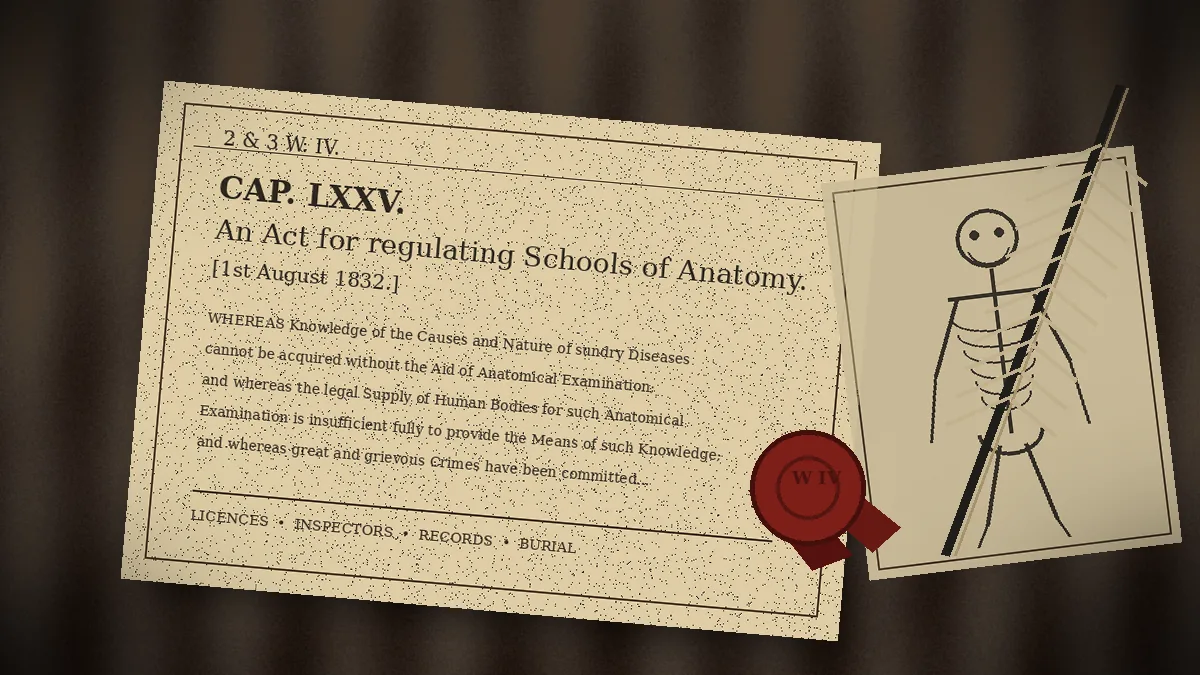
The Anatomy Act of 1832 changed how Britain obtained human bodies for medical dissection. It replaced a system that depended heavily on a tiny legal supply and an illegal trade in stolen corpses with a regulated way to make more bodies available for anatomy. The law licensed anatomy teachers, created inspectors and recordkeeping rules, required medical checks before a body could be used, and required burial afterward.
Britain changed the law because medical schools needed far more cadavers than the old system could provide. Body snatchers filled that gap by stealing freshly buried bodies. Then murder-for-sale cases such as Burke and Hare showed how dangerous a cash market for corpses could become. The 1832 law was meant to attack the cause of that market, not simply punish more grave robbers.
What Was the Anatomy Act of 1832?
The law received royal assent on August 1, 1832. Its official title was An Act for regulating Schools of Anatomy. The Act’s opening words made Parliament’s concern unusually clear: anatomical study was important to medicine, the legal supply of bodies was not enough, and serious crimes had been committed to obtain bodies for dissection.
The Act did not simply legalize body taking. It tried to replace an underground market with a supervised system. The Act brought anatomy practice under licensing and inspection. People handling bodies had to follow rules about permission, death certification, records, removal, examination, and burial.
The law applied across the United Kingdom, including Ireland. It became the major legal break between the classic resurrectionist era and a more regulated system of anatomical study.
Why Was Britain Short of Legal Bodies?
Before 1832, anatomy teachers had a basic supply problem. Medical students needed real human bodies to learn anatomy, but the law provided few. For much of the eighteenth and early nineteenth centuries, the bodies of some executed murderers could be sent for dissection. That was never enough to meet the needs of growing medical schools.
By 1828, Parliament had appointed a Select Committee on Anatomy to investigate the shortage. The committee heard from surgeons, anatomy teachers, and people who supplied bodies. Its report showed that medical education had become deeply dependent on bodies obtained outside the normal legal system.
The scale of the problem appeared again during debate on the Anatomy Bill in 1832. In the House of Commons, supporters estimated that London alone had about 700 surgical pupils and needed roughly 1,100 bodies a year for instruction. These were contemporary estimates, not exact national totals, but they show the size of the gap lawmakers believed they faced.
How Body Snatching Exposed the Problem
When legal supply could not meet demand, an illegal supply chain grew around it. Professional body snatchers, often called resurrectionists, watched burial grounds, removed fresh bodies, and sold them to anatomy teachers and medical schools.
This was not a side problem caused by a few strange criminals. It was directly tied to how anatomy education was supplied. Medical schools wanted cadavers. The law supplied too few. Resurrectionists supplied the difference.
Burke and Hare made the danger impossible to ignore. They were not ordinary resurrectionists because they did not dig bodies out of graves. They murdered people and sold the bodies for dissection in Edinburgh. A similar murder-for-sale scandal followed in London in 1831. These cases showed the ugliest possible result of putting a cash value on a fresh human body.
The scandals increased pressure for reform, but they did not create the problem. Britain had already been arguing about grave robbing, anatomy, and legal body supply for decades.
Britain Had Been Arguing About This for Decades
The road to the Anatomy Act began long before 1832. In 1795, Parliament considered a bill aimed at stopping the stealing of dead bodies from churchyards and burial grounds. It failed. That same year, physician William Rowley published a pamphlet addressed to the legislature arguing that anatomy needed encouragement while grave violation also had to be prevented.
The conflict was already clear: doctors wanted more bodies for teaching, while families wanted the dead left alone.
The 1828 Select Committee put the issue under formal investigation. After the Burke and Hare murders, another Anatomy Bill reached Parliament in 1829 but was withdrawn after strong objections, especially over the use of bodies from poor and public institutions.
So the 1832 Act was not a panicked law written after one famous murder case. It resulted from years of failed fixes, medical pressure, public anger, parliamentary investigation, and repeated proof that the existing system was not working.
What Did the Anatomy Act Actually Change?
The Act changed both the supply of bodies and the way anatomy was supervised. Its main rules included:
- Licensing and inspection. The government could license qualified anatomy teachers and appoint inspectors to oversee the system.
- A wider legal supply. A person or institution with lawful possession of a body could permit anatomical examination, subject to the Act’s protections and objections.
- The right to object. A body could not be used if the person had objected before death in the way the Act recognized, or if a surviving spouse or known relative required burial without examination.
- A waiting period and medical certificate. Anatomy could not be performed until at least 48 hours after death. Notice and a certificate stating the cause of death were also required.
- Records and oversight. Inspectors received information about bodies used for anatomy, and licensed places had reporting duties.
- Burial after examination. The remains had to be placed in a decent coffin or shell and buried in an appropriate burial ground. Burial had to be documented.
These rules mattered because the old black market worked in darkness. The new system created a legal chain of custody from death to dissection to burial.
The Law Did Not Simply Say “Take Bodies From Workhouses”
The Anatomy Act is often summarized by saying that it gave medical schools the unclaimed bodies of people who died in workhouses and hospitals. That description captures an important part of what happened in practice, but it is not the wording Parliament used.
The Act said that an executor or other party having lawful possession of a body could allow it to be examined, unless the deceased had objected or a surviving spouse or known relative required burial. That broader wording mattered. Institutions such as workhouses and hospitals often had lawful possession of bodies that no family member claimed for burial.
As a result, the new legal supply fell heavily on poor people and others who died in institutions without relatives able or willing to claim the body. Modern historians have emphasized this class burden. The law reduced the need to steal bodies from graves, but it did not make the ethics of dissection simple or equal.
In that sense, the 1832 reform solved one public crisis by creating a new source of anxiety. Families had less reason to fear resurrectionists digging up a grave, but poor people had good reason to worry about what might happen to their bodies if they died unclaimed.
The Act Also Removed Dissection as a Murder Punishment
One of the stranger parts of the reform had nothing to do with supply numbers. The Act repealed the power to sentence a murderer’s body to dissection after execution.
That change mattered because dissection had long carried the stigma of criminal punishment. For many families, being cut up after death was not viewed as ordinary medical education. It was associated with disgrace and the treatment of executed criminals.
By removing dissection from the punishment of murderers while creating a separate regulated supply for medical schools, the law began to separate two ideas that had been tied together for generations: anatomy as a medical practice and dissection as an added punishment after death.
That did not erase public fear. But it changed the legal meaning of anatomical dissection in a way that is easy to miss if you reduce the Act to a story about workhouses and body snatchers.
Did the Anatomy Act End Body Snatching?
Not overnight.
The law created a new supply system, but that system still had to be put into practice. Inspectors had to be appointed. Anatomy teachers had to be licensed. Institutions had to follow the new rules. Existing resurrectionists did not disappear the moment Parliament passed the Act.
The economics of the trade changed. When anatomy schools could legally obtain more bodies, they had less reason to pay professional grave robbers. Modern historical research suggests that grave robbing in Britain dwindled through the 1830s and into the 1840s rather than ending on a single date.
The Act therefore did what tougher punishment alone could not do. It attacked the shortage that made stolen bodies valuable in the first place.
What Did the Act Fix – and What Did It Not Fix?
The Anatomy Act of 1832 helped break the professional resurrectionist’s business model. It expanded legal access to cadavers, brought anatomy under government supervision, required records, and made burial after examination part of the regulated process.
It also responded to the danger created by the old corpse market. Parliament’s own preamble referred to serious crimes, including murder, committed to supply bodies for anatomy. The law was designed to make those crimes less profitable by giving medical schools another source.
But the reform did not create a modern system based only on freely donated bodies. It shifted much of the burden toward people who died poor, institutionalized, or unclaimed. That remained controversial, and later laws continued to change how anatomical bodies were obtained and regulated.
The result was a major turning point, not a clean ending. Britain moved away from a system that quietly depended on grave robbers, but the question of who should provide bodies for medical education did not disappear. It simply moved into a different legal and ethical argument.
The Short Version
The Anatomy Act of 1832 changed British anatomy law because medical schools needed more bodies than the old legal system could supply. That shortage helped create the resurrectionist trade and a cash market for fresh corpses. Murder-for-sale scandals made the danger impossible to ignore, but reform had been debated for decades before the Act finally passed.
The law licensed anatomy teachers, created inspectors and records, allowed bodies in lawful possession to be released for anatomy under set conditions, recognized objections by the deceased and relatives, required medical certification and burial afterward, and removed dissection as a punishment for murder.
It did not end body snatching instantly, and it placed a heavy burden on poor and unclaimed people. But by creating a larger legal supply of bodies, it undermined the market that had allowed professional resurrectionists to thrive.
We hope you enjoyed our little trip down the rabbit hole.
We’ll keep digging, and you keep reading.

Keep digging into more Body Snatching & Resurrectionists stories.
Sources and Further Reading
- UK Legislation – Anatomy Act 1832 (2 & 3 Will. 4 c.75), official PDF
- UK Parliament Hansard – Anatomy Bill, House of Commons, 27 February 1832
- UK Parliament Hansard – Schools of Anatomy, House of Lords, 19 July 1832
- Great Britain, House of Commons – Report from the Select Committee on Anatomy (1828), Wellcome Collection
- William Rowley – On the absolute necessity of encouraging…the study of anatomy (1795), Wellcome Collection
- UK Parliament – Body Snatching
- The National Archives – Body Snatchers
- Richard M. Ward – The Criminal Corpse, Anatomists and the Criminal Law (2015)
- Philp et al. – Bodies and bureaucracy: The demise of the body snatchers in 19th-century Britain (2022)