
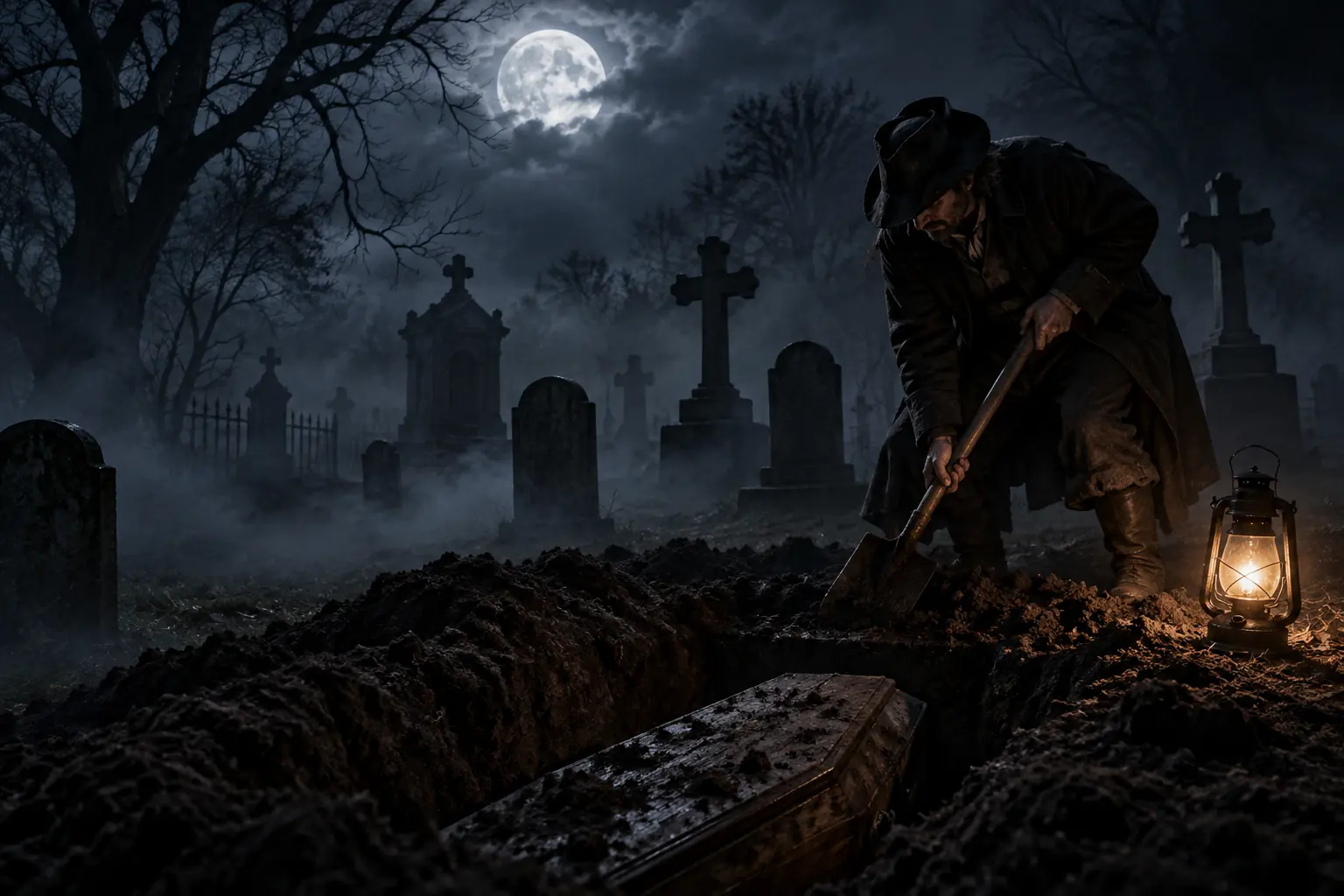
Famous grave robbers were usually not hunting for jewelry or treasure. In the eighteenth and nineteenth centuries, many stole fresh human bodies because medical schools needed cadavers for anatomy lessons and the legal supply was far too small. Some worked for money. Some were medical students trying to obtain a body to study. At least one well-known American resurrectionist was forced into the work while enslaved.
The best-documented names include London resurrectionists Ben Crouch and Joseph Naples, Grandison Harris in Georgia, Rufus Cantrell in Indiana, and the future German anatomy professor Friedrich Schlemm. Their stories show that grave robbing was not one single kind of crime. It could be an organized business, a medical shortcut, a scandalous black market, or work forced on someone with little or no choice.
What Did Grave Robbers Actually Steal?
In this part of history, a grave robber usually wanted the corpse itself. These body thieves were often called resurrectionists. They removed newly buried bodies and sold them to anatomy teachers, hospitals, or private medical schools for dissection.
That is different from robbing a tomb for valuables. In Britain, taking clothing, jewelry, or a burial shroud could expose a thief to more serious charges than taking the body alone. Professional resurrectionists therefore had a reason to leave grave goods behind and concentrate on the corpse.
The trade existed because medical education had a supply problem. Students were expected to learn from real human bodies, but the law provided only a small number of legal cadavers. Wherever demand outran supply, someone could make money – or gain access to a body – by taking one illegally.
Ben Crouch and the Borough Gang
Ben Crouch was one of the best-known professional resurrectionists in early nineteenth-century London. James Blake Bailey’s 1896 publication of The Diary of a Resurrectionist identifies Crouch as the leader of the gang recorded in the diary and describes the group as the chief body-snatching gang in London during that period.
Crouch was no quiet cemetery worker. Historical accounts describe him as a powerful man and a prizefighter. His gang treated bodies as merchandise, supplied anatomy schools, argued over money, fought with rivals, and tried to control access to the corpse trade.
The gang’s business model explains why grave robbing could become a profession instead of an occasional crime. A fresh body had a buyer. Experienced men knew which burial grounds were easiest to enter, which graves were newest, how to move bodies, and which anatomy schools would pay.
Joseph Naples: The Grave Robber Who Kept a Diary
Joseph Naples gives historians something most grave robbers did not leave behind: a working record of the trade. The Royal College of Surgeons identifies Naples as the author of a diary covering 1811 and 1812. He had served in the Royal Navy and later worked as a gravedigger before body snatching became his full-time occupation.
His diary records bodies taken, places where they were sold, payments, expenses, arrests, and the ordinary problems of running an illegal business. The Royal College of Surgeons notes that the gang supplied private anatomy schools and major London hospitals, and even sent bodies beyond London.
One detail makes the diary especially human. A modern Royal College of Surgeons summary reports that moonlight stopped the gang from working on 47 of the 194 nights covered by the diary. Grave robbing depended not only on courage and secrecy, but also on weather, darkness, guards, dogs, and the medical school calendar. Families and communities fought back by organizing a grave watch to protect newly buried loved ones from body snatchers.
Grandison Harris: Enslaved to Supply a Medical School
Grandison Harris belongs on any list of famous grave robbers, but his story requires an important distinction: he did not begin as a free criminal choosing the work for profit. Faculty members of the Medical College of Georgia purchased Harris while he was enslaved in 1852. His official job was porter and janitor, but he was also used as the school’s resurrection man.
Smithsonian records describe Harris learning to read funeral notices and memorizing grave decorations so he could put them back after removing a body. He often worked in Cedar Grove Cemetery in Augusta, where many poor and Black residents were buried. Medical students used the bodies for dissection.
After emancipation, Harris later returned to the college as a paid employee and continued working around the dissection rooms. His case shows why the motive behind grave robbing cannot always be reduced to greed. The people doing the digging could be workers trapped inside a much larger medical and social system.
Rufus Cantrell and the Indianapolis Grave-Robbing Scandal
Grave robbing for medical schools did not disappear everywhere after Britain passed the Anatomy Act of 1832. In the United States, the trade continued well into the nineteenth century and even into the early twentieth century.
In 1902, Indianapolis resident Rufus Cantrell was arrested and charged with grave robbing. The Indiana Historical Bureau describes the case as part of a far-reaching black market tied to medical education. Cantrell implicated other people, including a farmer and a physician, as authorities investigated stolen bodies and medical colleges.
The scandal grew large enough to prompt a legal response. In 1903, Indiana created a State Anatomical Board to oversee the distribution of cadavers to medical schools. Once again, the pattern was familiar: medical demand, an inadequate legal supply, an illegal body market, public outrage, and then reform.
Friedrich Schlemm: A Medical Student Caught Robbing a Grave
Not every grave robber belonged to a professional gang. Sometimes medical students did the digging themselves.
Friedrich Schlemm is a striking example because his name is still familiar in medicine. The drainage channel in the eye known as Schlemm’s canal is named for him. But in 1816, while he was a young anatomy student in Braunschweig, Schlemm and another student dug up a woman’s body from a churchyard to study how rickets affected her bones.
Archival research published in Annals of Anatomy found that authorities caught the pair and sentenced them to four weeks in prison. Schlemm later built a successful career and became a professor of anatomy in Berlin. His case shows that body snatching was not always a separate criminal profession. Medical trainees themselves could cross the line when legal bodies were hard to obtain.
Were Burke and Hare Grave Robbers?
William Burke and William Hare are often called the most famous grave robbers of the period, but that description is misleading. They did not become notorious by digging bodies out of graves. They murdered living people and sold the fresh bodies to Dr Robert Knox’s anatomy school in Edinburgh.
They operated in the same corpse market, but their crimes differed. Ordinary resurrectionists stole from the dead. Burke and Hare created bodies for sale by killing people. That distinction is important because the horror of their murders helped blur the public image of grave robbers, body snatchers, and murderers into one frightening idea.
Why Are So Few Grave Robbers Famous by Name?
The strange part of this history is that medical schools, surgeons, and murder cases often became more famous than the people who actually dug up graves. Many resurrectionists worked under false names, belonged to gangs, or appeared only briefly in court and newspaper records.
Bailey warned about this problem in The Diary of a Resurrectionist. He noted that newspaper reports could be wildly exaggerated and that arrested body snatchers often gave false names. Some sensational stories that sounded detailed and convincing could not later be confirmed.
That means you have to build a list of famous grave robbers carefully. The safest names are the people tied to diaries, court records, institutional archives, or well-documented scandals – not every ghoul who appeared in a nineteenth-century newspaper headline.
Why Did Grave Robbers Do It?
There was no single motive. Ben Crouch and Joseph Naples worked in an organized market where bodies meant money. Rufus Cantrell operated in another medical black market decades later. Friedrich Schlemm wanted a body for anatomical study. Grandison Harris was enslaved when a medical college put him to work.
What connects the cases is demand. Anatomy schools needed real human bodies. Legal systems repeatedly failed to provide enough. That gap created opportunities for professional thieves, desperate students, criminal networks, and institutions willing to ask too few questions.
The grave robber held the shovel, but the shovel existed because someone was waiting to buy what came out of the ground.
The Short Version
Some of the most famous grave robbers and body snatchers include Ben Crouch and Joseph Naples in London, Grandison Harris in Georgia, Rufus Cantrell in Indiana, and Friedrich Schlemm in Germany. They did not all have the same motive or the same degree of choice, but their stories grew from the same basic problem: medical schools needed more cadavers than the law supplied.
Professional resurrectionists turned fresh bodies into a business. Medical students sometimes stole bodies for their own training. In the United States, grave robbing continued long after Britain had begun reforming its anatomy laws. And figures such as Burke and Hare, although commonly grouped with grave robbers, went much further by murdering people for sale to an anatomy school.
The history is less about a handful of bizarre criminals than about a hidden supply chain connecting cemeteries to dissecting rooms.
We hope you enjoyed our little trip down the rabbit hole.
We’ll keep digging, and you keep reading.

Keep digging into more Body Snatching & Resurrectionists stories.
Sources and Further Reading
- Royal College of Surgeons of England – Diary of a resurrectionist: The unique record of a frightening trade born out of necessity
- Project Gutenberg – The Diary of a Resurrectionist, 1811-1812, by James Blake Bailey
- Smithsonian Magazine – Meet Grandison Harris, the Grave Robber Enslaved (and then Employed) By the Georgia Medical College
- Indiana Historical Bureau – Grave Robbing Scandal
- PubMed – Schlemm, the body snatcher?