
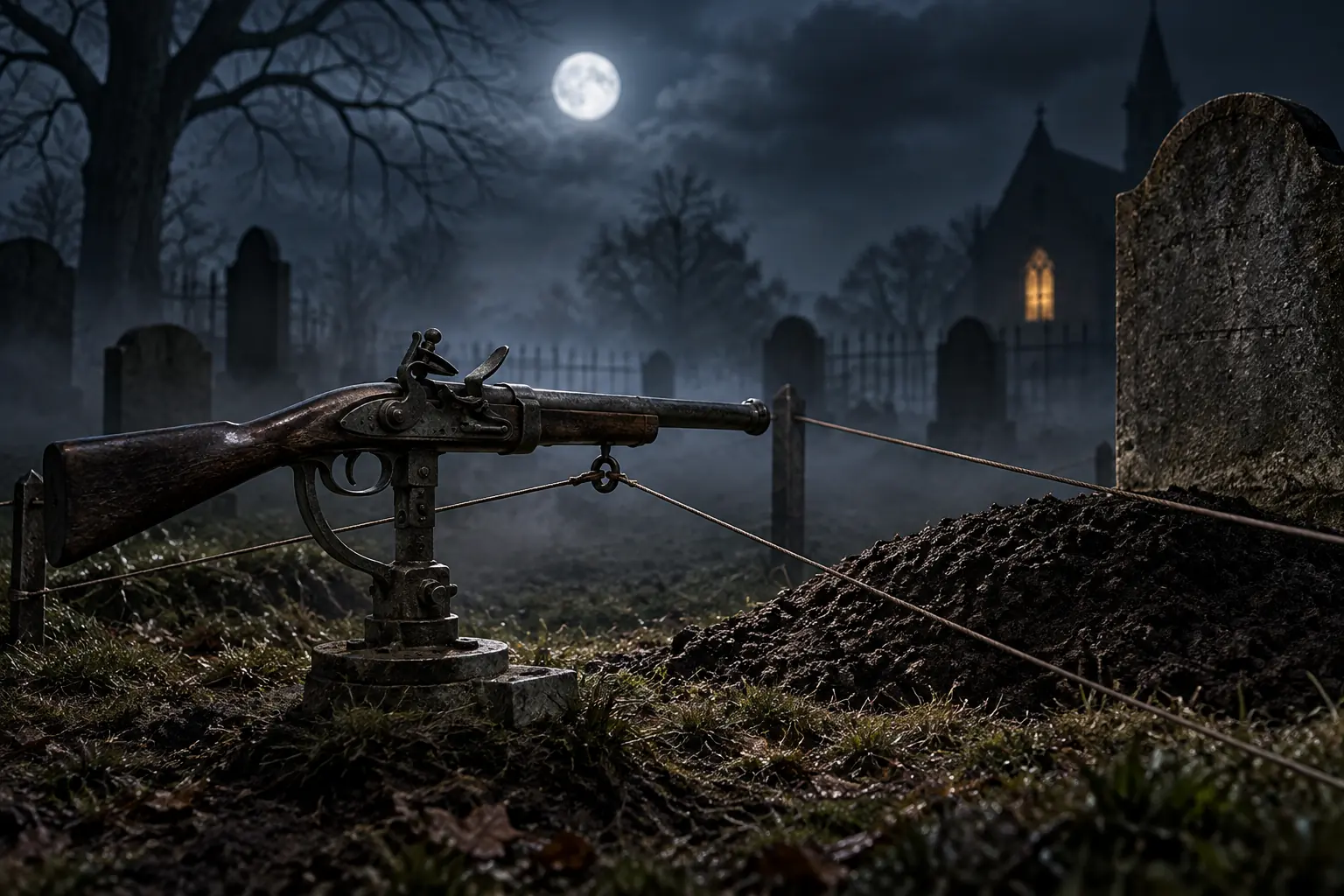
A grave gun was a trip-wire firearm placed near a fresh grave to stop body snatchers. The weapon was usually mounted to swing toward an intruder. Wires were stretched around the burial site, and a person who stumbled into one could trigger the gun.
It sounds like something invented for a horror movie, but grave guns were real. They belonged to the same strange world as grave watches, mortsafes, watch-houses, and other defenses created when families feared that a newly buried relative might disappear before morning.
The important detail is that a grave gun was not normally hidden inside the coffin. It guarded the grave from above. Later inventors took the idea further with coffin torpedoes and other buried traps.
What Was a Grave Gun?
A grave gun, also called a cemetery gun, was a form of spring gun. It was a firearm rigged to fire automatically when a cord or trip wire was disturbed.
The best-known surviving examples were flintlock weapons mounted on a base that allowed the gun to pivot. Several wires could spread away from the weapon around a grave. If someone crossed one in the dark, the pull could swing the gun toward the disturbance and release the trigger.
The idea was simple: a human guard could fall asleep, walk away, or be too expensive to hire. A mechanical guard could sit beside the grave all night.
Why Did Families Arm Graves?
The reason was the medical demand for fresh bodies. During the eighteenth and early nineteenth centuries, anatomy schools needed cadavers for teaching, but legal supplies were small. Professional body snatchers, often called resurrectionists, filled the gap by stealing newly buried corpses and selling them for dissection.
Fresh graves were the obvious targets. A body that had just been buried was easier to locate and more useful to an anatomy school than one that had been in the ground for a long time.
Families answered the threat in several ways. Some organized a grave watch, hired guards, or built watch-houses. Others used heavy stones, iron cages called mortsafes, or devices meant to punish the thief rather than merely block him.
The grave gun was one of the most aggressive answers: if somebody crossed the wrong wire in the dark, the grave defended itself.
How Did a Grave Gun Work?
The typical design used a loaded flintlock firearm fixed to a rotating or swiveling mount near the grave. Trip wires were arranged around the burial so an approaching person could catch one with a foot or leg.
Pulling the wire activated the mechanism. On surviving museum examples, the mount could turn the gun toward the disturbed wire before the firearm discharged.
That made the device different from simply pointing a gun in one direction. Several wires could cover more than one approach to the grave. The darkness that helped body snatchers hide also made thin wires difficult to see.
The exact ammunition used could vary. Later accounts describe anything from light shot meant to frighten or injure an intruder to loads capable of causing serious wounds. Because the devices were unattended, however, they did not know the difference between a resurrectionist and anyone else who happened to cross the wire.
What Did a Surviving Cemetery Gun Look Like?
One of the most frequently photographed cemetery guns came from the former Museum of Mourning Art at Arlington Cemetery in Pennsylvania. The piece was described as an eighteenth- or early nineteenth-century steel and wrought-iron gun with a rotating mechanism and attachment points for trip wires.
That surviving object matters because cemetery guns can sound too strange to be real. The physical artifact shows that this was more than a newspaper joke or a later legend.
The museum gun also shows how practical the idea was. It did not need complicated machinery. A firearm, a pivoting base, and several wires were enough to turn a fresh grave into a crude booby trap.
Could Body Snatchers Beat the Trap?
Yes. A grave gun was dangerous, but it was not unbeatable.
The biggest weakness was that it sat above ground. If a body-snatching gang learned where the gun was placed, the men could avoid its wires or disable them before digging.
Accounts collected around the surviving cemetery gun describe resurrectionists scouting graves during daylight and cemetery workers waiting until after dark to set the weapon. Whether every detail in these later stories can be proved is difficult to say, but the basic problem is obvious: once a trap was discovered, much of its advantage disappeared.
That is one reason grave protection became a contest of adaptation. Families changed defenses. Body snatchers changed tactics. Then defenders tried something else.
Were Grave Guns Legal?
In Britain, grave guns also ran into a legal problem.
Parliament passed the Spring Guns Act in 1827. The law made it a misdemeanor to set a spring gun, man trap, or similar device intended to kill or cause serious bodily harm to a trespasser or other person who came into contact with it. The law made limited exceptions for traps used against vermin and for nighttime protection inside a dwelling house.
A cemetery was not a dwelling house. So an unattended gun set beside a grave could fall squarely inside the kind of dangerous device Parliament was trying to stop.
That timing is interesting. Britain was still struggling with resurrectionists when lawmakers were already restricting one of the more violent ways families tried to stop them.
Did Grave Guns Actually Kill Grave Robbers?
This is where the history becomes less certain.
There are many later stories of spring guns injuring or killing body snatchers, and nineteenth-century accounts describe dangerous traps being set around property and burial grounds. But specific cemetery-gun shootings are often repeated without enough surviving detail to verify exactly what happened.
The safest conclusion is narrower. Grave guns were real devices, surviving examples exist, and spring guns were dangerous enough to warrant legislation. That strongly suggests people took the threat seriously.
What we should not do is turn every dramatic story about a dead grave robber into a confirmed fact simply because it has been repeated for a century.
Grave Guns Were Not Coffin Torpedoes
Grave guns and coffin torpedoes are often lumped together, but they were not the same thing.
A grave gun was normally positioned at or near the surface and triggered by wires around the burial. A coffin torpedo was a later defensive device placed in or near the coffin and designed to explode or discharge when the coffin or body was disturbed.
The goal was the same: make stealing a body dangerous. The engineering was different. Coffin torpedoes deserve their own article because nineteenth-century inventors patented several remarkable versions.
Why Did Grave Guns Disappear?
Several changes reduced the need for devices like grave guns.
In Britain, the Anatomy Act of 1832 expanded the legal supply of bodies available for dissection and helped weaken the market that supported professional resurrectionists. It did not end body snatching overnight, but it attacked the shortage that had made stolen corpses valuable.
Spring-gun laws also made unattended firearms harder to justify. Grave guns also had practical weaknesses: they could be spotted, avoided, damaged by weather, or triggered by the wrong person.
Other countries did not solve the cadaver shortage at the same time, so body snatching and grave-defense devices continued in different forms. By the late nineteenth century, American inventors were patenting coffin torpedoes and other grave traps that hid the danger closer to the coffin itself.
The grave gun belongs to an especially strange moment in history: medical schools needed bodies badly enough to create a black market, and families feared that market enough to leave a loaded gun guarding the dead.
The Short Version
A grave gun was an automatic firearm used to protect fresh graves from body snatchers. The weapon was usually mounted on a swiveling base and connected to trip wires around the burial. An intruder who caught a wire could cause the gun to turn and fire.
The devices appeared because anatomy schools needed more bodies than the legal system supplied. Families responded with grave watches, mortsafes, guards, and sometimes armed traps.
Grave guns were real, but stories about exactly how many grave robbers they shot are harder to prove. In Britain, Parliament restricted spring guns in 1827, and the Anatomy Act of 1832 later helped reduce the illegal corpse market. Coffin torpedoes carried the same idea into an even stranger generation of grave-defense inventions.
We hope you enjoyed our little trip down the rabbit hole.
We’ll keep digging, and you keep reading.

Keep digging into more Body Snatching & Resurrectionists stories.
Sources and Further Reading
- Hagley Museum and Library – Grave Guns & Coffin Torpedoes: Inventions for Protecting the Dead from the Living
- Mental Floss – Show & Tell: An 18th-Century Cemetery Gun
- PBS – Museum of Mourning Art segment featuring a cemetery gun
- UK Legislation – Spring Guns Act 1827
- Historic UK – The Art of Bodysnatching