
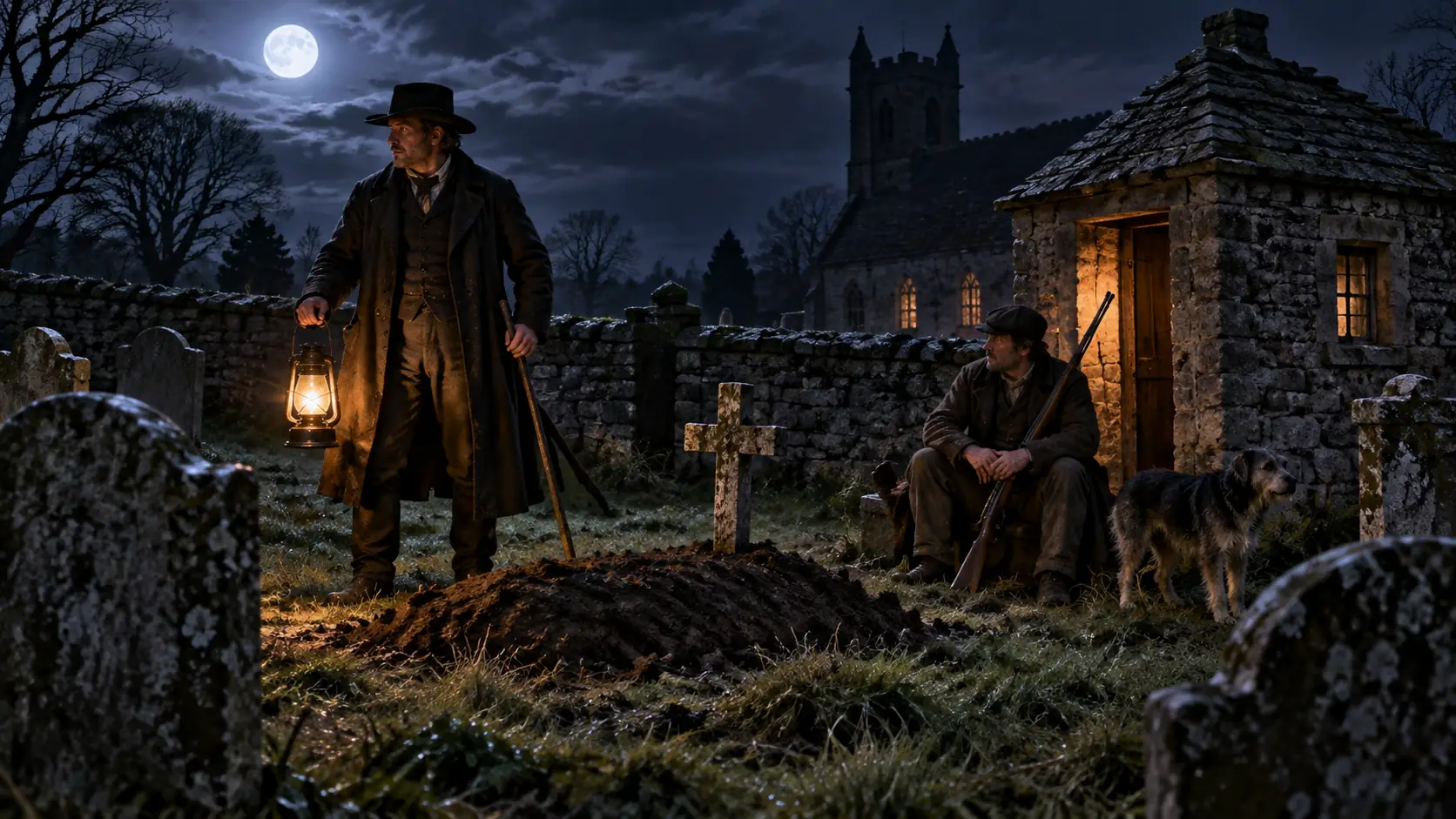
A grave watch was an overnight vigil kept over a newly buried body to stop resurrectionists from stealing it. In the early 1800s, especially in Scotland, families, neighbors, hired guards, and local associations watched churchyards while a corpse was still fresh enough to interest anatomy schools.
Some grave watches were informal. Others were surprisingly organized. Communities set schedules, collected small fees, fined people who skipped duty, bought lamps, kept fires going, used dogs, and sometimes carried guns. Watch-houses gave the guards shelter during the long nights.
What Was a Grave Watch?
In this article, grave watch means the practice of guarding a recently buried person after the funeral because body snatchers might return at night. It is different from a wake or vigil held before burial.
The goal was simple: make a fresh grave too risky to rob. A watcher could raise an alarm, confront strangers, call for help, or simply make the churchyard look too well guarded for thieves to bother with.
James Ritchie, who documented surviving grave defenses in Aberdeenshire in the early 1900s, described watch-houses as shelters people used overnight while guarding newly dug graves. The buildings were part of a larger system that also included heavy stones, mortsafes, and secure vaults.
Why Did Fresh Graves Need Watching?
Medical schools needed human bodies for anatomy lessons, but the legal supply was too small. That shortage created a market for freshly buried corpses. Professional body snatchers – often called resurrectionists – supplied the difference.
People who did this work were known as resurrectionists. They watched burials, learned which graves were fresh, and tried to remove bodies before decomposition made them less useful for dissection.
For a family, that meant burial did not always end the danger. A funeral could be followed by days or weeks of worry that someone might return after dark and open the grave.
Who Kept the Grave Watch?
There was no single system. In some places, relatives and neighbors took turns. In others, households or members of a local association followed a schedule. Wealthier people could hire someone to watch, while poorer families might have to do the job themselves.
Local records from the Falkirk district show just how communal the system could become. At Bo’ness, householders were expected to take a turn in the watch-house or provide a substitute. Some men also watched for pay.
Crail Museum records the same basic divide: an armed guard could be hired, while poorer families might keep watch themselves. Grave protection was not only about fear. It also depended on who had the money, time, and neighbors to keep a fresh burial guarded.
A Grave Watch Could Be Surprisingly Organized
The rules of the Slamannan Churchyard Watch Association show that grave watching could operate almost like a small neighborhood security service. Its 1825-1826 regulations included rules about money, schedules, equipment, and discipline.
- Members paid a small contribution to help cover expenses such as the fire.
- People were assigned turns and were expected to arrive on time and remain until relieved.
- A person who failed to appear could be fined and charged for a replacement watcher.
- Watchers had to be at least 16 years old and physically able to do the job.
- Firearms were not supposed to be discharged unless there was an actual alarm.
- The committee kept records of who watched and on which nights.
- Glass lamps could be hung on poles near the graves when there was no moonlight.
That level of organization matters. Grave watching was not always a few frightened relatives sitting beside a headstone. In some communities it became a formal duty with membership, schedules, penalties, and shared equipment.
What Did Grave Watchers Use?
Basic equipment included whatever helped a person stay alert, see movement, and raise an alarm. Lanterns or lamps were obvious tools. Dogs were useful because they could notice strangers before a tired watcher did. Firearms also appeared in the historical record, although they created their own problems.
One Falkirk-area watcher heard a disturbance, fired toward the noise, and hit a church window. The suspected intruder turned out to be a cow. Incidents like that help explain why local watch rules tried to control when guns could be fired.
The night could also be cold, long, and boring. Fires, food, and drink helped watchers get through it. One later local account said some paid watchers received bread and porter along with their nightly pay. The same account joked that early-morning workers sometimes found guards leaning over the churchyard wall from something stronger than simple lack of sleep.
What Were Watch-Houses?
A watch-house was a small building or room used by the living guards. It sheltered them while they watched the churchyard at night. Some were built for the purpose. Other communities reused session houses, collecting houses, or other buildings near the cemetery entrance.
Surviving examples show why shelter mattered. Some watch-houses had fireplaces or chimneys. A person could stay near the graves without spending an entire winter night standing in the open.
A watch-house should not be confused with a mort house. A watch-house sheltered the people guarding the dead. A mort house temporarily sheltered the dead themselves. Both existed for the same reason – fear of body snatching – but they solved the problem in very different ways.
How Long Did a Grave Watch Last?
No single rule applied to every churchyard. The danger was greatest while a body was fresh, so communities watched until they believed the corpse had decomposed enough to lose much of its value to anatomists.
The Slamannan association used a clear local schedule: protection continued for eight weeks in summer and ten weeks in winter after the most recent burial that qualified for the watch. That should not be treated as a universal British rule, but it shows that some communities planned grave protection for weeks, not just for the night after the funeral.
Other places relied on different periods, hired guards, heavy stones, mortsafes, or temporary storage buildings. The method varied, but the purpose was the same: keep the body beyond the period when a resurrectionist would want it.
Did Grave Watches Actually Stop Body Snatchers?
They could deter thieves, but they were not foolproof. A well-guarded churchyard was simply a harder target, and resurrectionists had good reason to look for an easier grave somewhere else.
One recorded attempt at Airth shows how little it could take to ruin a body snatcher’s night. A farmer passed the churchyard with his dog. The dog ran toward the graveyard and barked so persistently that the thieves fled. When the grave was later examined, people found that it had been partly opened and the body had been partly pulled from the coffin.
But human guards could also be late, absent, distracted, frightened, or drunk. Local associations created rules and fines because simply declaring that a grave would be watched did not guarantee that somebody dependable would actually be there all night.
Why Did Grave Watching Disappear?
Grave watches became less necessary as the body-snatching trade declined. The Anatomy Act of 1832 created a larger legal supply of bodies for anatomical study and reduced the financial incentive for medical schools to buy stolen corpses.
The change was gradual rather than instant. Watch-houses, mortsafes, and other defenses did not vanish the day the law passed. But as the underground market weakened, communities had less reason to organize night patrols around fresh graves.
Many old watch-houses survived after their original purpose disappeared. Today they can look like odd little cemetery buildings unless you know why they were placed there. They are physical reminders of a period when a family might bury someone in the afternoon and then arrange for somebody to stand guard over the grave after dark.
The Short Version
A grave watch was a night guard placed over a recently buried body to deter resurrectionists. Families, neighbors, paid guards, and local associations all took part. Some communities built watch-houses, used lamps and dogs, carried guns, and kept detailed schedules with fines for people who missed their turn.
The watch usually continued only while the corpse was fresh enough to attract body snatchers. Once decomposition made the body less useful for dissection, the danger dropped. Grave watching faded as the Anatomy Act of 1832 weakened the illegal market for stolen bodies.
The strange part is how ordinary the system could become. In some places, guarding the dead was not a dramatic one-night emergency. It was another community duty – complete with dues, shifts, rules, equipment, and people who occasionally showed up late.
We hope you enjoyed our little trip down the rabbit hole.
We’ll keep digging, and you keep reading.

Keep digging into more Body Snatching & Resurrectionists stories.
Sources and Further Reading
- James Ritchie – An Account of the Watch-houses, Mortsafes, and Public Vaults in Aberdeenshire Churchyards (1912), Proceedings of the Society of Antiquaries of Scotland
- Falkirk Local History Society – Body Snatching in the Falkirk District
- Royal College of Surgeons of England – Diary of a Resurrectionist: The Unique Record of a Frightening Trade Born Out of Necessity
- University of Edinburgh Library Heritage Collections – An Account of Body Snatching by Medical Students
- Crail Museum & Heritage Centre – The Dead House