
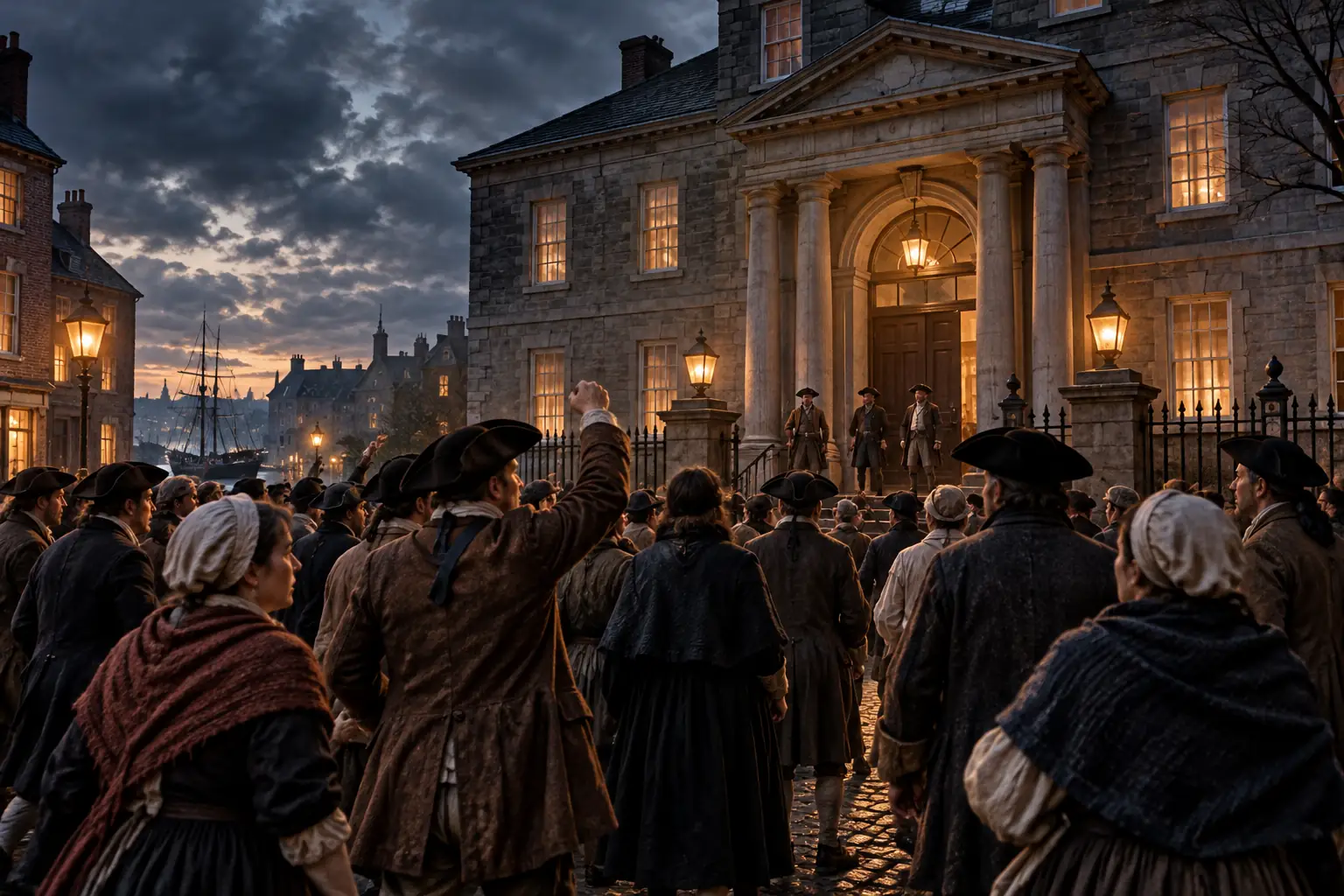
The Doctors Riot of 1788 was a deadly uprising against grave robbing and medical dissection in New York City. Angry residents attacked New York Hospital, searched for doctors and stolen bodies, and then clashed with armed men protecting physicians at the city jail. Several people died.
Despite its name, the doctors did not start the riot. They were its targets. Behind the violence was a question that had troubled the city for months: who had the right to take a body from a grave, and whose dead would be left in peace?
Why Were New Yorkers Angry With Doctors?
In 1788, medical students needed real human bodies to learn anatomy. But few lawful ways existed to obtain them. Some students and people working for doctors dug up fresh graves instead, a practice often called body snatching.
Grave robbing was more than an unpleasant rumor. Before the riot, newspapers carried complaints about disturbed burial sites. Families feared that someone they had just buried might be taken to a dissection room. The people who supplied stolen corpses were sometimes called resurrectionists.
Years later, a London body-snatching gang left behind a remarkable record of the trade, explored in The Diary of a Resurrectionist.
Many New Yorkers objected to the loss of a loved one’s remains and to the idea of cutting up the dead without permission. Those concerns did not mean that people rejected medical knowledge. They wanted graves respected, especially when the dead had no powerful relatives to defend them.
Whose Graves Were Being Robbed?
Some of the earliest documented complaints came from Black New Yorkers, not the city’s wealthiest residents. Medical students had been taking bodies from poor burial grounds and from a cemetery used by Black New Yorkers, including free and enslaved people.
In February 1788, Black residents petitioned New York’s Common Council about bodies being removed from their burial ground. They acknowledged that doctors needed to study anatomy, but asked that their relatives be treated with respect. Their appeal did not bring an effective end to the abuse.
Then news spread that a body had been stolen from Trinity Churchyard, where white New Yorkers with greater social standing were buried. Anger about the corpse trade grew wider. The change in public attention revealed an uncomfortable truth: whose grave was disturbed often shaped how urgently the city responded.
Did a Medical Student Really Wave a Severed Arm?
One of the best-known stories says that boys looked into a dissecting room at New York Hospital. A student supposedly waved a human arm at them and claimed it belonged to one boy’s mother. In some versions, the boy’s father then opened her grave and found the coffin empty.
It is an unforgettable story, but the details are not settled. Historical accounts disagree about what the boys saw, what the student said, and how they discovered the suspected theft. Some versions were written many decades after the riot.
An April 19, 1788, letter from Samuel Allyne Otis tells a different version. He wrote that boys looking through a hospital window were told by a junior doctor that the doctors were cutting up one boy’s recently buried father. Otis did not describe anyone waving a severed arm or claiming it belonged to the boy’s mother. The doctor’s claim may not have been true, but the letter shows why the better-known story should not be treated as proven fact.
How Did the Doctors’ Riot Unfold?
In April 1788, an angry crowd rushed New York Hospital, where anatomy lessons were being held. Doctors and students fled or tried to protect the rooms. People broke into the hospital and destroyed medical specimens and equipment.
Otis’s letter offers a striking detail. Some remains inside the hospital were so altered by dissection that people could not tell who they had belonged to. He reported that officials persuaded the crowd to allow the remains to be buried again rather than burned.
The trouble did not end there. The next day, crowds searched doctors’ homes and Columbia College for more bodies. Officials placed several physicians and students in the city jail for their own protection. Once the crowd learned where the doctors were, the jail became its next target.
Why Did the Crowd Attack the Jail?
The people outside the jail wanted the doctors handed over. They broke fences and windows and hurled stones and bricks. Governor George Clinton, Mayor James Duane, and other officials tried to restore order.
Alexander Hamilton attempted to calm people near Columbia College. John Jay, later the first chief justice of the United States, was hit by a brick while trying to stop the violence. Contemporary and later accounts also describe the crowd injuring Revolutionary War officer Baron von Steuben.
Armed men defending the jail eventually fired into the crowd. That ended the riot, but it turned a protest over the treatment of the dead into a tragedy involving the living.
How Many People Were Killed?
We know that gunfire killed people, but the exact death toll is disputed. In his April 19 letter, Otis reported three or four people killed outright and several others badly wounded. He believed some of those struck had only been watching.
Later histories sometimes give higher totals, including estimates reaching twenty deaths. Those numbers should not be presented as one settled figure. The evidence supports a deadly clash; it does not support pretending that every source agrees on the count.
What Changed After the Doctors’ Riot?
In 1789, New York passed a law aimed at stopping people from digging up buried bodies for dissection. It also allowed the bodies of some executed criminals to be used for anatomy lessons.
The law did not solve the shortage of teaching bodies. Grave robbing continued, and arguments over consent and the treatment of poor people carried on for years. Other American communities later saw their own anatomy riots.
The event left doctors with a hard lesson: anatomy education could not earn the public’s trust while the supply of bodies depended on violating families’ graves.
Why Is the Doctors’ Riot Still Worth Remembering?
The riot was not simply a tale about a mob afraid of science. Doctors had a real need for anatomy training, but people also had real reasons to object to the theft of their dead.
The complaints made by Black New Yorkers before the riot are especially important. They show that the problem was known before thousands of people took to the streets, and that not everyone’s objections received the same attention.
The most revealing detail may not be the famous severed arm. It is the older paper trail: petitions, newspaper complaints, and a letter written just days after the violence. Those records tell us what people feared and how the city responded.
The Short Version
The Doctors’ Riot erupted in New York in April 1788 after months of anger over bodies stolen from graves for medical teaching. Residents attacked New York Hospital and later the city jail, where doctors had been taken for safety. Gunfire killed several people, although sources disagree on the number.
The story of a student waving a dead woman’s arm may have helped keep the riot in public memory, but its details remain uncertain. The documented complaints about grave robbing, especially from Black residents, explain why the city was already close to boiling over.
We hope you enjoyed our little trip down the rabbit hole.
We’ll keep digging, and you keep reading.

Keep digging into more Body Snatching & Resurrectionists stories.
Sources and Further Reading
- University of Michigan, Clements Library, Samuel Allyne Otis Letter to George Thatcher, April 19, 1788 (contemporary letter)
- Smithsonian Magazine, Bess Lovejoy, The Gory New York City Riot That Shaped American Medicine (2014)
- Science History Institute, Sam Kean, The Anatomy Riot of 1788 (2020)
- Columbia University, David Hosack: Pioneer in Medicine and Doctor at History’s Most Famous Duel (2019)
- New York Academy of Medicine, Whitfield J. Bell Jr., Doctors’ Riot, New York, 1788 (1971)
- New York History, R. J. Swan, Prelude and Aftermath of the Doctors’ Riot of 1788 (2000), journal record
- HISTORY, Jack Tamisiea, How Grave Robbing Ignited a Deadly Riot in New York City (2025)