
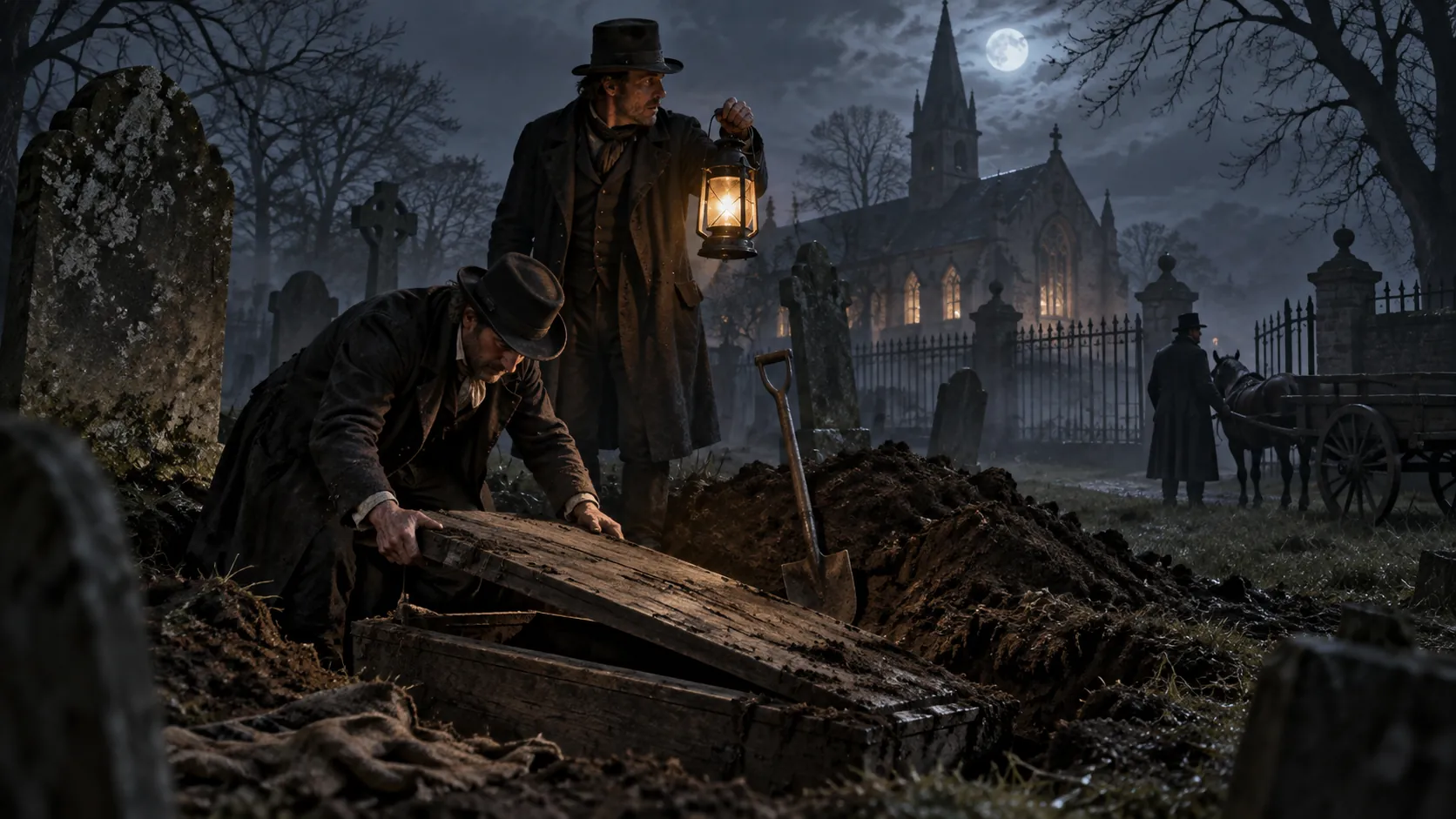
Resurrectionists were body snatchers who supplied dead bodies to anatomy teachers and medical schools. The trade peaked in the late 1700s and early 1800s. They often stole recently buried bodies from graves and sold them for dissection. Some worked alone. Others worked in organized gangs and treated body snatching as a paid trade.
They existed because medical schools faced a serious problem. Students needed real human bodies to learn anatomy, but the legal supply was far too small. That shortage created an underground trade. It linked graveyards and body snatchers with anatomy schools, hospitals, and surgeons.
What Was a Resurrectionist?
A resurrectionist was a person who obtained dead bodies for anatomy lessons, usually by taking them illegally from graves. People also called them resurrection men or body snatchers.
The name was darkly sarcastic. They did not bring the dead back to life. They brought the dead back out of the ground.
The word was already in use in the 1700s. The trade became especially notorious as anatomy teaching grew in Britain. By the early 1800s, resurrectionists were a familiar part of medical life. Newspapers, court reports, medical records, and popular books all referred to them.
Why Did Resurrectionists Exist?
The simplest answer is supply and demand.
Medical students needed hands-on experience with human anatomy. Watching a teacher was not enough. As dissection became more important, schools needed more bodies for students to examine.
The legal supply could not keep up. Under the Murder Act of 1752, the bodies of some executed murderers could be sent for dissection. That number was small compared with the growing number of anatomy students.
By 1828, the shortage was serious enough that the British House of Commons appointed a Select Committee on Anatomy. The committee heard from surgeons, anatomy teachers, and men who supplied bodies. Its report showed how much medical training depended on bodies obtained outside normal legal channels.
In other words, resurrectionists did not create the demand. They stepped into an existing market and supplied it.
Who Became Resurrectionists?
No single type of resurrectionist existed.
Before the trade became professional, medical students sometimes dug up bodies for their own lessons. Historical records describe students taking part in grave-robbing trips. James Blake Bailey reported the same pattern at St. George’s Hospital. He wrote that students there had once been expected to obtain bodies for themselves.
As medical schools grew, paid specialists took over more of the work. Some resurrectionists were laborers or men who already knew burial grounds well. Others had worked as gravediggers or cemetery keepers. That gave them useful knowledge of fresh burials, graveyard routines, and security weak points.
Joseph Naples is one of the best-documented examples. He served in the Royal Navy and later worked as a gravedigger in London. After losing legal graveyard work, he became a full-time body snatcher. He joined the gang linked to Ben Crouch. His surviving diary records the gang’s work in 1811 and 1812.
What Did Resurrectionists Actually Do?
Their main job was to obtain fresh human remains and deliver them to anatomy instructors.
Most often, they targeted a recent burial, removed the body, and tried to restore the grave well enough to delay discovery. In some cases, they obtained bodies before burial. They then carried or moved the bodies to anatomy schools, hospitals, or other buyers.
The work was more organized than the phrase “grave robber” may suggest. Professional gangs watched burial grounds, divided jobs, dealt with buyers, and stored bodies for short periods. Some also bribed people who had access to cemeteries. A surviving London diary records where bodies came from and where they went. It also names anatomists and schools that received them.
One small detail shows how closely the trade followed the school calendar. Joseph Naples’s diary has no entries for May, June, or July because the anatomy schools were not in session. When classes stopped, much of the demand stopped too.
The exact digging methods, tools, disguises, and transport tricks are a rabbit hole in themselves. So are the ways gangs tried to hide signs of a disturbed grave. Those details are better covered separately than packed into a basic explanation of resurrectionists.
Were Resurrectionists Just Grave Robbers?
The terms overlap, but they are not the same.
A grave robber could steal valuables from a grave or tomb. A resurrectionist wanted the corpse because someone in the medical world would buy it.
That difference mattered under English law. Digging up a corpse could be prosecuted as a misdemeanor. Stealing grave goods such as clothing, jewelry, or a burial shroud could bring more serious charges. Body snatchers therefore had a strong reason to leave valuables behind and take only the body.
So a resurrectionist might rob a grave, but the goal was usually not jewelry, coins, or the coffin. The corpse was the commodity.
Did Resurrectionists Murder People for Bodies?
Ordinary resurrectionists stole bodies from the dead. Killing a living person to create a body for sale was a different crime.
That difference matters when we look at William Burke and William Hare. They are the most famous names linked to the corpse trade, but they were not ordinary grave-robbing resurrectionists. They killed people and sold the bodies to anatomist Robert Knox in Edinburgh.
Similar murders for the anatomy trade later took place in London. These cases horrified the public. They seemed to prove the worst fear about the body trade: a market for corpses could reward people for producing bodies instead of stealing them.
Calling every resurrectionist a murderer would be wrong. But a cash market for bodies created a setting in which murder for sale could happen. Those scandals also helped push the government toward reform.
How Professional Did the Trade Become?
By the early 1800s, some resurrectionists were not occasional grave robbers. They were regular suppliers.
Medical schools needed a steady supply of bodies, and they competed for students. A school without enough bodies for dissection could lose students to a rival. That gave experienced resurrectionists bargaining power.
Bailey’s account describes gangs that repeatedly dealt with anatomy teachers. They also fought with rival suppliers. Royal College of Surgeons records show that the Borough gang supplied private anatomy schools, St. Thomas’s Hospital, and St. Bartholomew’s Hospital. The gang also sent bodies outside London.
The evidence makes the trade look less like random nighttime theft and more like a hidden supply chain. The graveyard was one end. The dissecting room was the other.
Why Were People So Afraid of Resurrectionists?
For families, this was not an abstract medical problem. They feared that a relative could be buried one day and missing soon afterward.
Public anger was made worse by what dissection meant at the time. For much of this period, dissection was closely linked with criminal punishment. Many people saw the cutting up of a body as an added disgrace after death, not as normal medical training.
Communities fought back in practical ways. Families watched graves. Burial grounds hired guards. Some places used heavy stones, iron devices, secure buildings, and other defenses to keep bodies away from resurrectionists.
Those defenses became their own strange chapter in burial history. They included mortsafes, watch houses, grave guns, and even explosive devices made to protect coffins.
What Ended the Resurrectionist Trade?
Britain did not solve the problem simply by catching more body snatchers. The deeper problem was the shortage of legal bodies for dissection.
The 1828 Select Committee on Anatomy investigated the shortage and the illegal trade. After years of debate, the Anatomy Act of 1832 widened the legal supply of bodies for study. It included unclaimed bodies from places such as workhouses and hospitals.
The law sharply reduced the need for professional body snatching in Britain. It did not end the controversy over dissection. The new system also fell hardest on poor people, whose bodies were more likely to go unclaimed. But it broke the business model that let resurrectionist gangs thrive.
The Short Version
Resurrectionists were paid body snatchers who supplied corpses to anatomy schools when legal bodies were scarce. Some medical students did the work themselves, but the trade grew into an organized business run by experienced gangs. They stole fresh bodies, sold them to anatomists, and became a feared part of early nineteenth-century medical life.
They were not all murderers, and they were not simply thieves hunting for grave goods. They existed because medicine wanted more bodies than the law could provide. Once the law changed the supply system, the classic resurrectionist trade faded away.
We hope you enjoyed our little trip down the rabbit hole.
We’ll keep digging, and you keep reading.

Sources and Further Reading
- Royal College of Surgeons of England – Diary of a Resurrectionist: The Unique Record of a Frightening Trade Born Out of Necessity
- Royal College of Surgeons of England – Body Donation in Georgian London
- Royal College of Surgeons of England – Dissection and the Resurrectionists in the College Archives
- Great Britain, House of Commons – Report from the Select Committee on Anatomy (1828), Wellcome Collection
- James Blake Bailey – The Diary of a Resurrectionist, 1811-1812 (1896), Project Gutenberg
- University of Edinburgh Heritage Collections – An Account of Body Snatching by Medical Students