
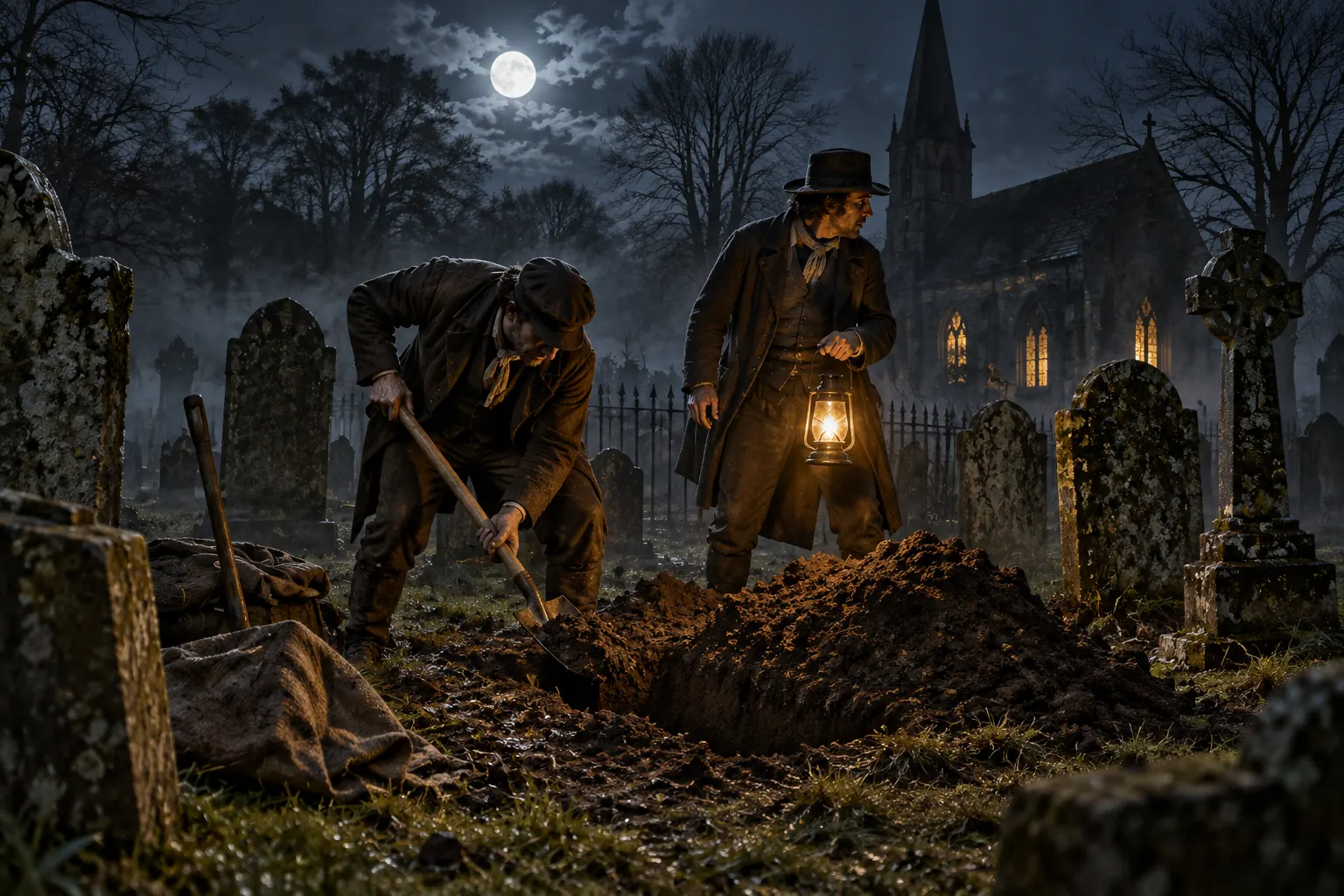
Grave robbing in the 1800s became a business because medical schools needed far more human bodies than the law could legally provide. Anatomy students were expected to learn by dissecting real cadavers, but the official supply was tiny. That gap created a black market for fresh corpses.
Many of the people who filled that market were called resurrectionists or resurrection men. They usually were not digging for jewelry or valuables. The body itself was what anatomy teachers would pay for.
The trade became especially notorious in Britain during the late 1700s and early 1800s. Some grave robbers worked in organized gangs. Some medical students did the digging themselves. Families answered with guards, watch houses, iron cages, heavy stones, and other defenses meant to keep the dead in the ground.
Why Did Medical Schools Need Stolen Bodies?
Human dissection had become central to medical training. Students could learn from books and lectures, but anatomy teachers also wanted them to see and handle the structures of a real human body.
The problem was supply. After the Murder Act of 1752, the bodies of some executed murderers could legally be sent for dissection. That provided cadavers, but nowhere near enough for the growing number of anatomy schools and students.
By the early 1800s, the shortage had become a national problem. Parliament’s 1828 Select Committee on Anatomy investigated how medical schools obtained bodies and why the illegal trade had become so hard to control.
The committee found no mystery. Medical education wanted more bodies than the law supplied. As long as anatomy teachers were willing to pay, someone had an incentive to find the difference.
Who Were the Grave Robbers?
No single type of nineteenth-century grave robber existed. Some were laborers who discovered that a fresh corpse could earn far more than ordinary work. Others already knew the burial grounds, the guards, and the local routines. A few built regular careers around supplying anatomy schools.
The stories of famous grave robbers put names to the people involved in this unsettling trade.
Joseph Naples is one of the best-documented examples. His surviving diary from 1811 and 1812 records the work of a London resurrectionist gang. The entries name where bodies were obtained, who bought them, and how much money changed hands.
The diary also shows how closely the trade followed the medical-school calendar. The diary includes no entries for May, June, or July because the anatomy schools were not in session. When classes slowed, demand for bodies did too.
Another resurrectionist, James May, later described how he entered the business after losing his job. He said he was introduced to other resurrectionists through a London pub and went with one of them to obtain a recently buried convict. May said they sold the body to St. Thomas’s for eight guineas. The National Archives notes that this was roughly equal to 42 days of wages for a skilled tradesman at the time.
That kind of money helps explain why the trade could attract people despite the risk, public hatred, and filthy working conditions.
What Did Grave Robbers Actually Steal?
The most important distinction is that body snatching and stealing grave goods were not always treated the same way under the law.
Resurrectionists wanted a fresh corpse because that was what the anatomy market would buy. Clothing, jewelry, coffin fittings, and burial shrouds could create more serious legal trouble. Under English law, disinterring a corpse could be prosecuted as a misdemeanor, while stealing property from the grave could amount to a felony.
That gave professional body snatchers a strange incentive: take the body and leave other property behind.
So when nineteenth-century sources describe a resurrectionist, the goal was usually not treasure. The corpse was the commodity. This is why the broader story of resurrectionists is so closely tied to medical schools rather than ordinary theft.
How Did Grave Robbing Work?
Most body snatchers targeted recent burials because anatomy teachers wanted bodies that were still suitable for dissection. They usually worked at night, when cemeteries and churchyards were quiet.
The exact methods varied, but the basic job was simple: find a fresh grave, dig up the body, move it without attracting attention, and deliver it to a buyer. Organized gangs divided the work and sometimes used carts or other transport to move bodies between burial grounds and anatomy schools.
The surviving diary of Joseph Naples shows this was more than random nighttime digging. His gang repeatedly dealt with hospitals, private anatomy teachers, and other buyers. They even moved bodies between cities. One diary entry records bodies being packed for Edinburgh.
Grave robbing in the 1800s therefore worked less like isolated vandalism and more like an illegal supply chain. The graveyard was one end of the business. The dissecting room was the other.
Did Medical Students Rob Graves Too?
Yes. Professional resurrectionists eventually became the most notorious suppliers, but medical students were also involved.
UK Parliament’s history of body snatching notes that anatomy teachers and students sometimes stole bodies themselves. The University of Edinburgh Library also preserves an account of a grave-robbing expedition carried out by medical students in 1830.
That surviving account is useful because it breaks the simple picture of criminals on one side and respectable medicine on the other. The shortage of cadavers reached directly into medical education. Before a more reliable legal supply existed, students could become part of the same system that the public feared.
Professional gangs made the process easier for schools by outsourcing the dangerous work. But the demand didn’t begin with grave robbers. It began in the dissecting room.
Were Burke and Hare Grave Robbers?
Not in the usual sense.
William Burke and William Hare are often grouped with body snatchers because they sold bodies to an Edinburgh anatomy school. But ordinary resurrectionists stole people who were already dead. Burke and Hare began murdering living people and selling the fresh bodies.
That difference matters. Their crimes were not simply an extreme version of digging up graves. They crossed from an illegal corpse trade into murder for profit.
The Burke and Hare scandal made public fear of the body market much worse. It showed what could happen when fresh corpses had cash value, and the legal supply remained badly inadequate.
How Did Families Try to Stop Body Snatchers?
Families did not simply accept the risk. Communities developed a surprising range of defenses.
Relatives sat beside fresh graves when a body was most valuable to resurrectionists. Burial grounds hired watchers. Some communities built watch houses where guards could shelter while keeping an eye on new graves.
Other defenses were more physical. Heavy stones were placed over graves. Iron cages called mortsafes could cover a coffin until the body had decomposed enough to lose its value to anatomists. Secure vaults and locked burial grounds were also used.
Some grave-protection ideas became even more aggressive, including guns and explosive devices. Those inventions sound bizarre now, but they make more sense when viewed as responses to a trade that families believed could steal a relative within days of burial.
The defenses also reveal something important about public anger. For anatomy schools, cadavers were teaching material. For families, they were parents, children, spouses, and friends whose graves were supposed to be places of rest.
What Changed After the Anatomy Act of 1832?
Britain eventually attacked the problem by changing the supply of bodies rather than relying only on catching grave robbers.
The Anatomy Act of 1832 created a regulated system for anatomical study and widened the legal supply of cadavers. Its own preamble admitted that the existing legal supply was insufficient and that serious crimes, including murder, had been committed to obtain bodies for anatomy.
The new system did not eliminate every controversy. It also placed a heavy burden on poor and unclaimed people whose bodies were more likely to enter anatomical study. But it weakened the market that had kept professional resurrectionists in business.
Once medical schools had a larger lawful supply, paying gangs to raid fresh graves became less necessary. The classic British resurrectionist trade faded, even though disputes over anatomy, consent, and the treatment of the dead continued.
The Short Version
Grave robbing in the 1800s was closely tied to the growth of medical education. Anatomy schools needed large numbers of human bodies, but the law provided only a small legal supply. Resurrectionists stepped into that gap and created a black market in fresh corpses.
Some were organized professional grave robbers such as the gang recorded in Joseph Naples’s diary. Others were medical students who sometimes obtained bodies for themselves. The corpse, not jewelry or grave goods, was usually the grave’s most valuable part.
Families fought back with grave watches, guards, heavy stones, mortsafes, secure burial structures, and other defenses. Public anger grew even stronger after murder-for-sale cases such as Burke and Hare.
The Anatomy Act of 1832 expanded the lawful supply of cadavers and helped break the business model that made professional body snatching profitable. Grave robbers didn’t disappear from history overnight, but the trade that had terrified British families was finally being pushed out of the shadows.
We hope you enjoyed our little trip down the rabbit hole.
We’ll keep digging, and you keep reading.

Keep digging into more Body Snatching & Resurrectionists stories.
Sources and Further Reading
- Royal College of Surgeons of England – Diary of a Resurrectionist: The Unique Record of a Frightening Trade Born Out of Necessity
- Royal College of Surgeons of England – Body Donation in Georgian London
- The National Archives – Body Snatchers
- The National Archives – Source One: Becoming a Resurrectionist
- University of Edinburgh Library Heritage Collections – An Account of Body Snatching by Medical Students
- UK Parliament – Body Snatching
- Wellcome Collection – Report from the Select Committee on Anatomy (1828)
- The National Archives – The Anatomy Act 1832
- James Blake Bailey – The Diary of a Resurrectionist, 1811-1812 (1896), Project Gutenberg