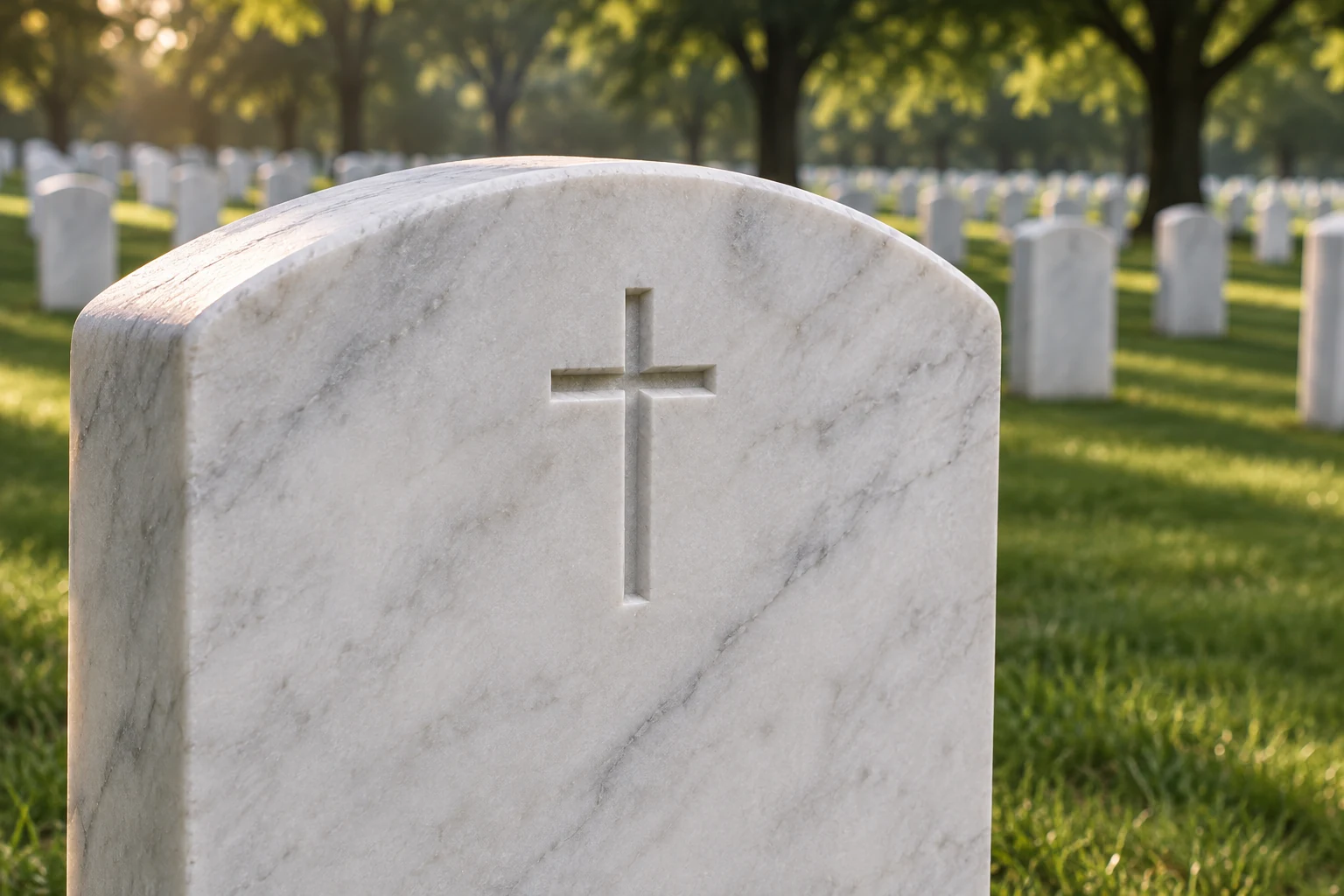
Military headstone symbols can express belief, recognize an honor, or identify an older government marker design. The words around them tell other parts of the story: a name, military service, dates, and sometimes a family’s message. On U.S. government markers, reading those parts separately helps you understand how they fit together.
From a distance, the orderly rows can look much alike. Move closer and the differences emerge. A shield surrounds one name. An eagle spreads its wings above another. Below an Army rank, two words quietly change the scale of the story: beloved daughter.
Separate the Symbol From the Service Record
Start by sorting what you see into a few groups:
- Belief emblem: A symbol such as a Latin cross, Star of David, or Buddhist wheel. These belong to the VA’s emblem-of-belief system.
- Service information: The military branch, rank, unit, and any recorded war service. These are usually words or abbreviations.
- Honors: Award names or abbreviations. Medal of Honor insignia are a distinct form of recognition.
- Personal wording: A family relationship, affectionate phrase, or other inscription that brings another part of the person’s life into view.
This guide concerns U.S. government-furnished markers. Privately designed monuments and American military cemeteries overseas have their own histories and designs.
Before the Symbols, There Was the Problem of Keeping a Name
After the Civil War, a wooden headboard could identify a grave. Keeping that name readable for generations was another matter.
The National Archives describes the debate over permanent markers and the role of Quartermaster General Montgomery C. Meigs. He opposed reducing known soldiers to numbered markers. Meigs had also lost his own son, Lieutenant John R. Meigs, during the war.
That puts a father inside what can sound like a dry argument about materials and expense. Someone visiting a grave needed to find a person, not simply an assigned space.
In 1873, Congress funded the replacement of wooden headboards with durable stone. The work helped preserve information that weather and time could otherwise erase.
Historic Example: W. H. Curtis, Who Died in 1872
The National Park Service pairs two photographs of a grave at Dayton National Cemetery. In the older image, a wooden marker names W. H. Curtis and records his death in 1872. In the later photograph, his name appears on a white stone inside a recessed shield.
The stone also reads CO. B and 57TH IND. INF. Those lines identify Company B and the 57th Indiana Infantry. The shield frames the military identification; it is not a medal awarded to Curtis.
The two photographs preserve a small act of continuity. The material changed. The name and unit carried forward.
VA’s historic-marker reference explains that recessed-shield designs for Union Civil War and Spanish-American War veterans have deliberately limited inscriptions. They do not carry the belief emblems used on other marker types. A plain space on an old stone has to be read within that design’s history.
What the Emblem of Belief Tells You
The VA uses “emblem of belief” for a symbol representing the deceased person’s religious belief or a belief system that served an equivalent role in their life. Its official illustrated list is the useful place to compare a carving.
Examples include the Latin cross, Star of David, Buddhist wheel, Muslim crescent and star, and Humanist emblem. The Landing Eagle is a less obvious example: the VA classifies that particular design as an emblem of belief.
These symbols identify a different part of a person’s life from US ARMY or US NAVY. An emblem of belief is not a military branch badge.
The marker’s period matters, too. The government adopted the familiar “General” headstone design in the World War I era, with its sturdier version approved in 1922. Its provision for a belief emblem was a change from the earlier shield design. Today’s illustrated list cannot tell you which choices existed when an older stone was made.
A Modern Example: First Sergeant, Beloved Daughter
A VA History photograph shows the granite headstone of Nicolette D. Clara at Quantico National Cemetery. Her dates are November 12, 1971, and January 30, 2016. Read the details as separate pieces:
- The bird matches the VA’s Landing Eagle emblem of belief.
- 1SG is the Army abbreviation for first sergeant.
- US ARMY identifies her branch of service.
- BELOVED DAUGHTER / NOT FORGOTTEN gives the memorial its personal closing.
The rank and the relationship occupy only a few lines, but they open very different views of the same person. One belongs to a military career. The other belongs to a family.
You can read the emblem correctly and still miss the most moving words on the stone. Give the inscription below it the same attention.
Reading Military Headstone Abbreviations
The VA’s inscription reference links to separate lists for ranks, awards, branches, and war service. Start with the branch shown on the marker, then use the matching list to expand the abbreviation.
For Army ranks, PVT means private, CPL means corporal, SGT means sergeant, and 1SG means first sergeant. The short forms compress very different careers into a small amount of stone.
Awards use another set of abbreviations. PH stands for Purple Heart; DFC stands for Distinguished Flying Cross; BSM stands for Bronze Star Medal. An award abbreviation identifies the decoration. A citation or service record can explain the circumstances behind it.
A Medal of Honor emblem belongs in this honors category. It serves a different purpose from a belief emblem, even when both appear on the same headstone.
A War Name and a Date Tell Different Things
Under current VA inscription guidance, war service can identify active duty during a recognized war period. For example, KOREA can refer to service during the Korean War period even if the veteran did not serve in Korea. Certain country inscriptions, including Iraq and Afghanistan, require service in that country.
Read the death date separately. A war name is not, by itself, a statement that the person died in combat.
IN MEMORY OF has another specific role on government memorial markers. It identifies a memorial rather than an ordinary grave marker for remains buried there. VA’s historic guidance includes cases in which remains were unrecoverable or could not be identified.
Let the Marker Lead You Back to the Person
For a useful record, photograph the whole marker and note its cemetery, name, dates, and exact wording. Keep the emblem, service details, and personal inscription together. The same approach helps with other cemetery symbols: the surrounding words often supply the clue that a close-up leaves out.
The Curtis photographs show a name surviving a change from wood to stone. Clara’s marker gives equal permanence to a military rank and a daughter’s place in her family.
From the path, you see a row of markers. Read one closely, and the row becomes a person.
We hope you enjoyed our little trip down the rabbit hole.
We’ll keep digging, and you keep reading.
Keep digging into more Gravestone Symbols and Epitaphs stories.
Sources and Further Reading
- National Cemetery Administration: Emblems of Belief — illustrated official reference
- National Cemetery Administration: Headstone and Marker Inscriptions
- National Archives: Honoring Our War Dead, by Mark C. Mollan
- National Park Service: A Nation Repays Its Debt — Dayton history and the paired Curtis marker photographs
- National Cemetery Administration: Historic Headstones and Markers, Prior to World War I
- VA History: National Cemetery “General” Headstone — includes the photograph of Nicolette D. Clara’s marker
- National Cemetery Administration: Army Rank Abbreviations (PDF)
- National Cemetery Administration: Award Abbreviations (PDF)