
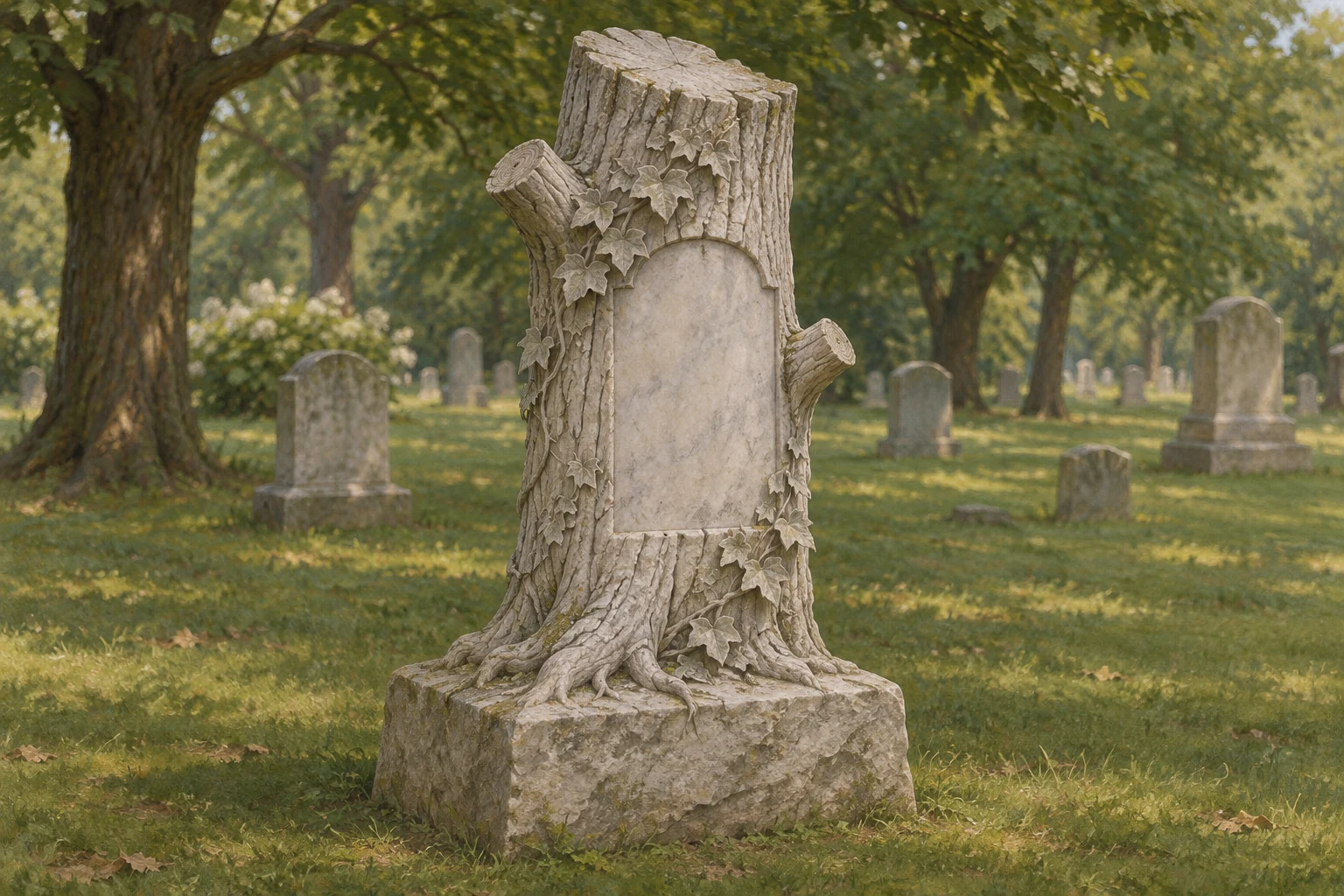
Tree stump gravestones bring several stories together: a taste for nature-inspired memorials, the image of a life cut short, and the burial benefits offered by Woodmen of the World. Some bear that organization’s name and emblem. Others share the tree shape without an established Woodmen connection.
The carved bark catches your eye first. Then come the branch stubs, roots, and a smooth patch left for a name. Look beyond the unusual shape, and these stone trees lead to a surprisingly practical world of insurance promises, monument makers, and mail-order shopping.
Why Tree Stump Gravestones Became Popular
Tree-shaped markers became popular in the late 1800s and early 1900s. Lakewood Cemetery in Minneapolis places them within a wider taste for nature in art and design. Flowers, branches, and woodland forms appeared on household objects as well as memorials.
On a gravestone, that style offered plenty of room for a carver’s skill. Stone could imitate rough bark, a cut branch, or a climbing vine. A polished inscription panel might look like a patch where the bark had been peeled away. The finished object combined a familiar living form with a material chosen to endure.
The cut tree also carried an emotional possibility: life interrupted. Yet a family could choose a tree form for its beauty, its associations, or several reasons at once. A design’s popularity does not give us every family’s reason for choosing it.
The Woodmen Connection: A Promise to Mark a Grave
Joseph Cullen Root founded Woodmen of the World in Omaha in 1890. It combined a fraternal organization with life insurance. Its successor, WoodmenLife, traces its beginning to June 6 of that year. The group’s history helps explain why its name appears on so many memorials.
A period court record shows how concrete the monument promise could be. William E. Jackson received his insurance certificate in Oklahoma in December 1911. He died the following January after developing pneumonia. His widow, Daisy, sued over a $500 insurance benefit and a separate $100 monument provision.
In its 1916 decision, the Oklahoma Supreme Court reproduced the order’s monument rules. They called for a marble or granite memorial bearing the organization’s motto and emblem, the words “Woodmen of the World Memorial,” and the member’s name and birth and death dates.
The distinction mattered to Daisy’s case. On rehearing, the court removed the $100 cash award to her while leaving the insurance award in place. Under those terms, the money was assigned to a monument rather than an extra payment to the beneficiary.
That record makes the carving more than decoration. It could be the visible result of a specific benefit, with rules about what the memorial had to say. It also shows why a blanket claim that every member simply received a free tree-shaped stone leaves too much out.
How to Recognize Woodmen of the World Gravestones
Start with the words and emblem. The Association for Gravestone Studies describes a Woodmen emblem that combines a tree stump with woodcutting tools. Useful details to look for include:
- The full name Woodmen of the World, sometimes within a circular seal or memorial inscription.
- An axe, a splitting maul or heavy mallet, and a wedge arranged with the stump.
- The Latin motto “Dum Tacet Clamat,” commonly translated as “Though silent, he speaks.”
Read those features together. A single carved tool is a weaker lead than a clearly named organization. Even a recognizable emblem leaves room for further research into the person, the local lodge, and the circumstances of the memorial.
The Arkansas Archeological Survey documents a useful example at Stearns Cemetery in Fayetteville. Its white and gray marble tree marker stands a little over five feet tall, with a circular plaque near the top and the Latin motto. Researchers date it to around 1916 based on the death year; that is an estimate of the monument’s age, not a known carving date.
Woodmen of the World tombstones are part of this story, but Lakewood also reports tree markers without the Woodmen seal. The outline of a trunk alone cannot settle the membership question.
You Could Order a Stone Tree From Sears
For a wonderfully direct look at the broader market, open the 1902 Sears, Roebuck and Company monument catalog. Pages 56–57 advertise a tall stone trunk to customers who liked rustic memorial art.
The smallest version stood four feet high, including its base, and weighed 828 pounds. The listed price for one marble option was $28.75. Buyers could choose larger sizes and a different marble, with prices rising accordingly.
That figure needs its fine print. Ordinary engraved inscription letters cost six cents each. The listed monument price covered delivery onto rail cars at the company’s Vermont works; freight to the buyer’s station was extra. Sears invited customers to request a freight quote and allowed four to six weeks to finish, letter, and ship an order.
Here was a woodland-shaped memorial offered through an ordinary sales catalog, complete with sizes, prices, and shipping details. The listing helps explain why similar stone trees could appear far apart. It does not tell us who supplied any particular cemetery’s marker; a maker’s mark, receipt, or other record would be needed for that.
Does a Broken Tree Mean Someone Died Young?
A cut trunk can suggest a life cut short. That is a possible symbolic reading, not a recorded age or cause of death. The person’s dates and any surviving family or burial records carry more weight than the height of the stump.
The same care applies to branch counts and other details. Without evidence tied to the memorial, counting branches is no reliable way to count children. A carved form may also reflect a design the monument maker offered.
Our guide to cemetery symbols explains how inscriptions, dates, and local records can help test an interpretation. With tree markers, the key is to keep the physical design, the organization’s emblem, and the individual person’s story connected without treating them as interchangeable.
What These Stone Trees Still Preserve
At Sumter Cemetery in South Carolina, the cemetery’s own illustrated account records about 25 tree or log markers, including memorials for three infants. A single cemetery can hold several versions of the idea. The surviving objects offer a better starting point than assuming every carved trunk followed one rule.
Look at the skill in the bark, then read the name. A stone tree may preserve a family’s chosen image of loss, an organization’s promise, or a design selected from a catalog. Sometimes the records let us connect those parts. Sometimes only the carving survives.
Either way, there is something striking about the choice: a tree that has stopped growing, made to keep someone’s memory standing.
We hope you enjoyed our little trip down the rabbit hole.
We’ll keep digging, and you keep reading.

Keep digging into more Gravestone Symbols and Epitaphs stories.
Sources and Further Reading
- Lakewood Cemetery, “Trees of Stone” (2020): local examples and the popularity of natural forms in memorial design
- WoodmenLife, “History”: the organization’s founding in 1890
- Oklahoma Supreme Court, Sovereign Camp of Woodmen of the World v. Jackson, 57 Okla. 318 (1916), via Hall Approved: the certificate, monument rules, and decision on rehearing
- Association for Gravestone Studies, “Symbolism”: interpreting carvings and identifying the Woodmen emblem
- Rachel Tebbetts, Arkansas Archeological Survey, “Woodmen of the World, a Fraternal Order symbol” (2026): the Stearns Cemetery marker
- Sears, Roebuck and Company, Special Catalogue of Tombstones, Monuments, Tablets and Markers (1902), pp. 56–57, Winterthur Museum Library via Internet Archive
- Sumter Cemetery, “Woodmen of the World”: photographed examples and the cemetery’s inventory of tree and log markers