
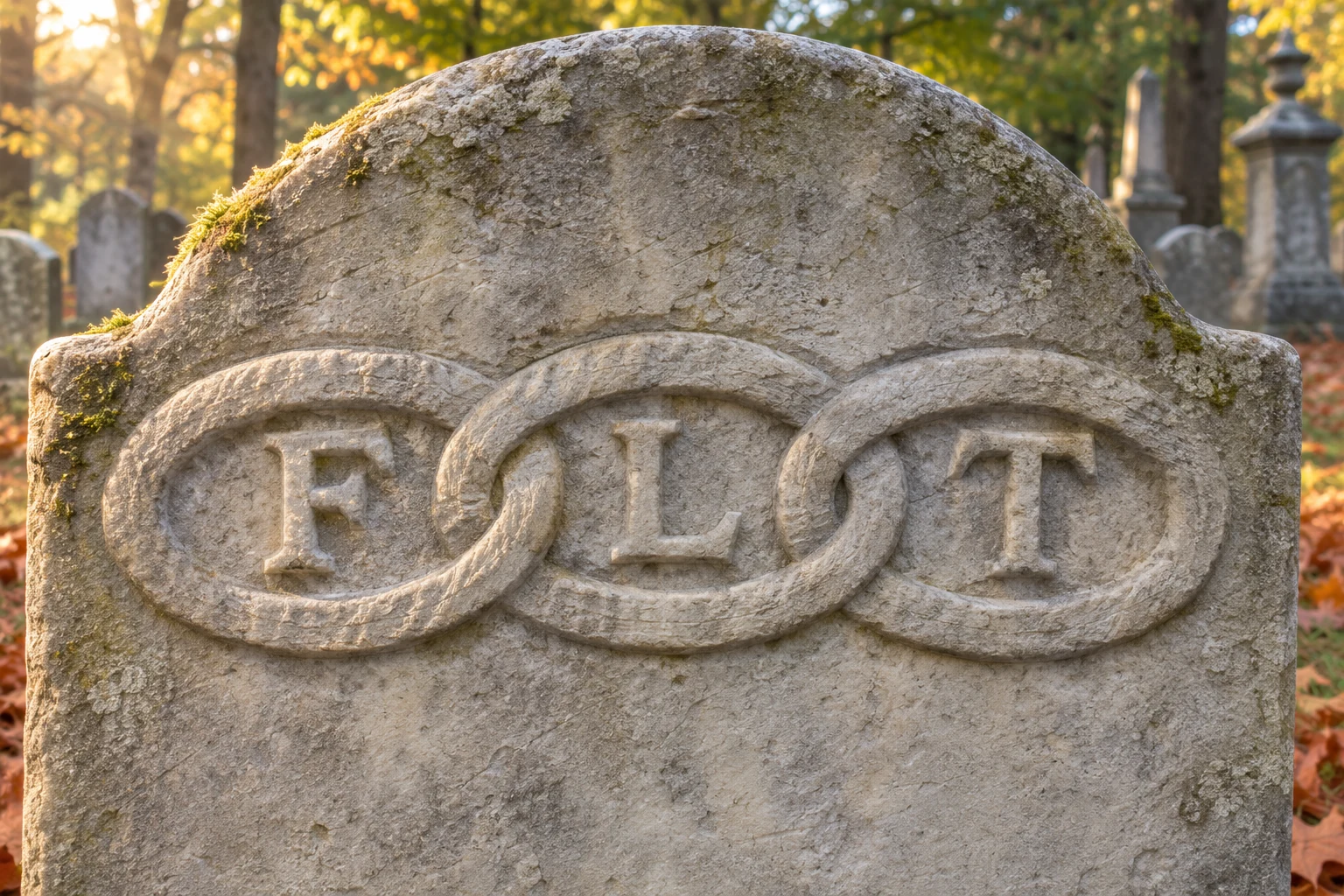
Odd Fellows grave symbols include the three-link chain, often with F, L, and T inside the links. The letters stand for Friendship, Love, and Truth. This emblem is strongly associated with the Independent Order of Odd Fellows, or IOOF, a fraternity whose work includes helping the sick, supporting people in distress, and burying the dead.
Three letters take up very little room on a gravestone. The idea behind them takes up considerably more. They point toward a question that matters as much now as it did then: when trouble comes, who will show up?
Three Links, One Promise
The Grand Lodge of Texas explains the linked chain as an image of strength through connection. Each letter names one of the order’s guiding principles:
- F — Friendship: goodwill and the bonds between people.
- L — Love: care expressed through service to others and family.
- T — Truth: a standard for conduct and trust.
On a marker, look for three joined oval links, usually arranged across the stone. The letters may be included, but the three-link emblem also appears without them. Plymouth’s Tonquish Lodge identifies the chain with FLT as its most widely encountered symbol on signs and grave markers.
The same lodge explains that symbols, passwords, and signs once helped establish membership when lodges paid benefits to sick or distressed members. Recognition had a practical purpose: protecting funds from people who had no claim to them.
Behind the formal language was an everyday concern. Help had to reach the people it was meant for.
Stephen and Mary Hoskin’s Memorial
A photographed memorial in Denver’s Fairmount Cemetery gives the emblem a setting and a name. The cemetery photography site Gravely Speaking documents the Hoskin monument, with an eye above three linked rings containing F, L, and T. Carved foliage surrounds the design, and columns frame the central panel.
In the wider photograph, a smaller marker at the foot of the monument identifies Stephen Hoskin, 1847–1933, and Mary E. Hoskin, 1856–1908. Twenty-five years separate their death dates. Their names now sit side by side beneath the larger family monument.
Look at the two stones together and they do different jobs. The smaller one tells you whose lives are remembered and when those lives ended. The larger one gives space to a public emblem of belonging and shared values.
For a passerby, the decoration may be the first thing noticed. For someone who knew the family, the name was enough.
When the Three Links Were Made of Flowers
The emblem did not exist only in stone. Smithsonian Gardens preserves a wire floral frame in the shape of the Odd Fellows’ three links, dated to about 1880. It measures eighteen and a half inches across.
The museum explains that organizations commonly sent floral tributes to members’ funerals in the late nineteenth and early twentieth centuries. Florists built recognizable emblems with flowers and ribbons arranged over shaped frames. The design had to remain clear enough for people to recognize the organization it represented.
That surviving wire frame puts another worker into the story: the florist, carefully turning a familiar sign into something living and temporary.
A floral chain and a carved chain could carry the same message in very different materials. The flowers would fade. The stone could keep the emblem visible long after the people who recognized it at a glance were gone.
Read the Eye, the Links, and the Initials Together
The eye on the Hoskin monument belongs to the same wider world of fraternal imagery. Tonquish Lodge lists the all-seeing eye of God among Odd Fellows symbols. Readers familiar with Masonic gravestone symbols will recognize it there, too. The three links and FLT give the Hoskin design its more specific Odd Fellows connection.
A chain can also be a decorative border or part of another design. Count the links, read any letters, and look at the whole panel. The combination is more informative than a single curved line worn into the stone.
IOOF and GUOOF Lead to Different Histories
Written initials can identify the organization more precisely. IOOF stands for Independent Order of Odd Fellows. GUOOF stands for Grand United Order of Odd Fellows.
The Filson Historical Society explains that the Grand United Order developed in the United States after Black men in New York were refused a charter by the American Independent Order. With the help of ship steward Peter Ogden, they obtained an English charter and established Philomathean Lodge in 1843.
That difference in initials preserves a significant part of the history: people seeking fellowship and mutual support built an organization when another excluded them. The Filson’s surviving Louisville records include membership ledgers and doctors’ notes verifying illness, tangible traces of that support system.
From a Carved Emblem to a Paper Trail
A useful next step is to record the full name, dates, cemetery, and any lodge name or number. Photograph both the complete marker and the smaller details. A close view may reveal letters that disappear when you stand a few feet away.
For an IOOF connection, the Sovereign Grand Lodge directs family researchers to the relevant state or provincial Grand Lodge. It does not keep a central file of every individual’s membership. Local lodge records, historical societies, and libraries may hold the next part of the story.
Membership applications can supply personal details. Minutes may record activities or offices held. Benefit records can reveal the times when a member needed assistance. Match those records to the person named on the stone before adding a particular lodge or role to their biography.
The cemetery’s own records may also help. Washington State Archives, for example, holds an index for the Odd Fellows Memorial Park in Tumwater drawn from registers, ledgers, and other cemetery paperwork. Its introduction states that the cemetery is open to everyone, not only Odd Fellows. Burial in a cemetery bearing the name and a personal lodge affiliation are separate things to trace.
A Small Sign of a Larger Connection
The flowers once arranged into three links were meant for people who already knew the sign. More than a century later, its carved counterpart can still catch a stranger’s eye.
F. L. T. Three short letters carrying an ambition much larger than the space they occupy: to make sure a person’s hardest days did not have to be faced alone.
We hope you enjoyed our little trip down the rabbit hole.
We’ll keep digging, and you keep reading.

Keep digging into more Gravestone Symbols and Epitaphs stories.
Sources and Further Reading
- Plymouth Tonquish Lodge No. 32: IOOF Symbols
- Grand Lodge of Texas: About the Independent Order of Odd Fellows
- Gravely Speaking: More Odd Fellows — photographs of the Hoskin memorial and its emblem
- Smithsonian Gardens: Wire Frame, Odd Fellows Emblem, Three Links, about 1880
- The Filson Historical Society: Grand United Order of Odd Fellows in America Records, 1911–1946
- Independent Order of Odd Fellows: Genealogy Research
- Washington State Archives: Odd Fellows Memorial Park Cemetery and Mausoleum Listings