
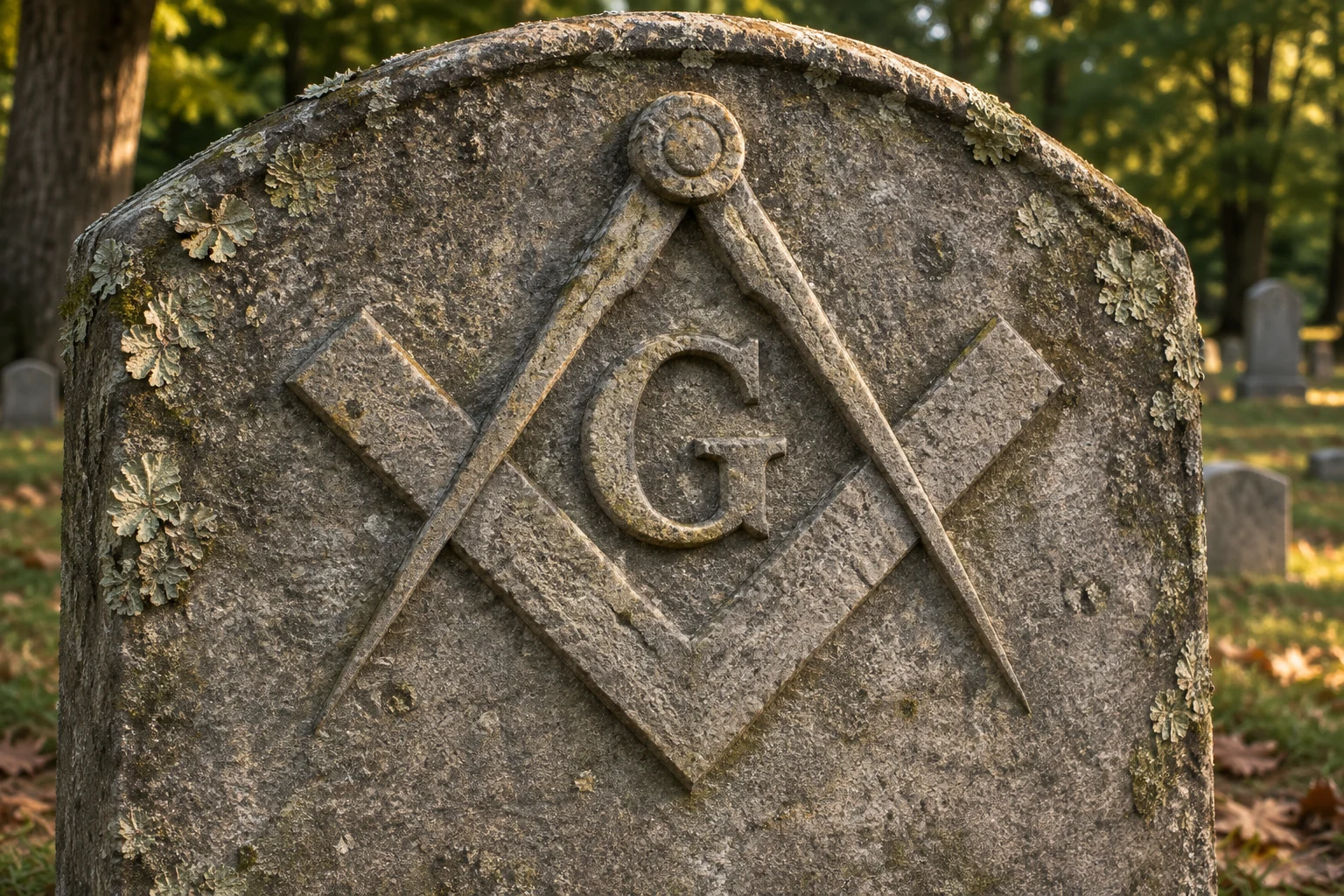
Masonic gravestone symbols most clearly point to Freemasonry when they show the square and compasses, often surrounding a letter G. These tools express ideas about conduct, self-control, and belief. Other carvings, including eyes and pillars, also appear in Masonic imagery, but have meanings beyond the fraternity.
Picture stopping at a stone because something above the name looks familiar. You have seen it on a building, perhaps a ring, but never thought much about it. Here, beside someone’s dates, the emblem raises a more personal question: what did belonging to that group mean in this person’s life?
Two Tools for Building a Life
The square and compasses borrow their shapes from working tools. A square checks a right angle. Drawing compasses open on a hinge to mark circles; they are different from a compass that points north.
In its explanation of the emblem, the Scottish Rite, Northern Masonic Jurisdiction, connects the square with moral behavior and the compasses with keeping desires within bounds. The tools become a way to think about how a person lives.
That makes the carving more interesting than an occupational badge. You are looking at a lesson expressed through tools, so it does not tell you that the person buried there earned a living cutting stone.
What Does the G Stand For?
The Scottish Rite explains the G through both geometry and God, described in Masonic language as the Grand Architect of the Universe. One meaning points toward order and measurement; the other toward belief and responsibility.
The G is not required for the emblem to be Masonic. The Grand Lodge of Maine’s guide for genealogists identifies versions of the square and compasses both with and without it.
A Gravestone Leads to a Lodge
One named example appears in the collection of the Scottish Rite Masonic Museum & Library: a rubbing taken from the gravestone of Major John Farrar. Writing in the November 2016 issue of The Northern Light, curator Ymelda Rivera Laxton associates Farrar with Trinity Lodge in Lancaster, Massachusetts.
That museum identification gives us a specific stone and a lodge name to follow. It is a firmer starting point than assigning a biography to an unfamiliar carving. The surviving image belongs to a particular person’s memorial, even when much of that person’s story remains out of view.
And the lodge’s own history offers something a list of symbols cannot: a glimpse of what membership could mean when life went wrong.
Sometimes Brotherhood Meant Window Glass
In a 1933 historical address, Gordon A. Brown described old Trinity Lodge’s surviving records from 1783 through 1800. Among the entries were requests for help. One member who lost his house to fire received thirty pounds. Another who had been burned out received window glass.
A widow with eight children was granted four pounds, and three men were appointed to consider what further help could be given. These were separate cases in the lodge’s history, recorded long before Brown retold them.
Window glass is an unexpectedly ordinary detail to find behind a mysterious-looking emblem. Yet it brings the idea of brotherhood into focus. A house needs rebuilding. Children need looking after. Someone has to decide what can be done.
The carving names an association. Records like these begin to show the human needs an association could answer.
The Eye and the Pillars
The Scottish Rite includes the all-seeing eye and pillars among the imagery found on Masonic gravestones. Within Masonic teaching, the eye represents divine watchfulness and a person’s duty to live by the fraternity’s moral standards.
That watchful eye also has a history in Christian art. Its appearance on a stone can express religious belief without identifying a particular lodge. The surrounding carvings and inscription help bring its meaning into focus.
The all-seeing eye appears in Odd Fellowship, too. Odd Fellows grave symbols include the three-link chain, often carrying the letters FLT.
Pillars have a place in Masonic symbolism through Solomon’s Temple. On a Masonic memorial, that temple imagery can give the stone another layer of meaning. An ordinary column, however, is also a familiar architectural form. A pair of pillars beside the square and compasses tells you more than an isolated shaft.
Why an Obelisk Is a Different Kind of Clue
A tall, pointed monument can feel like part of the same visual puzzle. But obelisk gravestones became popular across nineteenth-century cemeteries as part of the revival of ancient styles.
The Association for Gravestone Studies places Freemasonry within that wider cultural setting; it does not credit the fraternity with making obelisks so widespread. Look at what is carved on the monument as well as its shape. An emblem or lodge inscription carries a more specific message than height and geometry alone.
Following the Emblem Back to a Person
If a marker catches your curiosity, start with a photograph of the whole inscription and a closer view of the emblem. Record the name, dates, cemetery, and any lodge wording. Those details give an archive something useful to work with.
The Grand Lodge of Maine’s genealogy guide explains that membership information is held across individual lodges and their grand lodges, rather than in one worldwide register. Applications may record birth details; lodge records may note a death. Minutes can preserve glimpses of a member’s activities.
A local lodge or the appropriate grand lodge’s library is therefore a sensible next stop. Ask about the named person and the period in question. A date, an office held, or a mention in the minutes can turn a broad identification into a documented connection.
That is the satisfying turn in reading these stones. You arrive wondering what a symbol means. Follow it far enough, and you may find people meeting, helping, keeping accounts, or finding a way through a hard year.
Perhaps the most revealing thing behind an elaborate emblem will be something as plain as a pane of glass.
We hope you enjoyed our little trip down the rabbit hole.
We’ll keep digging, and you keep reading.

Keep digging into more Gravestone Symbols and Epitaphs stories.
Sources and Further Reading
- Scottish Rite, Northern Masonic Jurisdiction: The Origins of the Square and Compasses
- Scottish Rite, Northern Masonic Jurisdiction: Masonic Mourning Art & Gravestones
- Ymelda Rivera Laxton: Masonic Mourning and Memorial, The Northern Light, November 2016, pages 4–7; Farrar reference on page 6 (PDF)
- MasonicGenealogy: Old Trinity Lodge, including Gordon A. Brown’s 1933 historical address
- Scottish Rite, Northern Masonic Jurisdiction: The Eye of Providence
- Edward L. King, Grand Lodge of Maine: Freemasonry for Genealogists (PDF)
- Association for Gravestone Studies: Symbolism on Gravestones