
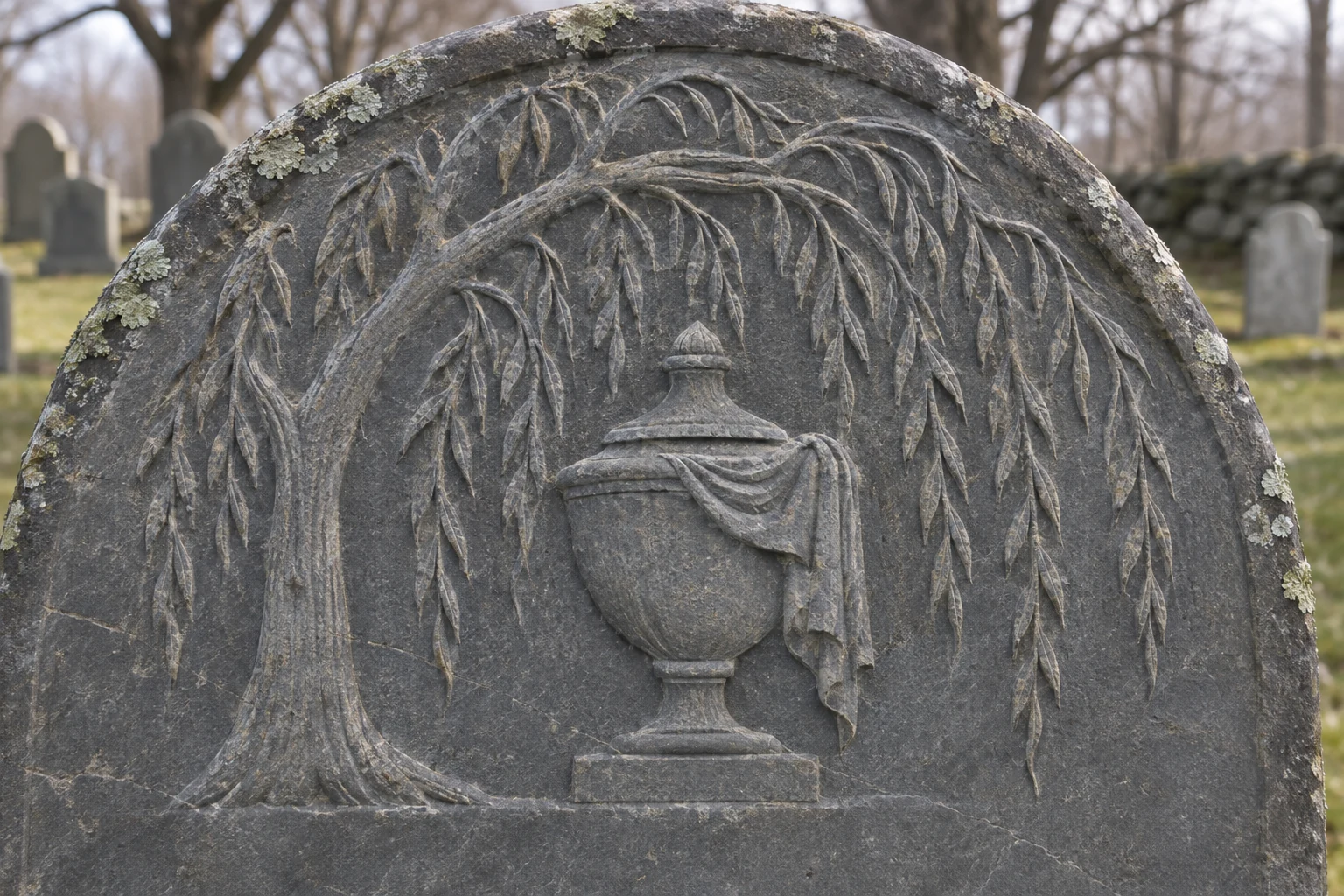
A willow and urn gravestone brings together two images of mourning: a tree associated with grief and a vessel borrowed from classical funerary art. The pairing became popular on American gravestones in the late 1700s and early 1800s. A carved urn expresses remembrance; it does not, by itself, establish that someone was cremated.
No one planted that little tree. No one filled that little urn. A stonecarver put them there to make something invisible recognizable. The name below tells you who died. The scene above it begins to tell another story: how the living pictured their loss.
Why the Willow Bends Over an Urn
The design is easy to recognize once you have noticed it. A willow’s branches curve down around a vase-shaped urn, often standing on a small pedestal. The tree can form a canopy over the vessel, turning the top of a marker into a miniature landscape.
The Church Monuments Society identifies the willow with grief and mourning. Its drooping branches give the association a visible shape. Even without a carved mourner, the tree seems to bow toward the memorial beneath it.
At Saint Paul’s Church National Historic Site in Mount Vernon, New York, a nineteenth-century marble marker shows the pairing clearly. The willow’s hanging branches frame the urn above the inscription. The National Park Service places this imagery within a wider revival of classical forms in American art and architecture.
The same interest in ancient forms also appears in obelisk gravestones, where the monument itself takes the shape of a tall, tapering shaft.
That fashion reached surprisingly far. Boston’s cemetery guide describes Americans looking to ancient Greece and Rome for the appearance of houses, public buildings, and gravestones. A family could choose an image with ancient roots for a very recent loss.
Two Names Under the Same Tree
In Yarmouth, Massachusetts, Ruthy Rider’s marker identifies her as the wife of Benjamin Rider. She died on September 6, 1812, in the twenty-first year of her age. Above the words, long willow branches descend around an urn.
Her memorial gives you a young wife’s name and a date. The choice of imagery adds a scene of mourning that someone thought belonged above those few lines.
At Bridge Road Cemetery in Eastham, another willow bends over the urn on Elizabeth Knowles’s slate marker. Its inscription identifies her as David Knowles’s widow and records her death on June 29, 1815, in her seventy-seventh year.
The photographs and transcriptions preserved by Cape Cod Gravestones let us place the two designs side by side. One commemorates a young wife; the other, an older widow. A familiar pattern had room for both lives. The names and words made each version personal.
The Girl Who Stitched the Same Scene
The willow and urn also traveled beyond the cemetery. One surviving example brings us to a schoolgirl with a loss of her own.
Elizabeth Alston Williams was born on September 6, 1803. Her father, Joseph John Williams, died on September 18, 1806. She had turned three just twelve days earlier.
In 1816, the year she left Salem Girls’ Boarding School in North Carolina, Elizabeth made a silk mourning picture dedicated to him. Old Salem Museums & Gardens preserves it today. A boy and girl appear beneath a weeping willow, with the girl kneeling beside a pedestal topped by an urn. Her father’s name and death date are written on the pedestal.
About a decade separated the death from the picture. By then, Elizabeth was old enough to make something bearing the name of the father she had lost as a small child.
Here is the same little scene, worked in thread. The repeated design carried one daughter’s dedication.
What the Urn Borrowed From Rome
The urn’s connection with ashes is real. Boston’s guide traces the funerary vessel to Roman containers for cremated remains. Later memorial artists borrowed its shape as part of a classical visual language.
Using that shape on a headstone did not require copying the burial practice behind it. An urn carved into a slab works as an image. To establish how a particular person’s remains were buried, you would need a burial record or other evidence about that grave.
Stone That Pretends to Be Cloth
On some monuments, the urn appears partly covered by fabric. Look closely at a draped urn gravestone and the folds are part of the stonework too: cloth that will never shift in the wind.
The Church Monuments Society connects the draped, empty urn with death and traces it to classical cinerary urns—the vessels used for ashes. Drapery adds another layer to that memorial image.
For the carver, it also presents a particular challenge. A hard surface has to suggest something soft: a hanging edge, a fold gathering over the rim, the weight of material falling down one side. It is worth giving those small details a moment of attention. Someone had to persuade stone to behave like cloth.
A Scene With Room for the Living
The National Park Service describes an increasing emphasis on bereaved families in this classical memorial imagery. Some stones even include mourners leaning against urns. The people left behind could become part of the picture.
The imagery has a different emphasis from the skulls explored in our winged skull gravestone article. Both address death, while the willow-and-urn scene gives grief a landscape to occupy. These designs belonged to overlapping traditions, with room for different choices.
Next time you notice the pairing, follow the branches down to the name. Somewhere behind that familiar design was a particular loss. The urn did not have to hold anything to carry someone’s memory.
We hope you enjoyed our little trip down the rabbit hole.
We’ll keep digging, and you keep reading.

Keep digging into more Gravestone Symbols and Epitaphs stories.
Sources and Further Reading
- Boston Parks and Recreation: Iconography of Gravestones at Burying Grounds
- National Park Service: Historic Cemetery, Saint Paul’s Church National Historic Site
- Church Monuments Society: Symbolism on Monuments
- Cape Cod Gravestones: Ruthy Rider, 1812—photograph and inscription
- Cape Cod Gravestones: Elizabeth Knowles, 1815—photograph and inscription
- Old Salem Museums & Gardens: Mourning Embroidery by Elizabeth Alston Williams, 1816