
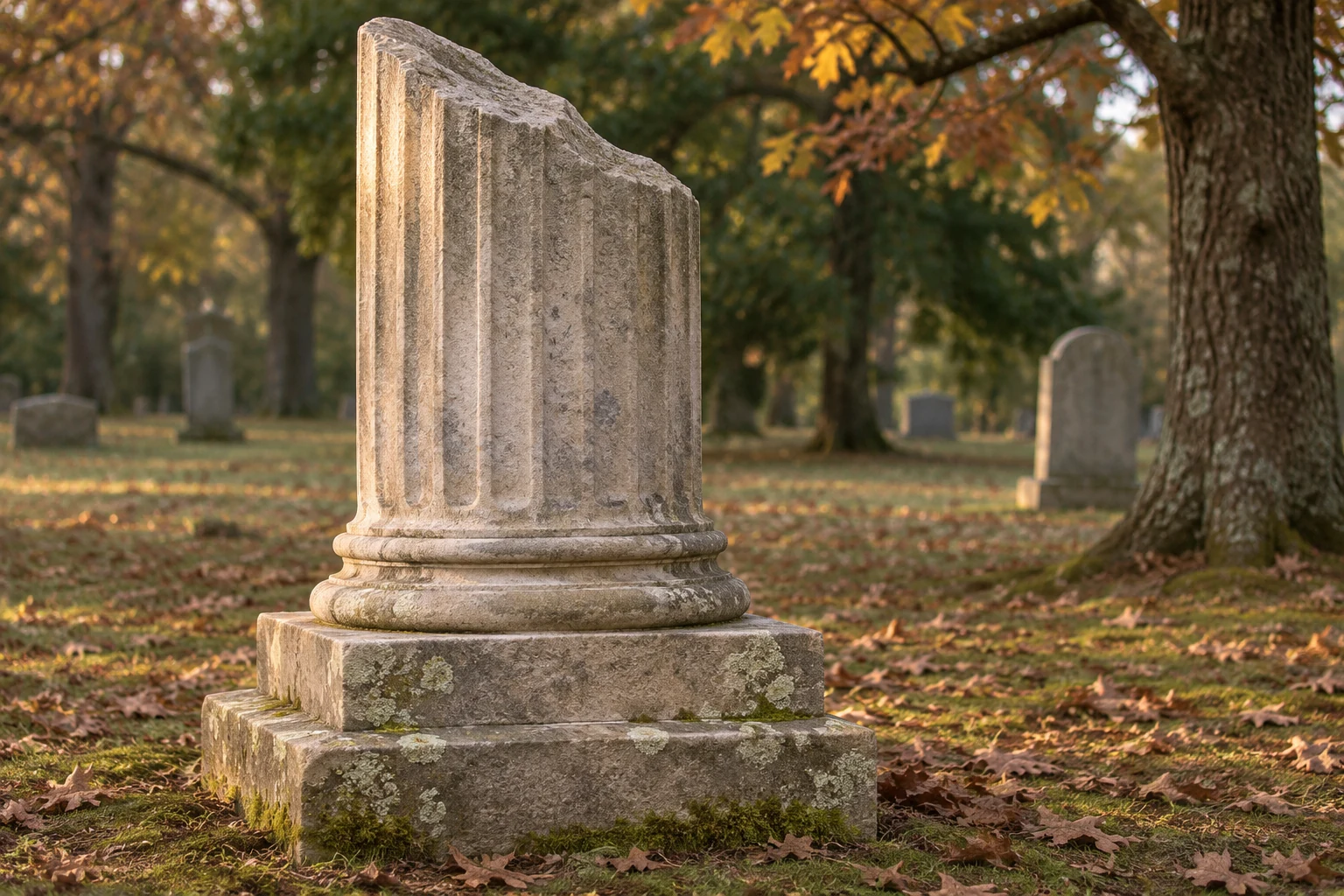
A broken column gravestone can be an intentional memorial design rather than evidence of later damage. Its shortened shaft has been used to suggest mortality, a life cut short, or the loss of someone who provided support. Which reading fits a particular grave depends on its inscription and history.
On a cemetery walk, that shape might send you looking for the missing piece in the grass. But a deliberately broken pillar asks you to notice an absence of another kind. It can give shape to a familiar feeling: this person should have had more time.
The Racing Driver Remembered as a Friend
At Percy Lambert’s grave in London’s Brompton Cemetery, a carved tire surrounds his name. It is an unusually fitting frame for the man who, in February 1913, became the first person to drive 100 miles in one hour.
The challenge was to keep going fast for a full hour. Lambert won the record, lost it, and returned to Brooklands to try to win it back. He died in a crash there in October of that same year.
The Royal Parks interprets his broken column as a life cut short. Below it, the tire preserves the racing connection. But another inscription makes room for the person beyond the achievement: “A modest friend, a fine gentleman and a thorough sportsman.”
Someone chose to give friendship space on a record breaker’s memorial. You can learn what Lambert accomplished from the tire and the words about his record. That quieter line gives you something else to remember about him.
What a Broken Column Gravestone Can Mean
A column supports something. Remove its upper part, and that familiar architectural shape becomes a way to express loss. The association is easy to understand: we still talk about people as pillars of a family or community.
The Church Monuments Society associates a column with the support of life, and a broken column with mortality or that support being broken. The National Park Service’s guide to cemetery symbolism also describes an interpretation connected with the death of a family’s head: the loss of someone whose absence disrupted the household.
That gives the image two closely related meanings. It can express the ending of a life or the support that disappeared with it. A memorial’s wording may draw your attention toward one of those ideas.
There is a small contradiction built into the stonecarver’s job. To make this kind of memorial, the craftsperson had to finish a column that looked unfinished. The missing top belonged to the design.
Meriwether Lewis’s Monument Was Built This Way
At explorer Meriwether Lewis’s burial place on the Natchez Trace Parkway in Tennessee, a tall column rises from a stepped stone base. Look toward the top, and the column ends in an irregular edge.
The National Park Service identifies that broken shaft as deliberate: a nineteenth-century memorial custom expressing a life cut short by an untimely death.
Lewis died while traveling the Old Natchez Trace in 1809. The Tennessee legislature later provided $500 for a monument, which was erected in 1848. Thirty-nine years had passed between the death and this act of remembrance.
That long gap is worth pausing over. A death date records when a life ended; a monument can record a later decision about how that life should be remembered. In Lewis’s case, the people commissioning it chose a form that made interruption visible.
The Broken Top in a Century-Old Photograph
The National Park Service’s cultural landscape inventory includes a photograph of Lewis’s monument published in 1905 and another dated around 1916. Both show the tall column with its irregular upper edge.
Compare those views with the monument today, and the familiar outline is still there. The inventory records a restoration in 2000–2001. Across those years, the broken form remained part of the memorial.
This is one reward of looking through old photographs: an odd feature stops looking like something that happened yesterday. Here, the photographs support the documented history of the design. Elsewhere, the earliest photograph might only tell you that a break was already present when the camera arrived.
Was It Designed to Look Broken—or Damaged Later?
For a column without such a well-recorded history, a little investigation can help. The Discovering England’s Burial Spaces recording guidance separates a memorial’s form, inscription, condition, and repairs. Those categories give you a useful way to organize what you find:
- Compare dated photographs. Look for changes in the outline and note when each picture was taken.
- Check cemetery descriptions and conservation records for an account of the original design or later damage.
- Record the inscription as well as the shape. Names, dates, and wording help connect the object with a person and a time.
- Leave the monument undisturbed. Do not touch, push, climb, or try to fit loose pieces together to work out what happened.
The shape alone cannot establish an age, family role, or cause of death. If the records leave the design uncertain, keep that question open. Our guide to cemetery symbols offers more ways to follow a carving back to the people connected with it.
What Would You Want the Stone to Remember?
A name and two dates leave a great deal unsaid. Choosing a memorial means deciding what else deserves room: an achievement, a relationship, a belief, or a sense that more life should have followed.
That makes a broken column a curious piece of craftsmanship. It uses solid stone to draw attention to something missing. Next time one catches your eye, look down as well as up. The detail that stays with you may be waiting beside the name.
We hope you enjoyed our little trip down the rabbit hole.
We’ll keep digging, and you keep reading.

Keep digging into more Gravestone Symbols and Epitaphs stories.
Sources and Further Reading
- Church Monuments Society: Symbolism on Monuments
- National Park Service: Meriwether Lewis Burial Monument
- National Park Service: Cultural Landscapes Inventory—Meriwether Lewis, Natchez Trace Parkway (PDF, printed pages 26–27 and 40; hosted by NPSHistory)
- The Royal Parks: Percy Lambert (1880–1913)
- National Park Service: Echoes Written in Stone
- Discovering England’s Burial Spaces: Recording the Memorials