
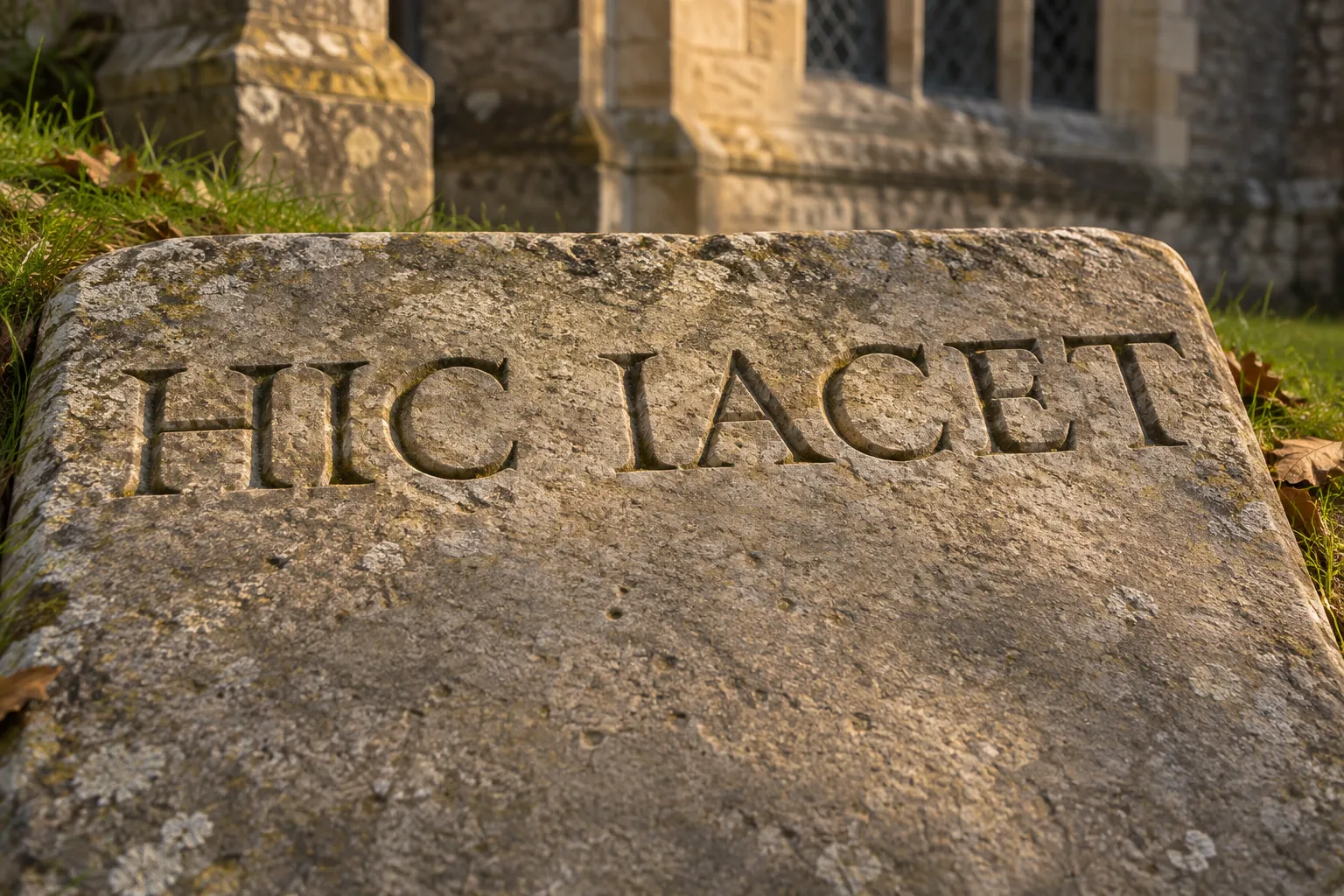
Three letters on a grave can look familiar and still lead you astray. Latin gravestone inscriptions often identify the dead, record a relationship or date, and ask for prayer or remembrance. A few recurring phrases make them easier to approach. But a word’s ending matters, and a familiar letter group may not be Latin at all.
Once you get past that first barrier, the reward can be surprisingly human. A memorial may ask you to pray, introduce you to someone’s wife, or even suggest that you overlook the family’s faults. A few words can bring the people behind the stone a little closer.
Five Latin Clues to Recognize
Hamline University’s guide to memorial brass inscriptions explains several recurring forms. They also help readers approach the language of Latin epitaphs:
- Hic jacet, also written hic iacet: “here lies.” This commonly introduces the person being commemorated.
- Orate pro anima: “pray for the soul.” The reader is being asked to do something, not just learn a name.
- Qui obiit: “who died.” Look next for the death date.
- Uxor eius: “his wife.” A short phrase can establish a relationship between names.
- Anno domini: “in the year of the Lord.” This introduces a calendar year and may appear in shortened forms such as Ao dni.
Read each phrase with its neighbors. A line may move from a name to a spouse, then to a date and a prayer. Recognizing one part gives you a foothold for the next.
The Hope Behind RIP
Requiescat in pace means “may he or she rest in peace.” Its familiar initials are RIP. The little word “may” carries an important part of the meaning: this is a wish or prayer for the person who died.
You may also meet requiescant in pace, the plural form: “may they rest in peace.” The Vatican’s Compendium prints that wording in the Latin prayer for eternal rest beside its English translation.
That extra n is small enough to miss but changes who the prayer concerns. It is a useful reminder that Latin word endings do real work.
To translate the phrase is to explain what the words say. To describe it as a prayer is to explain what they are doing. That distinction brings the living back into the picture: someone is asking for peace for a person they have lost.
The Family That Asked You Not to Flatter It
Tonbridge Historical Society records a Weller family memorial on the north wall of the north aisle of St Peter and St Paul. Its Latin and English texts speak directly to the visitor.
Ad Lectorem means “To the reader.” Then comes Non Mortuos ut ampliem Mendaciis, a clause about not magnifying the dead with falsehoods. The accompanying English begins, “I stand not here to compliment the Dead.”
The memorial goes on to ask that faults be treated charitably and virtues imitated. The English expresses the message in verse, without matching every Latin word.
That is a wonderfully recognizable request: remember the good, go gently over the failings, and skip the inflated praise. Beneath the formal language is the awkward business of summing up imperfect people. We still face that problem whenever someone asks us to say a few words about a life.
Why IHS Is the Translation Trap
See IHS on a gravestone, and it is tempting to assign a Latin word to each letter. Its origin lies elsewhere.
Jesuits in Britain explain that IHS represents the name of Jesus in Greek. The United Methodist Church identifies the letters as iota, eta, and sigma. The H-shaped letter is the Greek capital eta. The symbol is a Christogram: a compact representation of Christ’s name.
Latin interpretations developed too. The Methodist explanation gives Iesus Hominum Salvator, meaning “Jesus, Savior of humankind.” The Church Monuments Society also records interpretations involving In Hoc Salus and In Hoc Signo.
These readings explain why different guides may give different answers. A later Latin interpretation and the Greek origin are different parts of the symbol’s history.
For a particular memorial, begin with the central meaning: a reference to Jesus. A nearby inscription or a reliable local record may support a more specific reading. The three letters alone do not identify which expanded phrase a family had in mind.
When the Words Outlast the Stone
Sometimes the inscription you are reading survives on paper rather than on the memorial itself.
Tonbridge’s compilation combines a 1970–71 survey with five stones recorded in Registrum Roffense in 1796 but later lost. Samuel Speed’s 1731 memorial is among them. Its translated text survives; the society identifies the stone itself as lost.
That distinction changes the story you can tell. An old transcript can preserve someone’s words without proving that a visitor can still find those words carved in place today.
For any recorded inscription, keep track of what you have: a photograph of the object, a transcription, or a translation. Each answers a different question. A translation gives meaning; it cannot show whether a damaged letter was confidently read or reconstructed by an earlier recorder.
For a practical way to work through worn lettering, see how to read old gravestones. It covers photographs, unfamiliar English terms, and keeping missing characters visible in your notes.
Find the Person Inside the Formula
Start with what is actually written. Copy the Latin before expanding abbreviations, then separate the name, relationship, date, and prayer. Hamline’s guide shows how much abbreviated and variable spelling can compress into a line. If a longer passage resists a simple reading, a published translation or someone experienced in historical Latin can help.
The same attention to names and relationships is useful when reading Jewish gravestone inscriptions, though the language and conventions are different. In either setting, a small phrase may tell you how one person was connected to another.
Then ask who the words address. “Here lies” introduces the dead. “Pray for the soul” calls on the living. “To the reader” reaches straight toward whoever has stopped to look.
Someone chose words for a future stranger. For the moment you stand there reading, that stranger is you.
We hope you enjoyed our little trip down the rabbit hole.
We’ll keep digging, and you keep reading.

Keep digging into more Gravestone Symbols and Epitaphs stories.
Sources and Further Reading
- Hamline University: Inscriptions on Brasses
- Tonbridge Historical Society: Memorials and Gravestones Inscriptions
- Online Etymology Dictionary: Requiescat
- Vatican: Compendium of the Catechism, Appendix A — Common Prayers
- Jesuits in Britain: What Does IHS Stand For?
- United Methodist Church: What Do the Letters IHS Stand For?
- Church Monuments Society: Symbolism on Monuments