
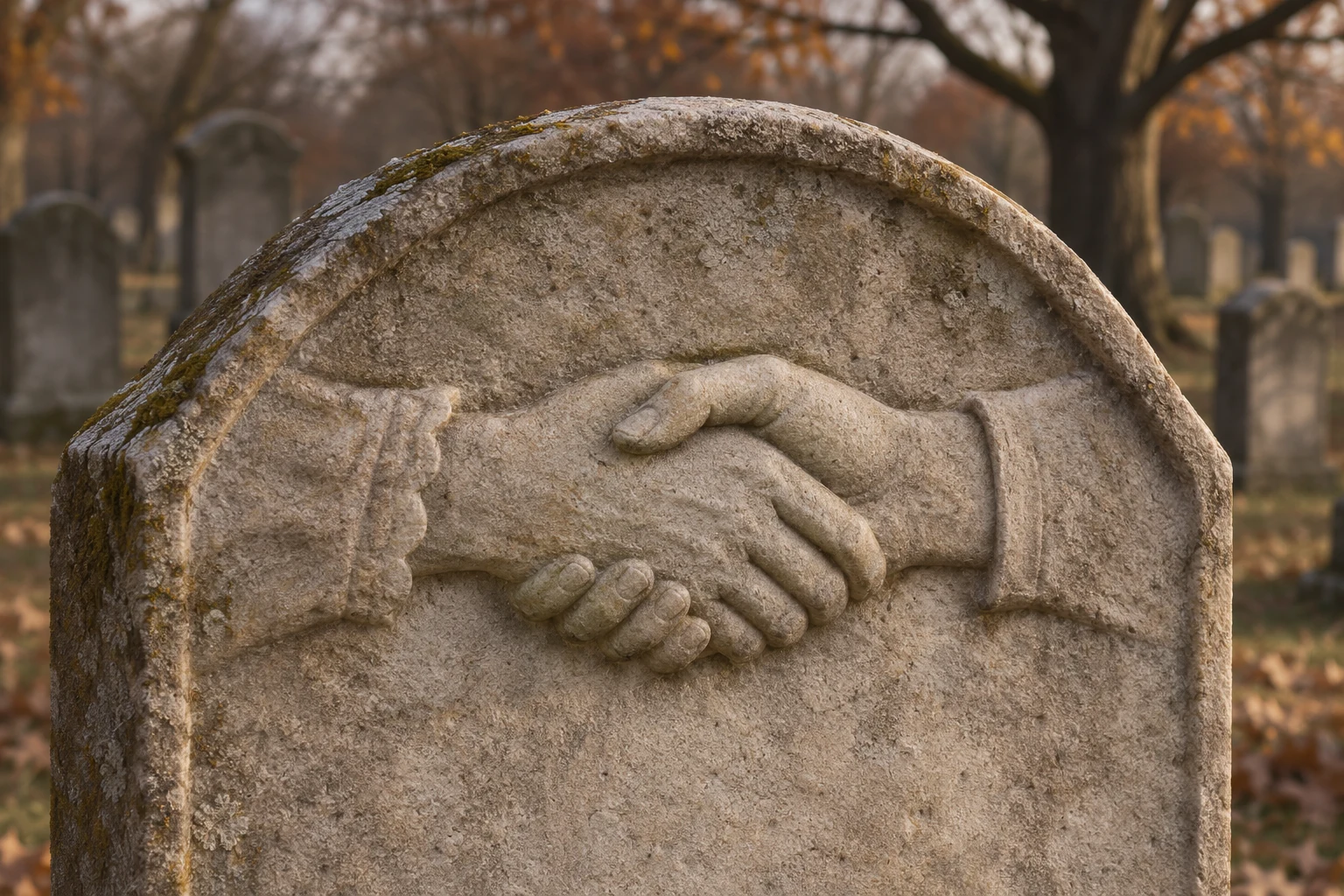
Clasped hands on gravestones can express farewell, a bond between people, or hope of reunion after death. Marriage is one possible reading, but the carving alone does not identify a spouse or tell you whose hand is whose. Names, inscriptions, and the history of the particular grave give the gesture its meaning.
Sometimes that history makes the image especially moving. In one Dutch cemetery, two stone hands meet above a wall that separates a husband’s grave from his wife’s. The wall belongs to their story as much as the hands do.
What Clasped Hands on Gravestones Can Mean
A handshake can carry several messages. Mammoth Cave National Park’s guide associates clasped hands with farewell, marriage, and being a good neighbor. The Church Monuments Society also includes brotherly love and reunion among its interpretations.
Those readings suggest three useful starting points:
- Farewell: a final parting from someone loved, or from earthly life.
- A lasting bond: affection, friendship, or a marriage remembered after death.
- Reunion: the hope that people separated by death would meet again.
These ideas can overlap. A memorial could acknowledge a painful goodbye while also expressing hope. The Association for Gravestone Studies cautions that interpretations are possibilities, not certainties. A handshake in stone gives you a question worth pursuing; it does not supply a complete family history.
Two Graves Joined Across a Wall
At the Oude Kerkhof in Roermond, in the Netherlands, two similar memorials stand on opposite sides of a brick cemetery wall. From the back of each monument, a carved arm reaches toward the other. Their hands clasp above the dividing line.
The graves belong to Jacob van Gorkum and Josephine van Aefferden. According to Roermond’s municipal archive, they married in 1842. He was Protestant; she was Catholic. When he died in 1880, he was buried beside the wall on the Protestant side. She died eight years later and was buried opposite him on the Catholic side, rather than in her family’s burial vault.
The Dutch heritage register identifies the paired monuments as a memorial to their bond across the religious divide. Here, the marriage reading rests on documented people and a particular cemetery arrangement.
The inscriptions add another layer. The cemetery’s walking guide transcribes both markers. Van Gorkum’s inscription names his wife after the Dutch abbreviation “Echtg. van,” meaning spouse of. Her marker gives her married identity and birth name. You do not have to infer their relationship from the sleeves.
Even this well-known story has an uncertain detail. The municipal archive notes that no document recording her supposed written burial instructions has been found. The surviving memorial establishes the arrangement; it does not prove every account of how the plan was made.
What the Cuffs Can—and Cannot—Tell You
Carved cuffs are worth a close look. In Jessica Cooper’s photograph for the Mammoth Cave guide, the handshake above the name S. O. Davis has two different sleeve treatments: one ruffled, the other plain with a button. The small clothing details make the gesture feel personal.
A ruffle may invite a reading based on period dress. It still does not identify a wife, husband, parent, child, or friend by itself. Record what is visible, then look for names and relationship words on the full marker. If the photograph stops above the dates and inscription, the missing information stays missing.
The same restraint applies to the grip. Which hand seems relaxed or which thumb appears on top is not enough to establish who died first. Death dates provide better evidence, when both people are actually identified.
Pointing Hands on Gravestones
A Finger Pointing Up
A finger pointing up on a gravestone is commonly read in Christian memorial imagery as a reference to heaven or eternal life. Mammoth Cave’s guide gives this interpretation. The surrounding words may make the religious message clearer, especially when the stone includes a biblical verse.
That reading concerns the belief expressed by a memorial. It cannot tell us everything the person named on it believed.
A Hand Pointing Down
A hand pointing down on a gravestone is more difficult to reduce to one definition. The Association for Gravestone Studies lists God’s hand and mortality or sudden death among the possibilities. The Church Monuments Society gives a different reading for a downward finger: calling the earth to witness.
That disagreement matters. A downward gesture does not establish that someone was condemned to hell, nor does it prove a sudden death. Look at whether the hand points, reaches, or holds something, and read the inscription before choosing an explanation.
Praying Hands Are a Different Gesture
Hands held together in prayer are generally interpreted as religious devotion. Look for palms brought together and fingers directed upward, rather than two hands reaching toward each other in a handshake.
Two raised hands can also belong to a different tradition. On Jewish gravestones, hands shown in the priestly blessing gesture are associated with the kohanim, the hereditary priestly line. The Roermond cemetery guide identifies this motif on Erich Marx’s grave. It should not be folded into a general marriage or farewell reading simply because two hands appear.
Hand position, nearby wording, and the cemetery’s religious context work together. Keeping those distinctions visible helps avoid giving every pair of carved hands the same story.
Bring the Hands Back to the Whole Memorial
If photography is allowed, take both a close view of the gesture and a wider view showing the complete inscription. A useful record includes:
- The names, dates, and any stated relationships.
- The hand position and visible sleeve details.
- Other emblems, initials, or religious wording.
- The cemetery and the marker’s location within it.
Our guide to cemetery symbols explains how those details can be checked against local records. A clearly named couple supports a marriage reading. Without that evidence, farewell, friendship, or reunion may remain reasonable possibilities.
At Roermond, the hands cross a real boundary, and the names tell us whose bond they preserve. Elsewhere, the answer may remain less certain. Either way, looking beyond the handshake brings the memorial back to the people who made it matter.
We hope you enjoyed our little trip down the rabbit hole.
We’ll keep digging, and you keep reading.

Keep digging into more Gravestone Symbols and Epitaphs stories.
Sources and Further Reading
- National Park Service, “Echoes Written in Stone”: hand gestures and Jessica Cooper’s photograph of the S. O. Davis marker
- Association for Gravestone Studies, “Symbolism on Gravestones”: possible hand interpretations and their limits
- Church Monuments Society, “Symbolism on monuments”: hands, pointing fingers, and religious context
- Cultural Heritage Agency of the Netherlands, monument 520489: the paired Roermond graves (Dutch)
- Roermond Municipal Archive, John Vaessen, “Het ‘graf met de handjes’”: the couple’s history and the limits of the surviving documentation (Dutch)
- Oude Kerkhof walking guide, updated December 2021, pp. 3 and 6: the Erich Marx hand motif and transcriptions of the paired graves (Dutch PDF)