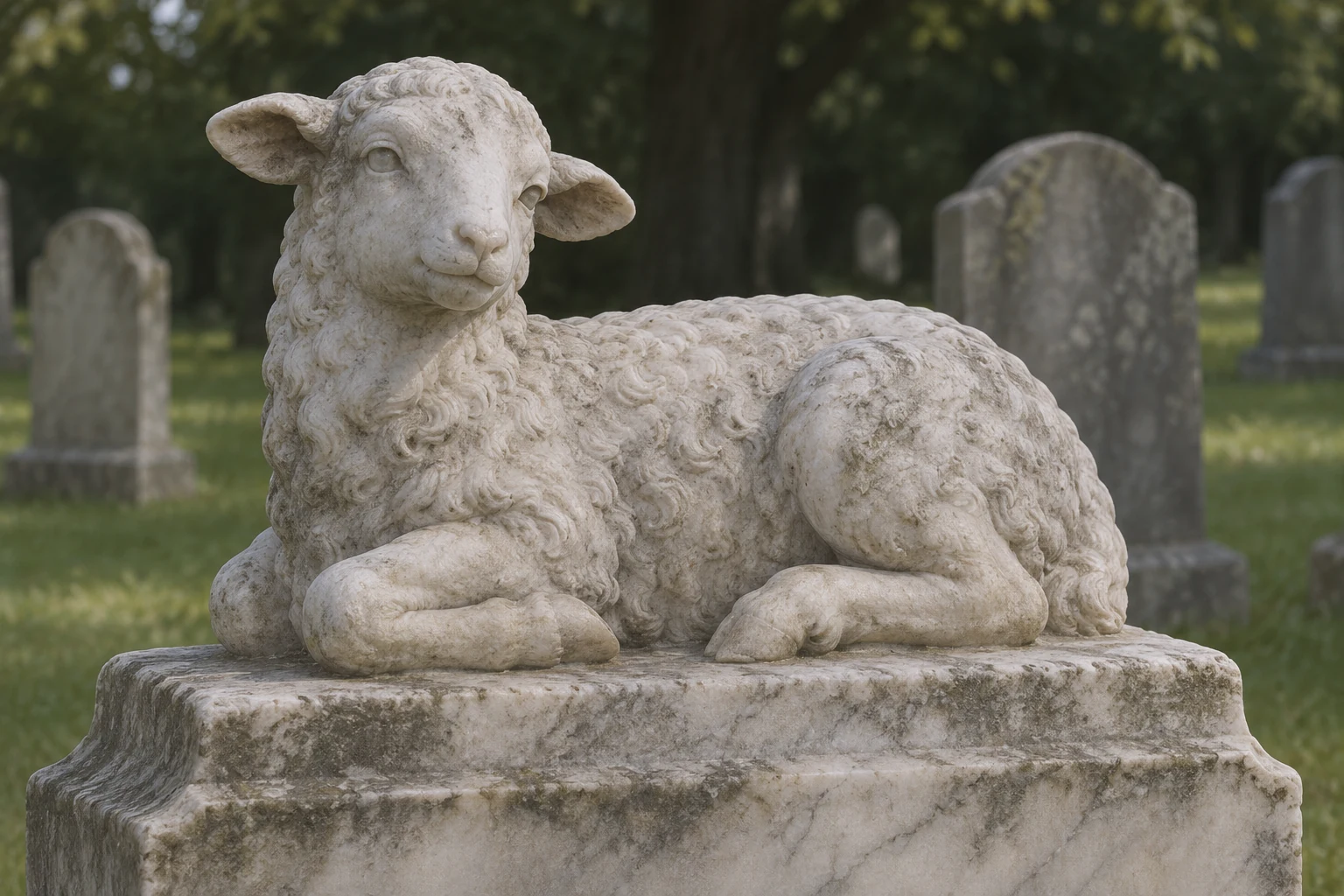
A lamb on a gravestone usually represents innocence, especially on an infant’s or child’s memorial. It also has a long history in Christian art as the Lamb of God. Those meanings help explain why a small farm animal appears above a human name.
But follow the lamb from one cemetery to another, and something unexpected happens. One leads you to a baby who lived for just over two months. Another leads to a great-grandmother, a flooded river, and the beginning of a presidential family’s burial ground.
Two Months in 1924
In a National Park Service photograph from Mammoth Cave National Park, fallen leaves surround a low stone bearing the name Marian Darlene Davis. A small lamb sits between two sets of dates: January 16, 1924, and March 18, 1924.
The carving is simple. You can make out the animal’s raised head, its body, and the few lines that turn a patch of stone into a lamb. There is no elaborate scene to work through. The name and dates do most of the talking.
The Park Service describes lambs on children’s gravestones as symbols of innocence and vulnerability. Here, the inscription makes that connection painfully clear. Both dates fall within the same year. The interval between them is barely a season.
You can read those dates in a second. Living through them was another matter.
Why a Lamb Belongs on a Human Grave
A lamb is a young animal, so its connection with childhood is easy to grasp. Yet the symbol also carries a religious meaning that reaches well beyond a person’s age.
The Church Monuments Society identifies the lamb with the Agnus Dei, Latin for “Lamb of God,” as well as innocence. Its guide points readers to John 1:29 and Revelation 5:6–14. In Christian imagery, the Lamb of God represents Christ.
You can see how old that visual tradition is in an ivory plaque held by the Metropolitan Museum of Art. Made in southern Italy around 1000–1050, it places the lamb on a cross, surrounded by the symbols of the four Gospel writers. The plaque once decorated the cover of a Gospel book that no longer survives.
The book is gone; the lamb remains. Centuries before the dates on Marian’s stone, artists were already using this animal to express Christian belief.
On a child’s memorial, innocence and faith can sit comfortably together. A plain lamb can also carry the simpler meaning of a young life. Forest Hills Cemetery’s own interpretation recognizes both religious and secular readings of the animal.
A Sleeping Child Beside a Lamb
At Forest Hills Cemetery in Boston, two monuments make that human connection unusually direct. The cemetery’s self-guided tour identifies them as memorials to two children from the same family.
One shows a baby resting on a pillow and bed. The other is a lamb.
Place those images side by side in your mind. One preserves the shape of a sleeping child. The other uses a small animal to suggest childhood. The cemetery explains that the lamb could express Christian belonging to God’s flock or the innocence of a young child without a specifically religious meaning.
There is something recognizable about the sleeping figure. A pillow and a bed belong to the everyday business of caring for someone. Carved in stone, those ordinary objects become permanent.
One memorial gives the child a human form. The other lets a lamb carry the association. Both give tenderness a lasting shape.
The Lamb Above a Great-Grandmother
Now consider a white marble marker in Texas’s Johnson Family Cemetery. A lamb rests above Priscilla Bunton, President Lyndon B. Johnson’s great-grandmother.
According to the National Park Service, Bunton died on April 28, 1905, during a violent storm. Her family intended to bury her beside her husband at Stonewall Community Cemetery. A flooding river prevented them from getting there.
They chose a grove of live oaks on Johnson’s grandfather’s property instead. Bunton became the cemetery’s first burial.
A storm had changed the family’s burial plans and, with them, the location of a cemetery.
Her grave also changes how we read the animal. Here the lamb stands above a woman whose family extended across generations. The park’s account explains the unusual burial, but does not record why this carving was chosen.
Follow the Lamb to the Person
When you come across one of these memorials, start with the detail that caught your eye. Is the lamb a small outline cut into a flat stone, like Marian’s, or a sculpture resting above the inscription? Then move from the animal to the name.
The dates may confirm an infant’s grave. They may reveal an adult. An epitaph or accompanying religious image may add something the lamb alone leaves unsaid. A nearby family name can open another line of inquiry.
You can make a similar comparison with flowers carved on gravestones: a bud, a broken stem, and an open bloom offer different visual clues. Read them alongside the inscription, and the carving becomes part of a particular person’s memorial.
That is what makes the lamb worth a second look. The same gentle animal can draw your attention to two months in 1924 or to a woman whose family could not cross a flooded river in 1905. You begin by wondering about a carving. You leave knowing someone’s name.
We hope you enjoyed our little trip down the rabbit hole.
We’ll keep digging, and you keep reading.
Keep digging into more Gravestone Symbols and Epitaphs stories.
Sources and Further Reading
- National Park Service — Echoes Written in Stone (includes Jessica Cooper’s photograph of Marian Darlene Davis’s marker).
- Church Monuments Society — Symbolism on Monuments (Lamb entry).
- Metropolitan Museum of Art — Medieval Gospel-book plaque with the Lamb of God (object 17.190.38, dated 1000–1050).
- Forest Hills Cemetery — Lamb & Sleeping Child.
- National Park Service — Johnson Family Cemetery (Priscilla Bunton’s burial and marble marker).