
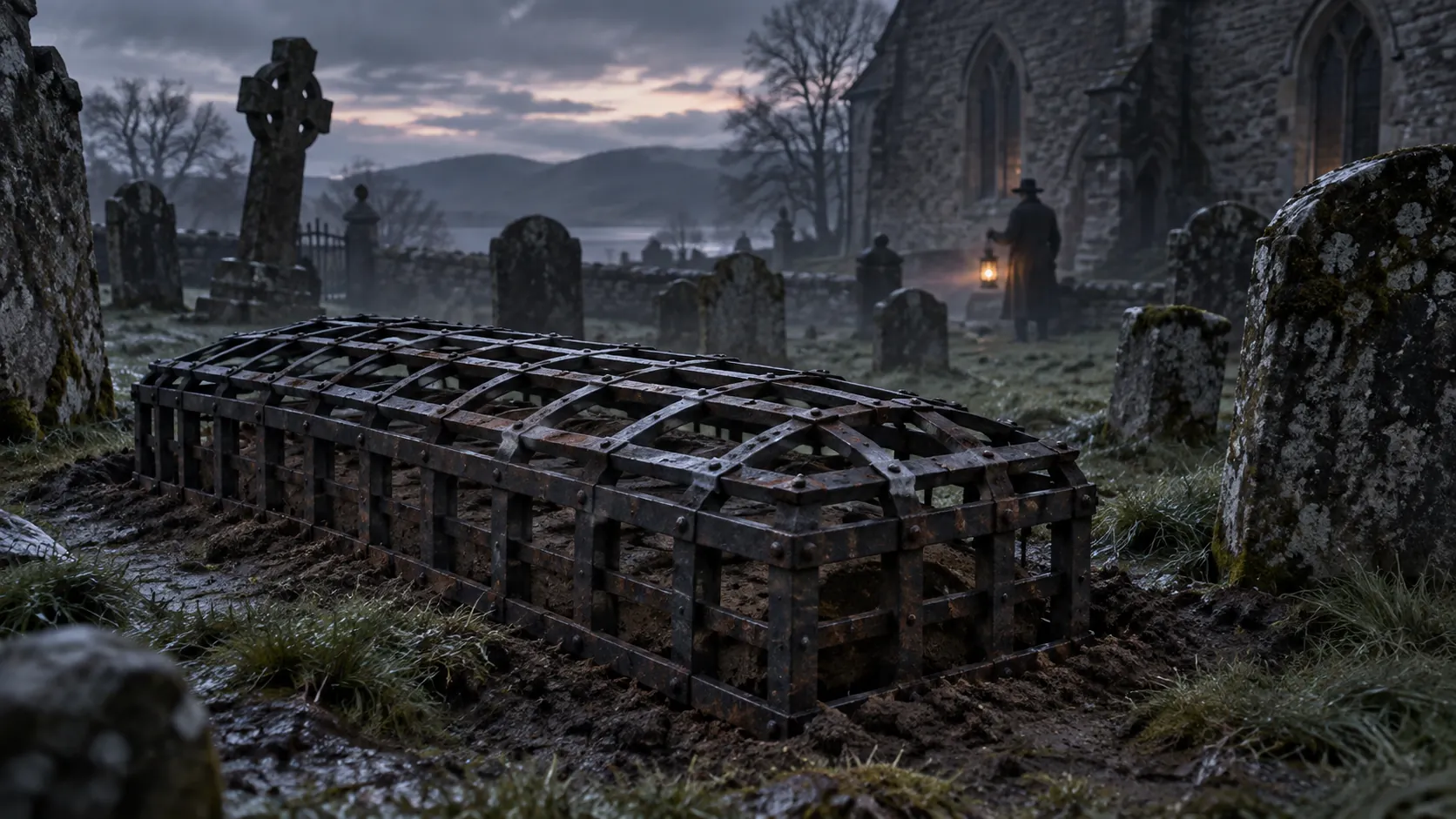
Mortsafes were heavy iron or stone-and-iron devices that protected newly buried coffins from body snatchers. They became especially associated with Scotland in the early 1800s, when anatomy schools needed more cadavers than the law could legally provide.
The cage-like structures look strange today, but their purpose was practical. A mortsafe did not have to guard a grave forever. It only had to keep the body safe until decomposition made it of little use for dissection. Then many mortsafes could be removed and used again.
What Were Mortsafes?
A mortsafe was a physical barrier meant to make a fresh grave too difficult to rob quickly and quietly. Some were made mostly of iron. Others combined a heavy stone slab with iron bars or latticework. Many followed the outline of a coffin.
James Ritchie documented surviving grave defenses in Aberdeenshire in a 1912 study. He described simple heavy stones as well as stronger designs in which iron latticework extended down around the coffin. In one form, the ironwork reached about 18 inches below the stone, blocking access from the sides and above.
That extra protection mattered. Ritchie recorded that a heavy stone alone could still be defeated by digging under one end of it and reaching the coffin without moving the slab. The iron framework turned a heavy obstacle into a much more complete barrier.
Modern photographs can make mortsafes look like permanent cages sitting above graves. That was not always how they worked. Many were lowered into the grave with the coffin, covered with earth, and later dug up after the danger had passed.
Why Did People Put Iron Cages on Graves?
The short answer is body snatching.
During the late 1700s and early 1800s, medical schools needed human bodies for anatomy lessons. The legal supply was small. That shortage created a market for freshly buried corpses, and professional body snatchers – often called resurrectionists – supplied it.
For a grieving family, burial did not always end the danger. A newly filled grave could attract thieves because a fresh body had value to anatomy teachers. Families and church communities responded with grave watching, secure vaults, heavy stones, iron collars, and increasingly elaborate metal defenses.
Iron mortsafes began appearing around 1816. Their job was not to make a grave impossible to open forever. They only had to make theft slow, noisy, difficult, and risky enough that a resurrectionist would look for an easier target.
How Did a Mortsafe Work?
A typical mortsafe protected the coffin with weight, iron, locks, or some combination of all three. Depending on the design, a stone or iron plate might sit above the coffin while bars or a cage extended around it. Other examples were coffin-shaped iron shells or frameworks.
The key feature wasn’t how frightening the device looked. It was resistance. A body snatcher working at night wanted speed and secrecy. A heavy locked structure forced the thief to spend far more time digging, cutting, levering, or dismantling the protection.
Some mortsafes were so heavy that they required special lifting gear. In a 1921 follow-up paper, Ritchie described the mortsafe tackle used at Inverurie to lower the protection into a grave and later lift it out again.
There was an extra twist: the lifting tackle itself had to be stored securely. If body snatchers got hold of it, the same equipment used to protect a grave could help them remove the protection. More than a century later, Aberdeenshire records still note that the old Inverurie mortsafe tackle survived and was moved to the local museum.
Mortsafes Were Not All the Same
There was no single standard design. Ritchie recorded heavy stones, stone-and-iron combinations, iron coffin-shaped guards, and other local variations. The basic idea stayed the same, but communities used whatever design they could build, buy, or share.
Some were public or community property. Others were private. Ritchie’s later survey noted that the mortsafe at Oyne had been made for one private burial rather than repeated public use. Its lighter construction made more sense once he knew it had not been built as a reusable parish device.
Mortsafes also belonged to a larger system of grave defense. Watch-houses gave guards a place to stay near fresh graves, while secure burial vaults held coffins until the bodies inside were no longer useful to anatomists. Other grave defenses took a more dangerous approach, including grave guns designed to deter body snatchers. Those defenses deserve their own stories; the mortsafe was simply one of the most visible answers to the same fear.
How Long Did a Mortsafe Stay on a Grave?
Usually, the protection was temporary. National Museums Scotland describes families using locked iron mortsafes for roughly the first six weeks after burial. By then, decomposition had normally advanced enough that the body had little value for anatomical study.
Six weeks is a useful historical rule of thumb, not a precise timer. Burial conditions and local practice varied. The important point is that the danger was greatest while the corpse was fresh.
Once that danger had passed, a reusable mortsafe could be lifted out and kept for another burial. That temporary use is one reason a church, parish, or local group could justify paying for such a large and expensive object.
Who Paid for Mortsafes?
A large iron grave guard was beyond the means of many individual families. Communities found ways around that problem.
Parishes could own mortsafes and make them available when needed. In some places, people formed mortsafe societies or subscription groups that spread the cost among members. Instead of every household buying its own iron cage, one device could protect many people over time.
That shared-use system also explains why some mortsafes were built to be extremely sturdy. A community-owned guard might be buried, removed, stored, and reused again and again.
Were Mortsafes Made to Keep the Dead From Escaping?
No. The surviving historical record is clear about their purpose: mortsafes were designed to keep body snatchers out, not to keep the dead in.
Modern photographs of rusted cages over old graves invite supernatural explanations. They are sometimes described online as vampire cages or devices meant to stop the dead from rising. That makes a good ghost story, but it does not match the documented history of Scottish mortsafes.
Ritchie’s studies, museum records, and surviving archival photographs connect the devices directly with the fear of resurrectionists and the theft of fresh corpses for anatomy.
What Happened to Mortsafes After Body Snatching Declined?
Mortsafes did not remain common for long. Ritchie noted that watch-houses, mortsafes, and public burial vaults gradually fell out of use after the Anatomy Act of 1832 widened the legal supply of bodies for medical study.
Once the illegal corpse trade declined, communities no longer needed to keep buying, lifting, burying, and storing heavy grave defenses. Many iron examples were eventually discarded, broken up, or recycled.
Some had much stranger second lives. One of Ritchie’s early photographs shows a mortsafe at Durris, Aberdeenshire, reused as a cattle drinking trough. At an Upper Mills farm, another coffin-shaped mortsafe was set beneath a wall between two fields so animals on both sides could drink from it.
By the time Ritchie recorded these objects in the early 1900s, some had already shifted from feared grave defenses to ordinary farm equipment. That detail is what makes surviving mortsafes valuable: they are not just odd pieces of cemetery ironwork. They are physical evidence of the collision between medical education, grave robbing, public fear, and everyday community life.
Ritchie understood that they were disappearing. He treated the remaining mortsafes as reminders of a period that was already slipping out of living memory. More than a century later, the surviving cages, stones, photographs, and lifting gear show how seriously communities once took the threat of a fresh grave being opened after dark.
The Short Version
Mortsafes were heavy grave-protection devices used mainly during the body-snatching era of the early 1800s. They covered or surrounded recently buried coffins so resurrectionists could not easily remove the corpse and sell it for dissection.
They came in several designs, including iron cages, coffin-shaped guards, and stone-and-iron structures. Many were temporary and reusable. After several weeks, when the body had decomposed enough to lose its value to anatomists, they could remove the mortsafe and reuse it.
The iron cages were never about vampires, zombies, or trapping the dead. They were built because people had a very real reason to fear what might happen to a fresh grave after dark.
We hope you enjoyed our little trip down the rabbit hole.
We’ll keep digging, and you keep reading.

Keep digging into more Body Snatching & Resurrectionists stories.
Sources and Further Reading
- James Ritchie — An Account of the Watch-houses, Mortsafes, and Public Vaults in Aberdeenshire Churchyards (1912)
- James Ritchie — Relics of the Body-Snatchers: Supplementary Notes (1921)
- Wellcome Collection – Beating the bodysnatchers
- National Museums Scotland – A mystery: The coffins found on Arthur’s Seat
- Aberdeenshire Council Historic Environment Record – Chapel of Inverurie / mortsafe tackle