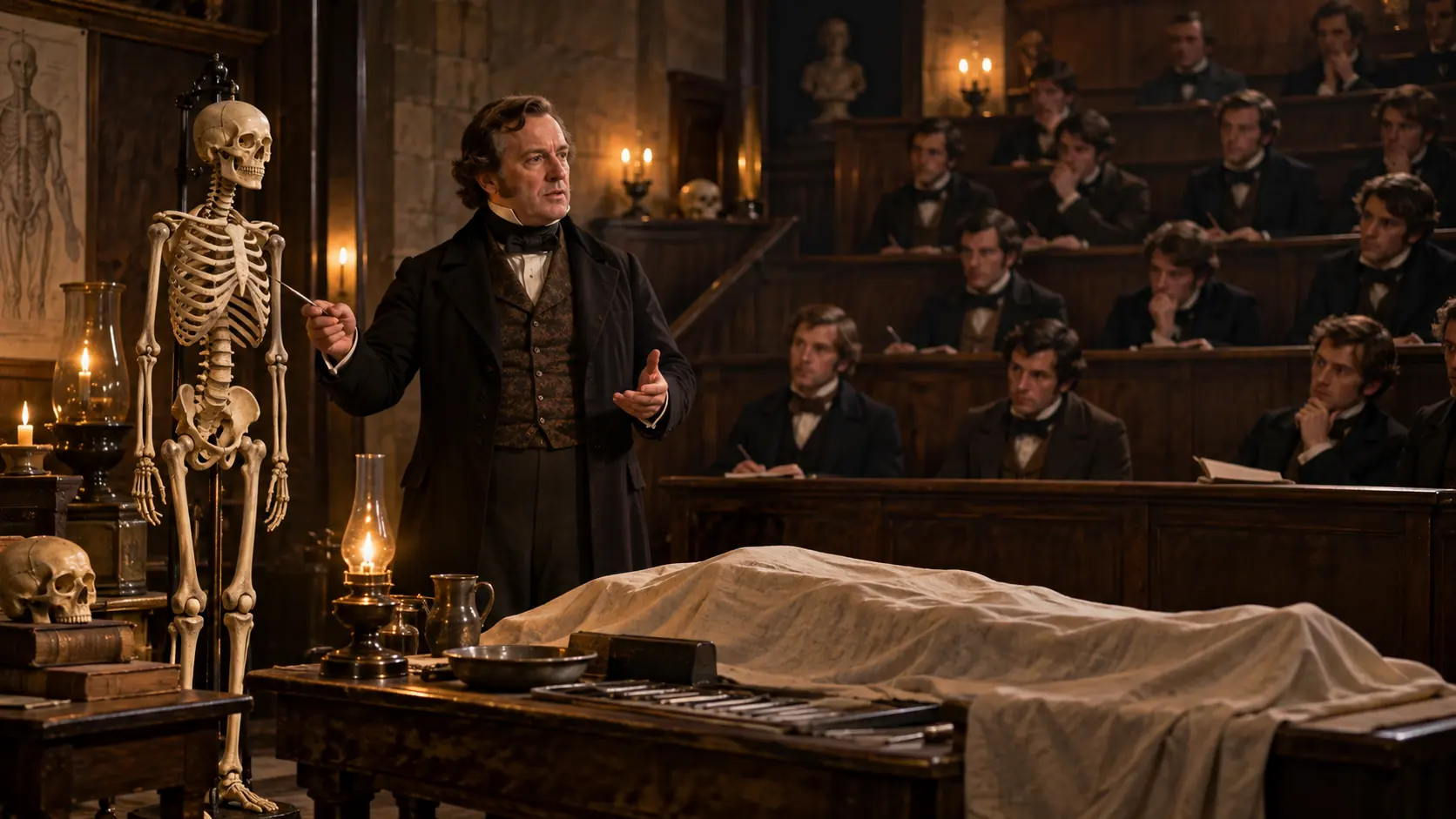
Dr. Robert Knox was one of Edinburgh’s most successful anatomy teachers when William Burke and William Hare began delivering bodies to his school in 1827 and 1828. The bodies included people the pair had murdered for money. Knox was never charged with taking part in the killings, and no evidence proved that he knew the bodies were murder victims.
That does not mean the story ends with a simple declaration of innocence. An 1829 committee found no evidence that Knox or his assistants knew about the murders, but it also criticized the loose way his school bought bodies and the lack of questions asked about where they came from. Knox escaped criminal prosecution, but the scandal damaged his reputation and followed him for the rest of his life.
Who Was Dr. Robert Knox?
Robert Knox was born in Edinburgh in 1791 and graduated from the University of Edinburgh with a medical degree in 1814. He later served as an army surgeon and spent several years in South Africa before returning to Edinburgh, where he built a career in anatomy, teaching, and museum work.
By the late 1820s, Knox was not an obscure doctor working in a back room. He was one of the city’s star anatomy lecturers. The Royal College of Surgeons of Edinburgh records that just over 500 students enrolled in his private anatomy class during the 1827-28 academic year.
His classes were popular because Knox emphasized practical dissection. Students expected to see the human body opened, examined, and completely dissected. That made bodies essential teaching material, and a school with hundreds of students needed a steady supply.
Why Did Knox’s School Need So Many Bodies?
The problem was not unique to Knox. British anatomy schools had more students than the legal supply of bodies could support. The bodies of some executed murderers could be used for dissection, but there were nowhere near enough of them for the growing medical schools.
That shortage created a black market. Professional resurrectionists stole recently buried bodies and sold them to anatomy teachers. Knox’s school was part of that larger system. The Royal Society of Edinburgh notes that Knox’s teaching program may have required as many as 90 cadavers in a year.
The shortage explains why anatomists bought bodies from questionable suppliers. It does not excuse murder, but it explains why Burke and Hare found a ready market when they discovered that a fresh corpse could be turned into cash.
How Did Burke and Hare Become Suppliers to Knox?
The first body Burke and Hare sold was not a murder victim. A lodger named Donald died naturally while owing Hare rent. Burke and Hare removed the body from its coffin and took it to the anatomy market instead of allowing it to be buried.
They eventually reached Knox’s school and were paid for the body. After that first sale, they realized that bodies were valuable. Rather than wait for another natural death or dig up graves, they began killing people and selling the bodies to the same school.
One detail is less settled than many modern retellings make it sound: exactly how much personal contact Knox had with Burke and Hare. A modern Royal College of Surgeons biography says Knox never met either man. However, the 1829 West Port Murders volume preserves testimony and confessions that place Knox in the rooms during some transactions. The safest conclusion is that the bodies went to Knox’s school, while the surviving accounts dispute the exact amount of direct contact between Knox and the killers.
Did Dr. Robert Knox Know the Bodies Were Murder Victims?
This is the central question, and the historical record does not support a confident claim that Knox knew Burke and Hare were murdering people.
Burke’s confession said that Knox and his assistants did not express suspicion and that the killers used stories meant to make the bodies appear lawfully obtained. Modern institutional histories from the University of Edinburgh and the Royal College of Surgeons also state that Knox was never proved to have known the true source of the bodies.
But people remained suspicious for obvious reasons. The bodies were unusually fresh, some showed no signs of long illness, and Knox’s school kept buying from the same suppliers. The issue was not just what Knox knew. It was how hard he tried to find out.
What Did the 1829 Inquiry Find?
Under intense public pressure, Knox asked for a committee to investigate the accusations against him. The committee reviewed evidence and published its findings in March 1829.
Its conclusion was more complicated than a simple clearing of Knox. The committee said it had found no evidence that Knox or his assistants knew murder had been committed to obtain the bodies. It also found no proof that Knox personally suspected murder before Burke and Hare were caught.
Then came the criticism. The committee said Knox had acted carelessly. It objected to the loose system in which assistants and a doorkeeper could receive bodies, and suppliers were not closely questioned about where those bodies came from. The report concluded that those lax rules unintentionally made it easier for Burke and Hare to dispose of their victims.
In plain English: the committee did not find Knox to be a participant in murder, but it did find serious problems in the way his school bought bodies.
Why Was Dr. Knox Never Prosecuted?
Public suspicion is not the same as evidence that can support a criminal charge. Burke and Hare were the men who carried out the murders. William Hare gave evidence against Burke, and Burke was convicted and executed. Knox was never charged with participating in the killings.
The surviving records did not establish that Knox ordered murders, knew murders were being committed, or agreed with Burke and Hare to produce bodies by killing people. Without evidence of that kind, outrage alone was not enough to make him one of the murder defendants.
That legal result did not satisfy much of Edinburgh. To many people, the man who paid for the bodies seemed inseparable from the system that made the murders profitable.
How Did Edinburgh React to Knox?
The public reaction was fierce. People mocked Knox in songs, pamphlets, and caricatures. In February 1829, a crowd carried an effigy of him through Edinburgh, hanged it from a tree, and tore it apart. His house was attacked, and its windows were smashed.
Even respected figures were wary of being seen as defending him. Records highlighted by the Royal Society of Edinburgh show that Sir Walter Scott refused to join Knox’s investigating committee because he feared it would look like an attempt to whitewash a deeply suspicious case.
The public did not need a courtroom conviction to reach its own verdict. Knox’s name had become permanently attached to Burke and Hare.
What Happened to Knox’s Career?
The scandal did not destroy Knox’s teaching career overnight. The Royal College of Surgeons says his students initially remained loyal and his classes continued. But his professional position weakened over time.
In July 1831, Knox resigned as conservator of the Royal College of Surgeons museum. His anatomy classes gradually became smaller, and attempts to secure other academic positions failed. In 1842, he left Edinburgh for London.
Knox continued to lecture, write, and practice medicine. In 1856, he became a pathologist at the institution now known as the Royal Marsden Hospital. He died in 1862.
So the common image of Knox instantly disappearing in disgrace is too simple. His career continued, but the Burke and Hare scandal changed its direction and remained the part of his life most people remembered.
Was Knox Guilty, Innocent, or Something in Between?
The evidence supports a careful answer.
There is no proven evidence that Dr. Robert Knox knew Burke and Hare were murdering people for his anatomy school. He was not prosecuted, Burke’s confession denied that the doctors knew, and the 1829 committee said it found no evidence of knowledge or complicity.
At the same time, the committee criticized the way Knox’s school accepted bodies. The system relied on asking few questions of people working in an illegal, secretive trade. That made it easier for murdered bodies to enter the dissecting room without anyone stopping the supply chain.
Calling Knox a murderer goes beyond the evidence. Calling the entire arrangement blameless ignores what the inquiry itself found. The uncomfortable historical answer sits between those two extremes.
The Short Version
Dr Robert Knox was a prominent Edinburgh anatomist whose school bought the bodies supplied by William Burke and William Hare. The pair murdered at least 16 people and sold the bodies for dissection.
Knox was never charged with taking part in the murders, and no evidence proved that he knew where the bodies really came from. An 1829 committee largely cleared him of knowledge or complicity but criticized his school’s loose body-buying system and its failure to ask enough questions.
The law did not convict Knox, but Edinburgh’s public opinion did. His house was attacked, his reputation was shattered, and his career declined. He continued working for decades, yet his name is still remembered mainly because of the bodies Burke and Hare brought to his anatomy school.
We hope you enjoyed our little trip down the rabbit hole.
We’ll keep digging, and you keep reading.
Keep digging into more Body Snatching & Resurrectionists stories.
Sources and Further Reading
- University of Edinburgh – Dr Robert Knox (1791-1862)
- Royal College of Surgeons of Edinburgh – Robert Knox
- Royal Society of Edinburgh – When Science Met Scandal: Dr Robert Knox and the Burke and Hare Murders
- Project Gutenberg – The History of Burke and Hare (George MacGregor, 1884)
- Project Gutenberg – West Port Murders (1829)