
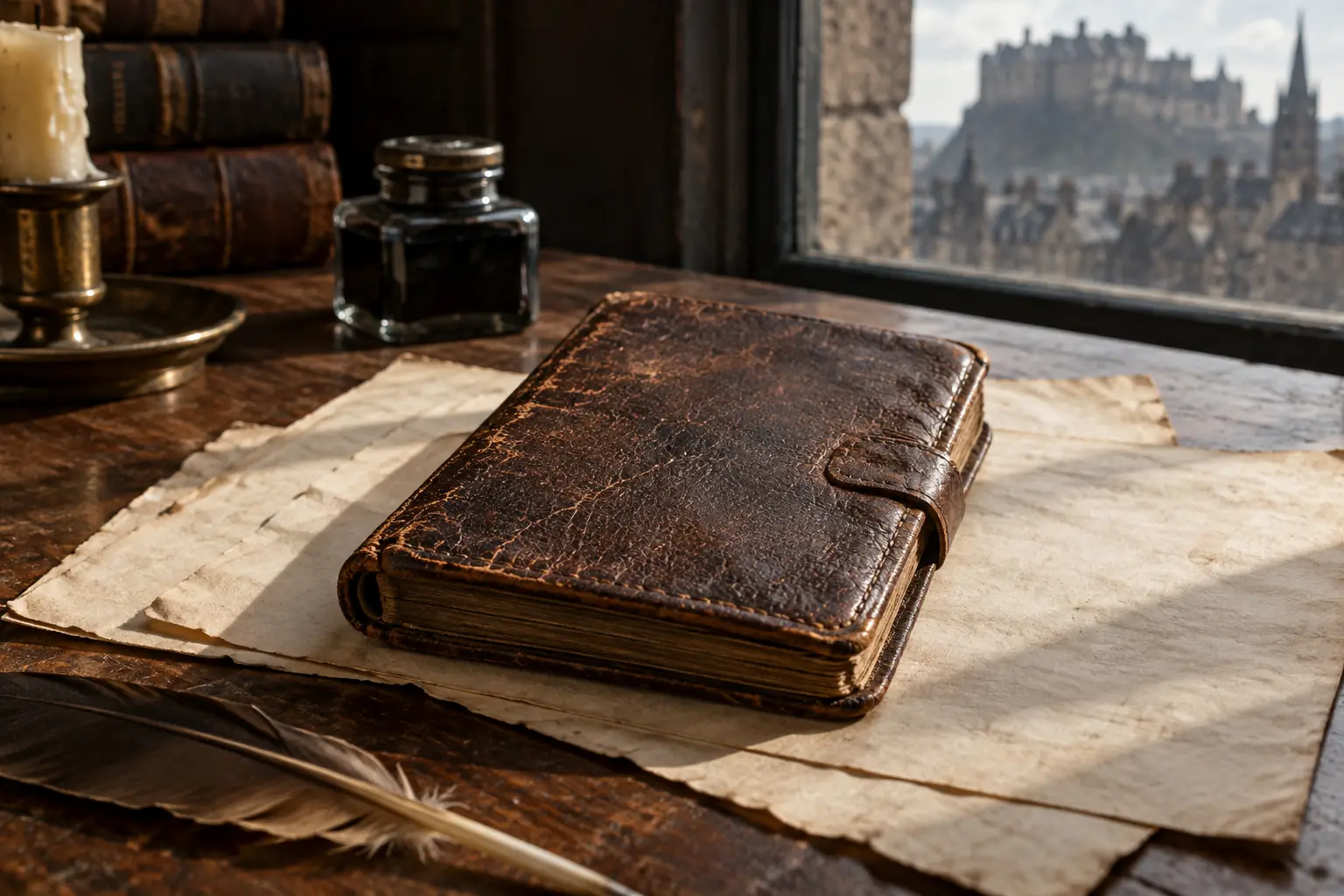
The object known as the William Burke skin book is not just an internet legend. A small pocketbook bearing his name is displayed at Surgeons’ Hall Museums in Edinburgh, Scotland. The museum describes it as an object said to be made from his skin after his execution in 1829. The pocketbook is real. Whether its leather can be traced to Burke himself is a more difficult question.
The story connects the Burke and Hare murders, the punishment Burke received, and a disturbing trade in keepsakes made from human remains. The surviving object tells part of that story. The evidence does not answer every question.
What Is William Burke’s Skin Book?
It is a small pocketbook, not a novel or a book written by Burke. Its cover is stamped with the words ‘BURKE’S SKIN POCKET BOOK.’ Another inscription reads ‘EXECUTED 28 JAN 1829.’ The date matches the day Burke was hanged in Edinburgh.
The name on the cover tells us what the object was claimed to be. It does not, by itself, prove where the leather came from. The museum’s current gallery description uses the careful phrase ‘said to be made from Burke’s skin.’
How Did Burke’s Skin Become Part of the Story?
William Burke and William Hare murdered people in Edinburgh and sold their bodies for medical dissection. The buyers were connected to anatomy teacher Dr. Robert Knox. Unlike ordinary resurrectionists, who stole people who were already dead from their graves, Burke and Hare supplied bodies by killing their victims.
The same danger surfaced again in 1831, when the London Burkers tried to sell a murder victim’s body for dissection.
After Hare gave evidence against Burke, Burke was convicted of murder. He was hanged on January 28, 1829. His body was then dissected by Professor Alexander Monro, known as Monro tertius, at the University of Edinburgh. At that time, dissection could also serve as a further punishment for a convicted murderer.
A history published by Surgeons’ Hall Museums says that objects sold as being made from Burke’s skin appeared in Edinburgh after his death. Books and wallets were among the reported souvenirs. The skin pocketbook became the best-known example.
There is a sharp irony in that history. Burke had earned money by delivering other people’s bodies for dissection. After his execution, parts of his own remains were treated as objects to study and collect.
What Does the Pocketbook Actually Look Like?
The surviving item looks like a small, dark brown leather pocketbook. Its most unusual feature is not its shape but its gold-stamped label. Without that wording, a visitor might mistake it for an ordinary old leather accessory.
It is sometimes called a skin book or notebook, but it should not be confused with Burke’s memoirs or a written account of his crimes. The date on its cover records his execution. It does not tell us exactly when the pocketbook was made.
Has Anyone Proved the Book Is Made From Human Skin?
The practice of binding books in human skin has a name: anthropodermic bibliopegy. It sounds like something invented for a horror story, but some human skin books have been confirmed through scientific testing.
Researchers can test tiny samples of old leather using a method called peptide mass fingerprinting. It looks at proteins and can help identify whether a binding came from a human or another animal. Such tests have also shown that some books long described as human-skin bindings were actually covered in animal leather.
The evidence for Burke’s pocketbook needs careful wording. In a 2015 interview, medical historian Lindsey Fitzharris said the object had been tested and identified as human skin. A 2020 review, however, described it as still awaiting peptide mass fingerprinting, a particular modern method for identifying the species of leather. These statements could refer to different tests rather than contradict each other. The museum’s current description remains cautious.
Most importantly, even proof that a cover is human skin would not, by itself, prove it came from William Burke. That would also require reliable evidence linking the material to him. For this article, the safest conclusion is that the museum object and its historical claim are real, while the exact origin of the leather is not clearly established by the publicly available records reviewed here.
Who Made Burke’s Skin Pocketbook?
The museum history describes the sale of souvenirs after Burke’s dissection, but it does not identify the person who made the surviving pocketbook. Nor does the cover reveal where the leather was prepared.
It is tempting to imagine a medical student taking some skin and turning it into a keepsake. That might make a vivid story, but without a reliable record it remains a guess. We can describe the object and the reported souvenir trade without inventing a maker or a complete chain of ownership.
Where Can You See William Burke’s Skin Book?
The pocketbook is part of the collections displayed at Surgeons’ Hall Museums in Edinburgh. The museum also shows Burke’s death mask, a cast of his face taken after his execution.
His skeleton is held somewhere else: the University of Edinburgh’s Anatomical Museum. The two museums are separate institutions. For more about the people who supplied anatomy schools, our article on resurrectionists explains the wider body trade.
Were Other Books Really Bound in Human Skin?
Yes. Human skin bookbinding is documented, although it was unusual. The Anthropodermic Book Project has tested alleged examples and found both genuine human-skin bindings and objects made from other kinds of leather.
One useful warning comes from Harvard Law School Library. A book once believed to be bound in human skin was tested and found to have a sheepskin binding. A handwritten claim or an old label was not enough to settle the matter.
That is why William Burke’s skin book deserves both attention and care. A striking story becomes more trustworthy when the parts that can be checked are kept separate from the parts that remain uncertain.
The Short Version
The story is grounded in a real object. Surgeons’ Hall Museum displays a pocketbook marked as Burke’s skin and dated to his 1829 execution. Burke was hanged and publicly dissected, and the museum reports that skin-related souvenirs appeared afterward.
What is less certain is the full history of this particular pocketbook. The museum’s current description says it is ‘said to be’ made from Burke’s skin, and the public accounts of testing are not fully consistent. Its existence is not in doubt. Its exact material history deserves a more cautious answer.
We hope you enjoyed our little trip down the rabbit hole.
We’ll keep digging, and you keep reading.

Keep digging into more Body Snatching & Resurrectionists stories.
Sources and Further Reading
- Surgeons’ Hall Museums, History of Surgery Gallery
- Surgeons’ Hall Museums, Edinburgh’s Dark History: Burke and Hare (2016)
- The People Who Became Book Bindings, UCL Researchers in Museums (2016)
- The Anthropodermic Book Project
- Let’s Talk About Binding Books with Human Skin, interview with Lindsey Fitzharris (2015)
- The Hide That Binds, Mike Jay, The New York Review of Books (2020)
- Harvard Law School Library, Revisiting the Human Skin Book (2024)
- University of Edinburgh, Visit Our Anatomical Museum
- West Port Murders (1829), digitized by Wellcome Collection, Public Domain Mark