
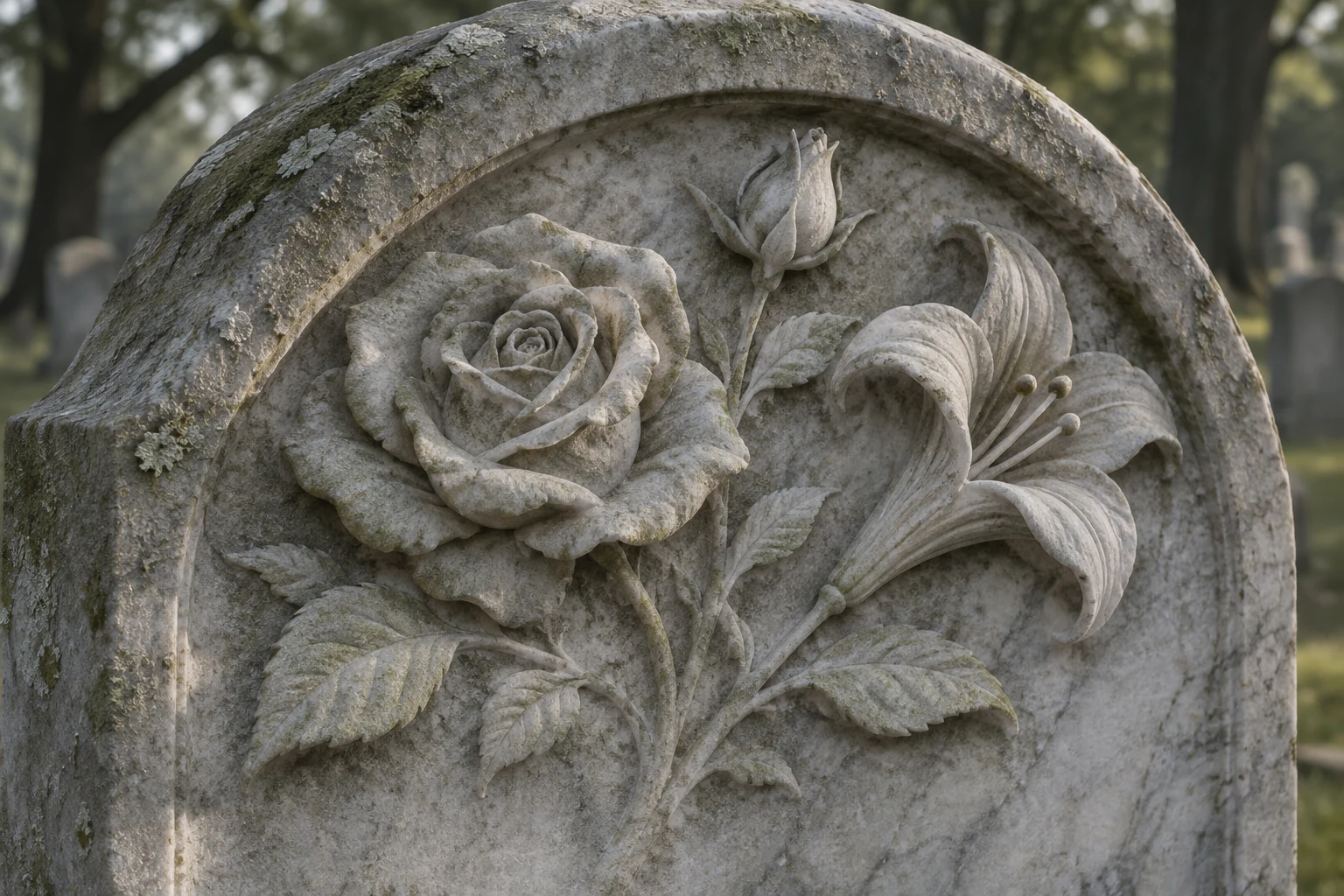
Flowers carved on gravestones often express love, remembrance, innocence, or the brevity of life. Roses, lilies, unopened buds, and broken stems give those ideas different shapes. Their meaning becomes clearer when you read the flower together with the name, dates, and other details of the memorial.
There is something quietly strange about a flower made to outlast a person. Its petals never fall. Its bud never opens. A carver has stopped a small piece of nature at exactly the moment someone wanted to preserve. Sometimes, the most revealing detail is the part that was never allowed to grow.
The Child Holding a Lily
At Worden-Sweet Cemetery in the town of Scriba, New York, Cora L. Sweet’s memorial gives a flower a human setting.
The Smithsonian’s sculpture inventory describes a marble child standing against a rock. She is barefoot, with shoulder-length hair and a knee-length dress. A bow rests at the back of the dress. Her right hand extends outward; her left holds the stem of a lily.
The base names Cora as the daughter of H. H. and M. E. Sweet and records the years 1893–1905. The monument also carries the name A. Salladin & Sons of Oswego, bringing the people who made it into the record.
Those details change the way the flower reads. It belongs to a scene built around a child’s name, a child’s clothes, and a child’s bare feet. The lily is held in a small hand.
A glossary might give you one word for that flower. The memorial gives you Cora.
Roses, Lilies, and Unopened Buds
Start with the shape. Look at the petals, the stem, and whether the bloom is open or closed. These features can tell you more than the simple observation that a stone has flowers on it.
Roses: Love and a Life in Bloom
A rose on a gravestone may have overlapping layers of petals or a small, tightly gathered bud. The Rutherford B. Hayes Presidential Library & Museums connects roses in Victorian cemetery art with love and beauty. Its guide associates full blooms with adults and rosebuds with children.
The comparison is easy to feel: a bud holds the promise of something still to come. On a child’s memorial, that familiar garden image can make an unfinished life painfully visible. Read the recorded age for the person’s actual years; the flower offers a way of picturing them.
Roses also had religious associations. The Church Monuments Society connects them with the Virgin Mary and Paradise. A nearby cross or religious verse can help place a rose within that tradition.
Lilies: Innocence and the Hope of Renewal
A lily on a gravestone can bring Christian ideas of purity, innocence, and resurrection into the design. The Church Monuments Society records those associations, including the flower’s connection with the Virgin Mary.
Pay attention to which form you see. A large, open lily and a spray of small, hanging lily-of-the-valley bells are visually different. The Society lists lily of the valley separately, with an association of rebirth. A careful description keeps two different flowers from becoming one vague label.
The Break Was Part of the Design
Some carved flowers seem to have suffered a small disaster. A stem bends sharply, breaks, or lets its blossom droop. On an otherwise intact panel, the damage belongs to the pictured plant.
Writing for the Association for Gravestone Studies, Jessie Lie Farber identifies the broken flower as a readily understandable image of a life cut short. The Hayes museum’s guide also places the broken-stemmed rosebud among designs associated with a child’s death.
The difference between a bud and a broken bud matters. One shows growth waiting to happen. The other adds an interruption. You can understand the loss before you have read a single date.
Then the inscription gives that image its particular setting. The carving expresses loss; a death record or contemporary account is where you would look for its cause.
Look closely at the break itself, too. A snapped stem deliberately shaped within the relief is different from a crack running through the slab. Time can damage a monument that already contains an image of something broken.
A Flower Dictionary—with Missing Colors
The Victorian interest in floral meanings left us actual books to consult. The Metropolitan Museum of Art dates Kate Greenaway’s Language of Flowers to 1884. Its text, available through Project Gutenberg, makes an intriguing companion to a cemetery visit.
Greenaway gives the rose a broad association with love, then divides roses by variety, condition, and color. A white rosebud refers to girlhood. A yellow rose carries associations of fading love and jealousy. Even lilies change their message with their color.
Now picture a rose cut into plain gray stone. The color information has disappeared—or may never have been supplied. Matching that carving to a colored-flower entry would require adding a detail the object does not give you.
The book shows how many meanings people could attach to flowers. A particular family might have drawn on religious imagery, familiar memorial designs, personal taste, or several influences at once. The interesting question is which clues survive on this stone.
Two Stones, One Familiar Pattern
A National Park Service photograph from Mammoth Cave shows two France family markers with matching floral panels near their upper corners. Each also has a central letter F within a wreath-like design. The shared decoration is visible before you begin reading the separate inscriptions.
That repetition is worth noticing. A flower can be part of a design used more than once and still accompany an individual name. Familiar forms gave memorial makers a way to create something recognizable, while the lettering made each stone particular.
Compare nearby markers when you can. A flower that first seems unique may turn out to have several close neighbors.
The Garden That Stays
On your next cemetery walk, give a carved flower a few extra seconds. Follow its stem. Notice the unopened bud, the drooping head, or the hand holding it. Then read the name and the words around it.
Our guide to cemetery symbols explores how those details work together. With flowers, even a small change in the carving can shift your attention from beauty to growth, from growth to interruption, or from grief to hope.
Cora Sweet’s lily brings that attention back to a person. Elsewhere, a rosebud may do the same with only a few inches of carved marble. The stone has managed a strange reversal: it has made one of the most fragile things in a garden into something that can last for generations.
We hope you enjoyed our little trip down the rabbit hole.
We’ll keep digging, and you keep reading.

Keep digging into more Gravestone Symbols and Epitaphs stories.
Sources and Further Reading
- Smithsonian American Art Museum, Art Inventories Catalog: Cora L. Sweet Monument, survey record IAS NY001642
- Rutherford B. Hayes Presidential Library & Museums: Victorian Cemeteries
- Church Monuments Society: Symbolism on Monuments
- Association for Gravestone Studies, Jessie Lie Farber: Symbolism on Gravestones
- The Metropolitan Museum of Art: Kate Greenaway’s Language of Flowers, 1884
- Kate Greenaway: Language of Flowers, full text at Project Gutenberg
- National Park Service: Echoes Written in Stone, including the France family markers photographed by Jessica Cooper