
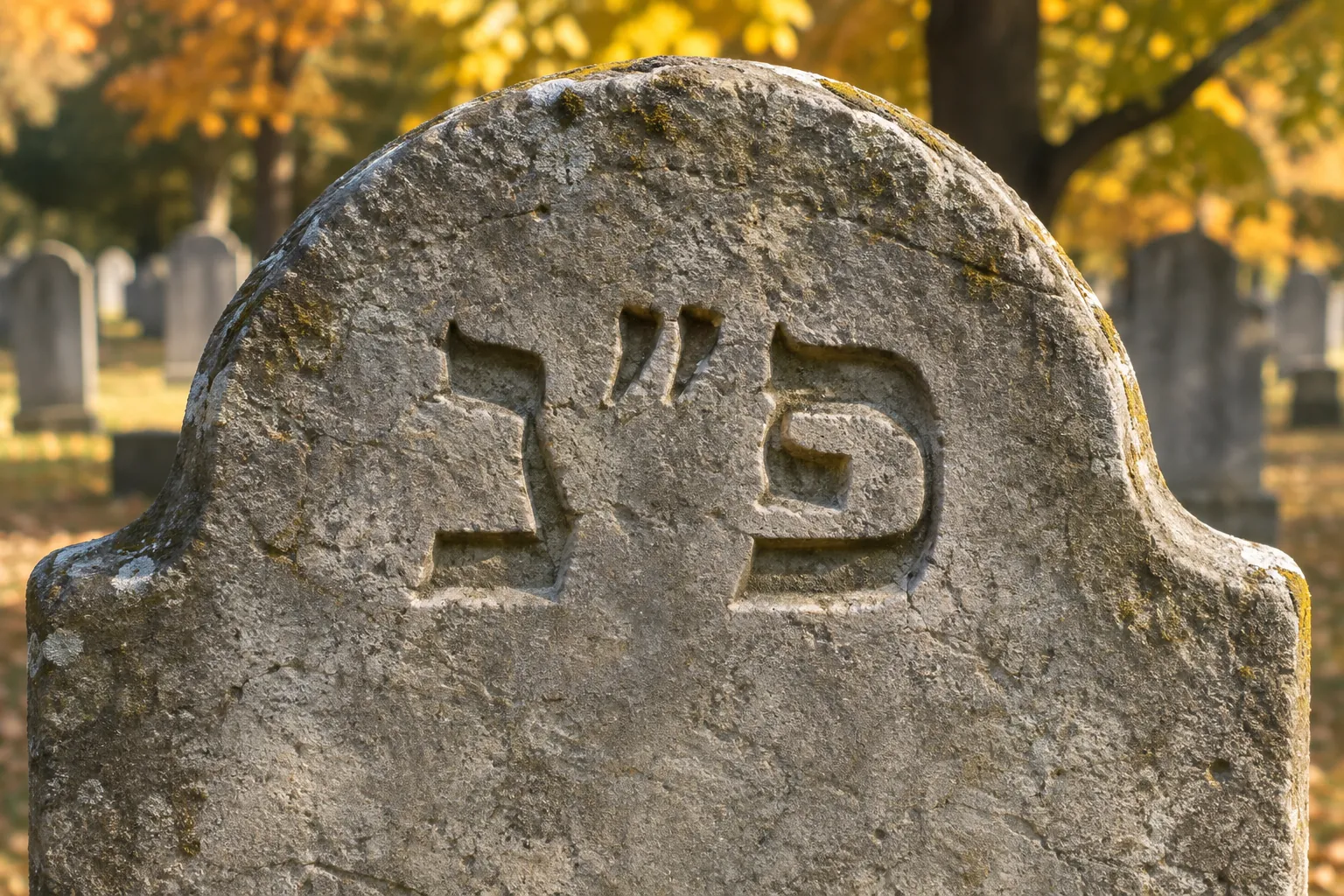
A gravestone can hold a family connection in two letters you almost walked past. Jewish gravestone inscriptions often record a person’s name, a relationship, and a date, framed by familiar Hebrew phrases. Recognizing those parts gives you a way into the inscription, even before you can translate the whole thing.
That matters because an unfamiliar alphabet can make a very personal message look unreachable. Start with a few recurring features, then follow one documented stone. Behind the lettering is someone who had a name, a family, and a place in other people’s lives.
Find the Opening, the Name, and the Closing
Hebrew reads from right to left. JewishGen’s tombstone guide identifies several useful landmarks in Hebrew gravestone inscriptions:
- פ״נ: an opening abbreviation commonly understood as “here lies.” You may see it near the top.
- בן: ben, meaning “son of.” The following name can identify the person’s father.
- בת: bat, meaning “daughter of.” This can preserve the same kind of family connection.
- תנצב״ה: a common closing abbreviation expressing the wish that the person’s soul be bound in the bond of life. Its biblical source is 1 Samuel 25:29.
These are landmarks, not a fixed template. Names, languages, and the amount of personal detail vary across communities and periods.
Among Hebrew gravestone abbreviations, ב״ר often introduces a parent’s name. JewishGen explains that reb is an honorific comparable to “Mr.” Seeing it does not, by itself, make the person a rabbi.
One Stone, Two Generations
At Solotvin Cemetery in present-day Ukraine, a sandstone memorial remembers Hindi Haya, daughter of Zvi. The Jewish Galicia & Bukovina project publishes its Hebrew transcription and English translation, crediting researcher Boris Khaimovich.
Three short pieces show how much a compact inscription can carry. These excerpts follow the project’s transcription:
- הינדי חייה: the woman’s name, rendered in the catalog as Hindi Haya.
- בת מ צבי זל: the relationship line. The catalog identifies her as the daughter of Mr. Zvi and adds a remembrance formula for him.
- כא שבט תרנז: the date portion, read in the catalog as 21 Shvat 5657.
The first name belongs to the woman being remembered. The second belongs to her father. If you copied only her name and the year, you would leave a generation behind.
There is no need to invent what their home was like or what they said to each other. The connection itself survived. A few letters still introduce a daughter through her father more than a century later.
When Letters Become a Date
Hebrew letters also have numerical values. In the date above, כ is 20 and א is 1, giving the day 21. The month is Shvat, also spelled Shevat.
The year letters are ת, ר, נ, and ז: 400 + 200 + 50 + 7 = 657. Hebrew dates commonly leave out the thousands. In this inscription’s documented setting, the year is 5657, not 657 CE.
Hebcal’s converter places 21 Shvat 5657 on Sunday, January 24, 1897. That agrees with the memorial catalog’s year of 1897. This is a conversion of the recorded Hebrew date; the stone does not supply a modern clock time.
Three details are worth keeping together when you check another inscription:
- The complete day, month, and year. A year alone cannot give you the exact civil date.
- The calendar’s evening boundary. A Hebrew day begins at sunset, so a death after sunset but before midnight belongs to the next Hebrew date.
- The month designation. Hebrew leap years have Adar I and Adar II. Copying only “Adar” can lose information needed for a conversion.
For this example, the Hebrew day began at sunset on January 23. That is why a difference of one civil day deserves a closer look before you call either record wrong. Use the complete inscription and a date converter, rather than adding or subtracting one fixed number from the year.
Read the Carving Beside the Words
Jewish gravestone symbols can add another clue to the inscription. Chabad’s guide explains three recurring motifs:
- Two raised hands with the fingers divided into groups represent the priestly blessing and are associated with a kohen, a member of the hereditary priestly line.
- A pitcher is associated with Levites and their role in washing the priests’ hands before the blessing.
- Candlesticks or a candelabrum often appear on women’s graves, recalling the lighting of Shabbat and holiday candles.
Those raised hands belong to a different visual language from the farewell gesture explored in our guide to clasped hands on gravestones. Look at the position of the fingers before deciding what two carved hands mean.
A symbol can point you toward a tradition or family identity. The words help you see how that clue fits this particular person. Neither needs to carry the whole story alone.
Make a Reading Someone Else Can Check
Begin with a photograph of the whole marker and a clear view of the lettering. Keep the cemetery name and plot details with it. When you copy the inscription, preserve its line breaks and mark the letters you cannot make out.
That last step is useful, not embarrassing. A visible gap tells the next reader where the problem is. A guessed letter can send the entire search toward the wrong name or year.
For a personal family search, take the full image and your tentative reading to someone experienced with Hebrew epitaphs. Ask them to separate the person’s name, relatives, honorifics, date, and closing formula. Fluent everyday Hebrew helps, but older abbreviations and names may call for someone familiar with that community’s inscriptions.
Then compare the reading with cemetery records and other family documents. On a bilingual stone, work through both inscriptions rather than assuming one repeats every detail of the other. Let each version contribute what it actually says.
The same habit helps with Latin gravestone inscriptions: separate the name, relationship, date, and prayer before deciding what the whole memorial says.
The Detail That Brings Someone Closer
You do not have to solve every line on your first visit. Find the name. Notice the relationship. Keep the date intact. Suddenly the stone offers more than a shape in a row.
Hindi Haya’s memorial gives us a small but lasting introduction: a woman, her father, and a day her community recorded. The next time unfamiliar lettering makes you pause, give it another moment. The detail you nearly passed may be the one that makes a person come into focus.
We hope you enjoyed our little trip down the rabbit hole.
We’ll keep digging, and you keep reading.

Keep digging into more Gravestone Symbols and Epitaphs stories.
Sources and Further Reading
- JewishGen: Reading Hebrew Tombstones
- Jewish Galicia & Bukovina: Tombstone of Hindi Haya, Daughter of Zvi
- Hebcal: Numerical Values of Hebrew Letters
- Hebcal: 21 Shvat 5657 / January 24, 1897
- Hebcal: Hebrew Dates and the After-Sunset Setting
- Chabad: The Jewish Calendar Year
- Chabad: Jewish Symbols and Their Meanings