
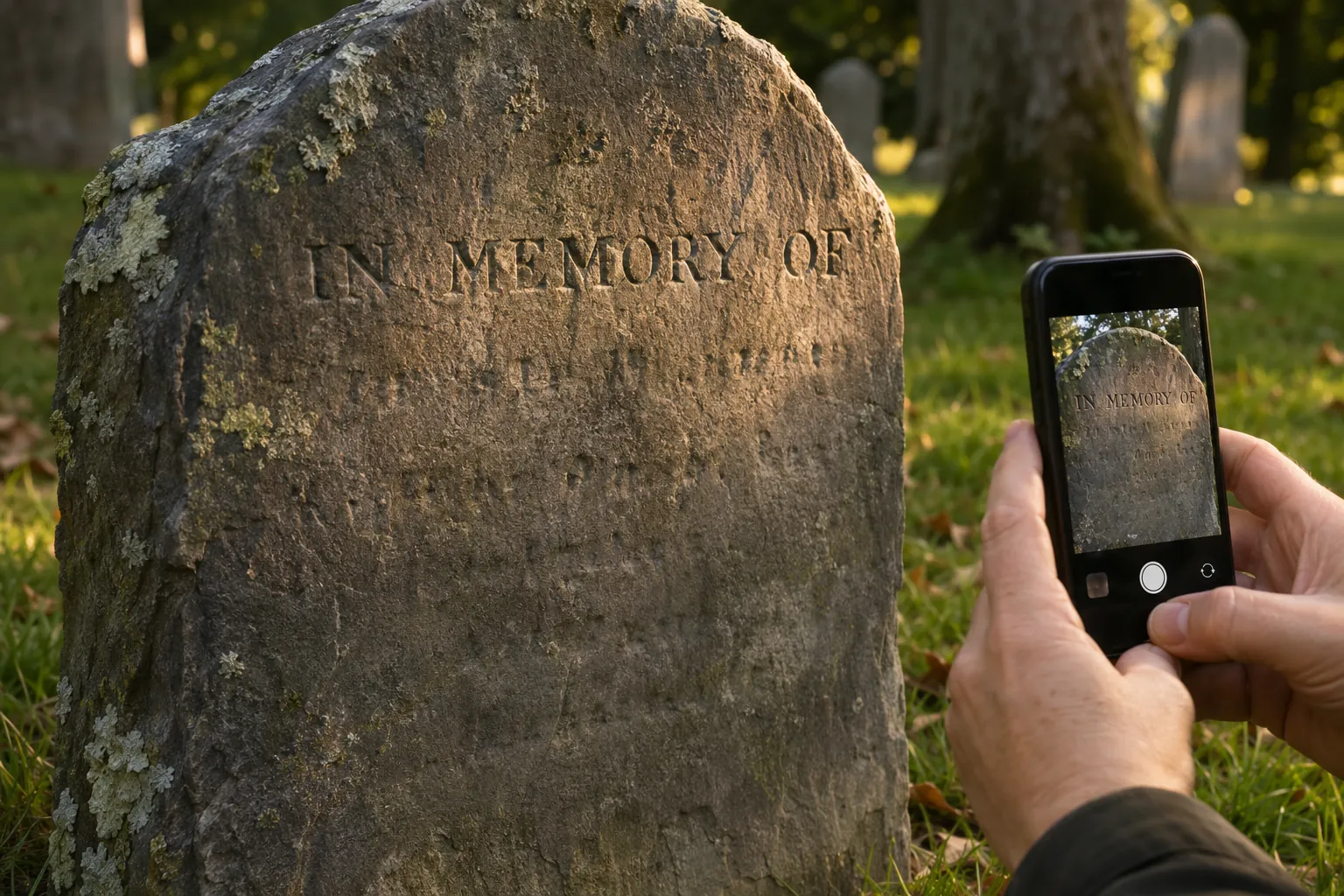
A name has almost disappeared. One letter might be an A. The date might end in a 3. Learning how to read old gravestones starts with a simple sequence: photograph the memorial, copy the visible lettering, mark the gaps, and compare your reading with older records. Sometimes the most useful clue is waiting in a transcript made decades before you arrived.
There is a particular satisfaction in getting past the unfamiliar lettering and finding a relationship: someone’s wife, someone’s daughter, someone who outlived a spouse. The stone stops being anonymous. The trick is to follow those clues without letting a good story supply the missing letters.
Start With the Light and the Whole Stone
Take a photograph of the complete marker, then closer photographs of the inscription. Include a wider view that helps you locate it again. The National Park Service recommends both overall and detail photographs, with a log recording when, where, and by whom the pictures were taken.
Before concentrating on a stubborn word, look around the memorial. Text may continue on another face or on its base. A close photograph of one name can leave the relationship to another name outside the frame.
For weathered lettering, change the light. Sunlight arriving from the side can cast shadows inside shallow cuts that nearly disappear under flatter illumination. The Park Service describes using a reflector to direct light across a surface. Keep the reflector clear of the stone and photograph the result. You can also return when the sun reaches it from a better angle.
A camera and better light make a useful starting kit. Leave the surface as you found it.
Copy What Is There Before Explaining It
The Discovering England’s Burial Spaces recording guide advises copying inscriptions line by line, retaining their capitals, punctuation, abbreviations, and apparent spelling mistakes. Put your interpretation in a separate note.
That separation pays off later. “What I could read” and “what I think it means” are different records. If you combine them at the start, someone returning to your notes may have no way to tell which letters came from the stone.
Even famous epitaphs can change between a memorial and a retelling, as the inscriptions associated with Shakespeare, Keats, and Ben Jonson show.
Give your photographs useful filenames and keep them with the transcript. Record the cemetery, the marker’s position or plot reference, and the date of your visit. Tomorrow’s reader may be you, trying to remember which of several similar stones you photographed.
Why Familiar English Looks Strange
Some apparent damage is unfamiliar lettering. Jessie Lie Farber’s introduction to the American Antiquarian Society’s gravestone collection explains several forms found on early American markers:
- The long s, shown here as ſ, can resemble an f. A word such as “bleſſed” reads as “blessed.”
- V can appear where a modern reader expects U, and I where J is expected.
- Joined letters, called ligatures, can make two characters look like one.
- Older spellings such as “dyed” for “died” and “lyes” for “lies” may be exactly what the carver intended.
Compare a troublesome shape with clearer letters elsewhere on the same memorial. Once you recognize one long s, another may become obvious. Knowing the pattern gives your eye something to look for.
Gravestone abbreviations need the surrounding words too. The burial-spaces guide identifies “ye” as “the” and “Aet” as a shortened form relating to age; dates may use forms such as “Decr.” Keep the original form in your transcript. For phrases in another language, our guide to Latin gravestone inscriptions explains recurring formulas and their meanings.
Relict and Consort Bring the Relationships Back
What does relict mean on a tombstone? In this setting it identifies a surviving spouse, commonly a widow. Merriam-Webster gives “widow” as a definition; the burial-spaces guide uses the broader surviving-spouse sense.
Tonbridge Historical Society’s record of Sarah Annesley’s memorial calls her the relict of Arthur Annesley. Read that unfamiliar word, and you have learned something about their lives: she survived him. The society places the inscription on a church-floor memorial that is no longer visible. The recorded words still make that introduction possible.
Consort means spouse. Farber notes its use for wives on early American gravestones. Treat it first as a relationship, then use dates and other records to establish who died first.
These terms can sound stiff until you put ordinary people back into them. A widow had once been part of a couple. A name followed by “daughter of” belongs to a family. A few inches of lettering can change what you notice about the person being remembered.
A Worked Reading With the Gaps Left In
Here is a made-up practice example, not a transcription of an actual grave. Suppose your photograph clearly shows most of a name and year, but one letter and one digit remain unreadable:
- MARY H[?]LL
- DIED 18[?]3
For this example, each [?] means one unreadable character. You can record MARY, the visible H and LL, and the surviving digits. You cannot yet choose HALL or HILL, or turn the date into 1843. Write possible readings separately and say why you are considering them.
If an older photograph clearly supplies the A, record that finding with the photograph’s source and date. Keep your present-day reading too. Together, the records show both the name and how you recovered it.
Explain whichever notation you use. A gap of unknown length needs a note such as [illegible; length unknown]. Brackets are useful only when the next reader knows what you put inside them.
Find an Earlier Pair of Eyes
A real example appears in Tonbridge’s record for Rebecca Austen. Its transcription includes “wife of WILLIAM AUSTEN Surgeon [ ] Daughter of Sir George Hampson Bart.” The empty brackets are already in the published record. Copy them as found; filling them with a plausible connecting word would disguise the gap.
The same entry names Rebecca and William’s daughter, Hampson Austen, and records her birth in 1728 and death in 1730. Even with a gap in one line, the record preserves a family relationship and a child’s short life.
Look for earlier photographs and memorial-inscription surveys through the cemetery, local archives, historical societies, and family-history collections. Keep the survey date and the identity of the recorder with anything you copy. Tonbridge’s compilation includes work from 1970–71 alongside records of five stones listed in 1796 and subsequently lost.
If two readings disagree, put the disputed letters or numbers side by side. A photograph may let you examine the strokes; a transcript tells you what someone else recorded. A burial register may help identify the person, while still leaving the exact carved wording unresolved.
Leave the Next Reader Something Useful
You may finish with a name, a relationship, and half a date. Keep them. A later photograph, another record, or another pair of eyes may answer the remaining question.
The reward is more than solving old lettering. Someone once chose which details should survive them. Your careful reading gives those details another chance to be noticed.
We hope you enjoyed our little trip down the rabbit hole.
We’ll keep digging, and you keep reading.

Keep digging into more Gravestone Symbols and Epitaphs stories.
Sources and Further Reading
- Discovering England’s Burial Spaces: Recording the Memorials
- National Park Service: Cemetery Documentation
- National Park Service: Reading Inscriptions With Raking Light
- American Antiquarian Society: Early American Gravestones, by Jessie Lie Farber
- Merriam-Webster: Relict
- Merriam-Webster: Consort
- Tonbridge Historical Society: Memorials and Gravestones Inscriptions