
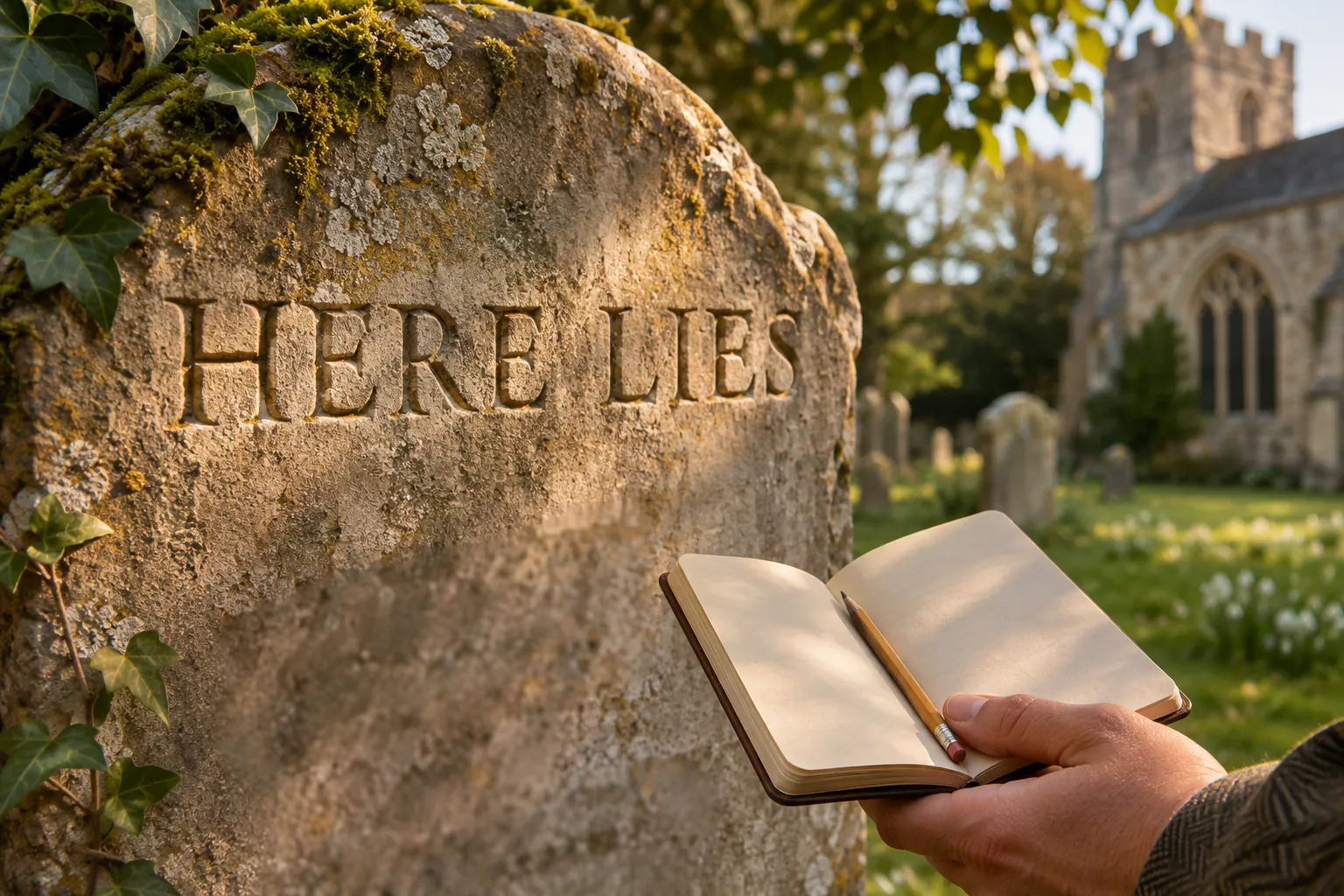
Famous epitaphs can sound like a dead person’s final word. Look closely at the memorials of Shakespeare, Keats, and Ben Jonson, though, and other voices enter the conversation: friends who added an explanation, later writers who assigned an author, and people who preserved an inscription on a different stone.
A few lines can outlive the person who chose them. They can also outgrow their original story. Follow these three inscriptions back to their memorials, and the question becomes surprisingly personal: how much control does anyone have over the words that will represent them?
What Is an Epitaph?
An epitaph is wording that commemorates someone who has died, especially an inscription on a grave or memorial. It may praise, mourn, joke, or speak directly to whoever stops to read. It need not be the deceased person’s own composition or their spoken last words.
That distinction matters here. A quotation attached to a famous name can feel like a signed statement. A memorial may tell a more complicated story.
Shakespeare’s Epitaph Addresses the Person Standing Above Him
At Holy Trinity Church in Stratford-upon-Avon, Shakespeare’s grave inscription begins by calling its reader a friend. Four lines later, that friendship has conditions. In modernized spelling, with the old abbreviations expanded, the verse reads:
“Good friend, for Jesus’ sake forbear / To dig the dust enclosed here; / Blessed be the man that spares these stones, / And cursed be he that moves my bones.”
The Folger Shakespeare Library’s transcription preserves the older forms, including “FREND,” “DIGG,” and “ENCLOASED.” The warning belongs to the grave slab. The bust and its inscription on the nearby wall form a separate monument. The Shakespeare Birthplace Trust notes something easily missed in a cropped quotation: the grave slab does not give his name.
Who wrote those four lines? The Church Monuments Society traces the tradition that Shakespeare composed them to about 1655–56, roughly forty years after his death. Earlier records connect the verse with his grave without establishing that he wrote it. His authorship remains uncertain.
The same study relates the warning to the prospect of bones being removed to a charnel house, a place for storing human remains. Read that way, the inscription addresses a practical fear about what might happen to a body after burial. The curse is part of the appeal carved for living readers.
What makes it arresting is the direct address. The reader has a role in the sentence. Whoever composed it imagined someone standing over these bones and deciding whether to leave them alone. Centuries later, the words still put us in that position.
Keats Wanted a Short Line. His Friends Had More to Say.
John Keats’s memorial in Rome’s Non-Catholic Cemetery contains one of the most familiar images of literary disappearance:
“Here lies One / Whose Name was writ in Water.”
Notice “in Water.” You will also encounter the phrase as “on water,” including in discussion of Keats’s wishes. The University of Victoria’s Mapping Keats’s Progress gives the carved version with “in.” Joseph Severn’s account of the completed memorial, reproduced by Keats House, uses “in” too. A remembered quotation and a transcription of a stone are not always identical.
Keats wanted the short epitaph alone. Severn and Charles Brown added the longer passage above it. Its opening identifies the person below as a “YOUNG ENGLISH POET.” It goes on to attribute his request to bitterness at the “Malicious Power of his Enemies.” The stone carries the friends’ explanation before it reaches the words associated with Keats’s own wish.
That is a considerable addition. Someone reading only the famous water line encounters an image of a name disappearing. Someone reading the whole inscription is first told how to interpret it. The friends have supplied a story about the poet’s state of mind.
The correspondence published by Keats House brings those friends into sharper focus. In 1823, Severn proposed another memorial in England. Brown resisted, worrying that Keats’s reputation was still too fragile and that a monument might invite ridicule. Their disagreement shows two people trying to protect the same friend’s memory in different ways.
In June 1823, Severn reported that the tomb had been put up. He also explained the carved lyre above the wording: its missing strings represented poetic ability cut short by death. The lettering and the decoration were both being asked to speak for Keats.
It is a recognizable human predicament. When someone dies, those left behind must decide what to say. A sentence may feel too small. Adding another can feel like loyalty, even when the person being remembered had asked for less.
Ben Jonson’s Four Words Appear in More Than One Place
Westminster Abbey records the inscription as “O Rare Ben Johnson.” The extra h belongs to the memorial’s spelling; Jonson himself used “Jonson.” Four words, and already there is a detail that a tidy quotation can lose.
The Abbey distinguishes three objects bearing the wording:
- The original gravestone, moved to the wall opposite the grave during nineteenth-century work on the nave floor.
- The small gray lozenge-shaped stone that now marks the burial place.
- The separate monument erected around 1723 in Poets’ Corner.
His burial is in the nave. A photograph of the Poets’ Corner monument therefore shows a commemoration elsewhere in the building.
The authorship story has alternatives too. The Abbey recounts a tradition that Jack Young paid a mason eighteen pence to cut the inscription as the grave was being covered. It also records an attribution to William D’Avenant. Neither account becomes certain merely because it makes a memorable anecdote.
The words survived movement and repetition. Finding them is only the beginning; identifying which memorial carries them tells you what you are looking at.
Read Past the Famous Quotation
These examples reward three small questions. Which object carries the words? Does the quotation preserve the wording? What evidence connects the inscription with the person said to have written it?
Shakespeare’s slab and wall monument answer different parts of his memorial story. Keats’s longer inscription changes the setting of the familiar water line. Jonson’s repeated wording belongs to objects with different histories. A photograph showing the whole memorial can reveal what a quotation leaves outside the frame.
For the practical work of copying lettering and comparing earlier records, our guide to how to read old gravestones explains how to keep the visible words separate from your interpretation.
Fame can make an inscription feel settled before you have looked at it. The useful discovery may be an extra letter, an added paragraph, or a monument standing somewhere other than the grave.
Who Gets the Last Word?
These memorials preserve more than the reputations of three writers. They preserve choices made around them: what to leave unnamed, what to explain, what to copy, and what to keep when a floor was changed.
That is the human pull of an epitaph. Someone’s life has ended, but other people are still deciding how to tell its story. Next time a famous grave offers you a few perfect words, look at the rest of the stone. There may be another voice waiting just above them.
We hope you enjoyed our little trip down the rabbit hole.
We’ll keep digging, and you keep reading.

Keep digging into more Gravestone Symbols and Epitaphs stories.
Sources and Further Reading
- Shakespeare Birthplace Trust: Shakespeare’s Burial and the Unnamed Grave Slab
- Folger Shakespeare Library: Shakespeare’s Life, Including the Grave Inscription
- Church Monuments Society: Shakespeare’s Grave Verse, Early Transcriptions, and Authorship
- University of Victoria: Mapping Keats’s Progress, 26 February 1821
- Keats House: 1823 Correspondence About Keats’s Gravestone, Below Fanny Brawne’s July Letter
- Westminster Abbey: Ben Jonson’s Grave, Original Stone, and Monument