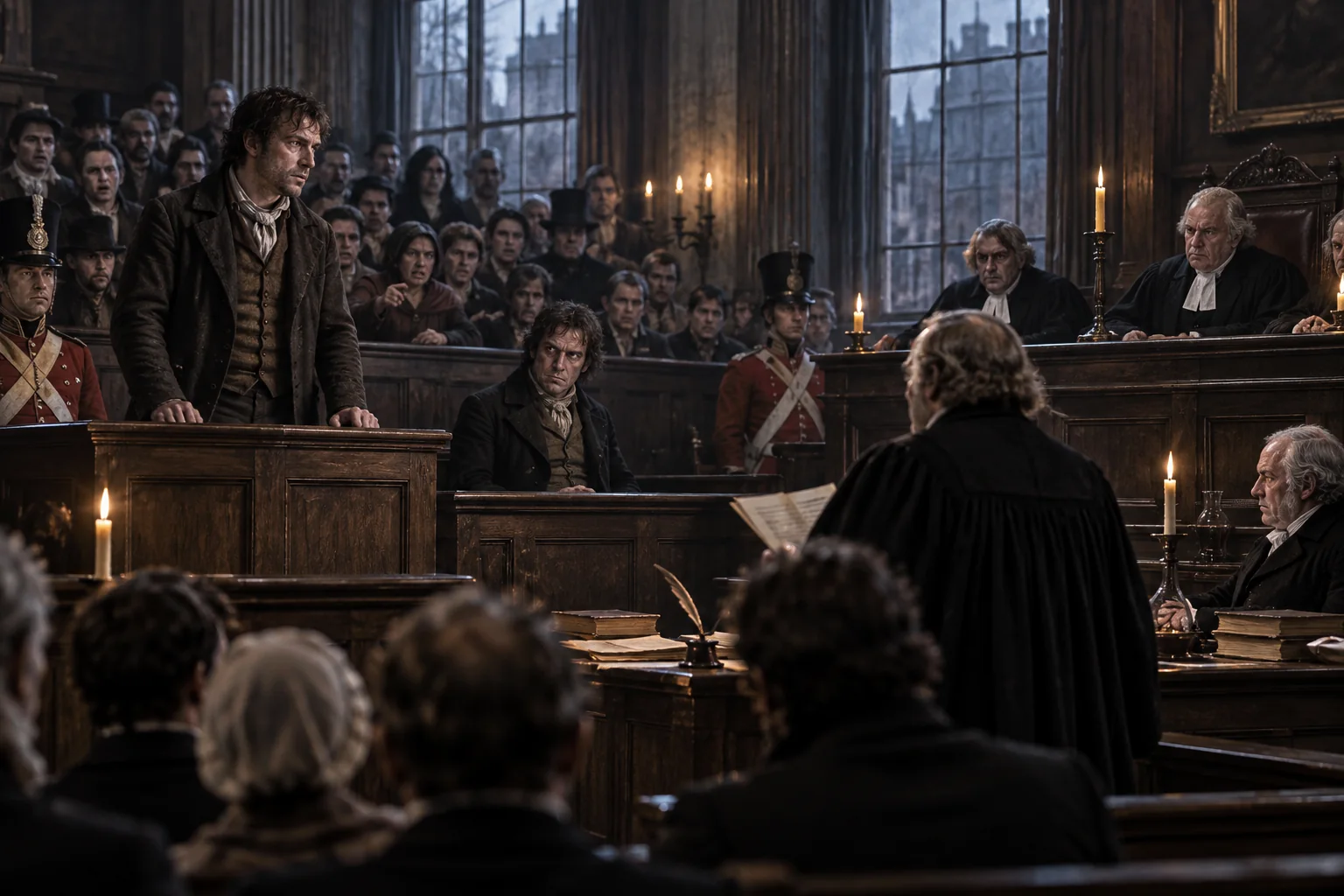
William Hare escaped the gallows by becoming the Crown’s key witness against William Burke. Hare had helped Burke murder people and sell their bodies for dissection in Edinburgh, but prosecutors faced a problem: they needed inside evidence strong enough to secure a conviction.
The Lord Advocate chose Hare, offered him protection from prosecution if he told what he knew, and used his testimony at Burke’s trial in December 1828. Burke was convicted and hanged. Hare survived. That decision made Hare one of the most hated men in Britain and created a legal fight over whether he could ever be prosecuted for the murders he had helped describe.
Who Was William Hare?
William Hare was an Irish laborer who came to Scotland while the Union Canal was being built. By the mid-1820s, he was living in Edinburgh and became connected with a lodging house in Tanner’s Close near the West Port.
Hare eventually lived there with Margaret Laird, usually called Maggie Hare. The house became one of the main locations connected with the murders that later made his name infamous.
Modern sources disagree on some details of Hare’s early life, including his exact birthplace and date of death. The safer historical picture is simple: he was an Irish laborer who settled in Edinburgh, ran a lodging house, and entered a partnership with William Burke that turned the city’s illegal corpse market into murder for profit.
How Did Hare and Burke Start Selling Bodies?
The first body they sold was not a murder victim. A lodger named Donald died naturally while owing Hare rent. Hare and Burke removed the body from its coffin and took it to the anatomy market instead of allowing it to be buried.
They eventually sold the body through the school of anatomist Robert Knox. Once they learned that a fresh corpse could bring in money, the pair stopped waiting for convenient deaths.
The broader story of Burke and Hare in Edinburgh explains how that first sale grew into a series of murders. Hare’s own article matters because his later decision to testify is the reason one partner was hanged while the other walked out of jail.
What Role Did William Hare Play in the Murders?
Hare was not a minor bystander. Surviving trial material, Burke’s confessions, and modern institutional accounts place him inside the murder operation.
Burke and Hare killed at least 16 people during 1827 and 1828 and sold the bodies for dissection. Their victims were often poor, transient, elderly, or otherwise vulnerable people who could disappear without an immediate alarm.
The exact balance of responsibility between Burke and Hare is harder to settle. Burke later tried to place much of the blame on Hare, while Hare’s courtroom evidence shifted blame toward Burke. Both men had strong reasons to minimize their own role.
That conflict is important. The safest conclusion is not that one man was the mastermind and the other merely followed. The surviving record shows two men repeatedly participating in a murder-for-sale operation.
Why Did Prosecutors Make Hare a Witness?
The case against Burke and the others was weaker than public anger made it appear. Police had a body, suspicious behavior, and several witnesses, but proving murder and proving who committed it were separate problems.
The National Library of Scotland explains that Lord Advocate Sir William Rae decided to use one accused person to give evidence against the others. Hare was selected and turned King’s evidence.
In practical terms, prosecutors offered Hare immunity if he gave information that could be used to prosecute Burke and Helen McDougal. Hare accepted.
The 1829 West Port Murders account records the Lord Advocate’s reasoning in unusual detail. He believed the available evidence was not strong enough to guarantee a murder conviction. Hare’s disclosures provided information the prosecution believed it could not obtain any other way.
What Did Hare Say at Burke’s Trial?
Hare entered the witness box on December 24, 1828. The contemporary trial account says his appearance caused a strong reaction in the courtroom.
He gave evidence about Margaret Docherty, the final victim in the case. His testimony described events inside Burke’s house and helped connect Burke to the killing and the sale of the body.
The Crown also cross-examined Hare about other crimes. At points he refused to answer questions that could further incriminate him. The court recognized that he could not simply be forced to confess to every murder while acting as a Crown witness.
His wife, Margaret Hare, also testified. Burke was convicted of Docherty’s murder. McDougal received Scotland’s ‘not proven’ verdict and was released.
Why Couldn’t William Hare Be Tried Later?
This is the part of the story that is often reduced to ‘Hare made a deal and got away.’ The legal fight was more complicated.
After Burke’s conviction, relatives of James Wilson, better known as Daft Jamie, tried to have Hare prosecuted for Wilson’s murder. Hare’s lawyers argued that the Crown had already used him as an accomplice witness and promised him protection.
The High Court of Justiciary considered whether that protection barred a later criminal prosecution. On February 2, 1829, the court ordered Hare released from the criminal proceedings.
The judges did not say Hare was innocent. They reasoned that the justice system could not promise an accomplice protection, use his evidence to obtain a conviction, and then turn around and prosecute him for the same crimes covered by that bargain.
One contemporary account summed up the uncomfortable result clearly: Hare’s escape was painful to accept, but breaking the promise would damage confidence in the law and make future accomplices less willing to give evidence.
What Happened When Hare Was Released?
Hare did not simply walk into a quiet new life. He was kept in custody for a time because officials feared that an angry crowd would attack him.
The National Library of Scotland records that he was released on February 5, 1829. A contemporary account says he left Edinburgh under the name ‘Mr. Black’ and traveled south by mail coach.
By the next morning he had reached Dumfries. News of his arrival spread quickly. A huge crowd gathered around the inn where he was being kept, and some people shouted for him to be killed.
Officials eventually moved him to the local jail for protection. In the early hours, they escorted him out of town and put him on the road toward England.
The same 1829 account records sightings near Carlisle shortly afterward. After that, the trail becomes uncertain.
Did Hare Go Blind and Beg in London?
One of the most repeated stories says Hare later worked at a lime kiln, was recognized, thrown into lime, blinded, and spent the rest of his life begging in London.
It is a memorable ending, but the evidence is weak. The University of Edinburgh notes that the story is only one of several traditions about what happened to him.
The better-supported record ends much earlier. Hare was seen traveling south after the Dumfries disturbance, and contemporary reports placed him near Carlisle. Later claimed sightings have not been securely verified.
So the honest answer is that William Hare’s later life is unknown. A dramatic punishment may feel satisfying, but there is not enough evidence to present the lime-pit story as fact.
Why Is William Hare Remembered Differently From Burke?
Burke became the public face of the murders because he was convicted, hanged, dissected, and physically preserved in ways that kept his story alive. The University of Edinburgh still holds Burke’s skeleton.
Hare left a different kind of legacy. He became the accomplice who survived by testifying. That made him useful to prosecutors and hated by the public at the same time.
His story also exposes an uncomfortable truth about criminal justice: sometimes the only way to convict one participant in a hidden crime is to make a deal with another participant.
Hare did not escape because anyone believed he was harmless. He escaped because prosecutors decided his evidence was more valuable than his prosecution.
The Short Version
William Hare was William Burke’s partner in the West Port murders of 1827 and 1828. The pair killed at least 16 people and sold the bodies to the anatomy school of Dr Robert Knox.
When prosecutors worried that the evidence was too weak to guarantee a conviction, Hare was offered protection in exchange for giving evidence against Burke. He testified at the December 1828 trial, and Burke was convicted and later hanged.
A later attempt to prosecute Hare for the murder of Daft Jamie failed because the High Court held that the protection created by using him as a Crown witness barred that criminal prosecution.
Hare was released in February 1829 and faced furious crowds as he traveled south through Dumfries. Contemporary reports tracked him near Carlisle, but what happened to him after that remains uncertain.
We hope you enjoyed our little trip down the rabbit hole.
We’ll keep digging, and you keep reading.
Keep digging into more Body Snatching & Resurrectionists stories.
Sources and Further Reading
- National Library of Scotland – From crime to collection: Burke and Hare at the Library
- University of Edinburgh Anatomical Museum – William Hare
- Project Gutenberg – West Port Murders (1829)
- Wellcome Collection – Supplement to the trial of William Burke & Helen McDougal (1829)
- National Records of Scotland – Trial papers relating to William Burke and Helen McDougal (JC26/1828/469)