The London Burkers were men who sold human bodies to anatomy schools. In 1831, John Bishop and Thomas Williams murdered a teenage boy in London and tried to sell his body for dissection. James May was convicted with them, although his role in the killing was disputed.
Their case echoed the earlier crimes of Burke and Hare in Edinburgh. It also left one question that the trial never fully settled: Was the dead boy really Carlo Ferrari, the Italian street performer named in court?
Who Were the London Burkers?
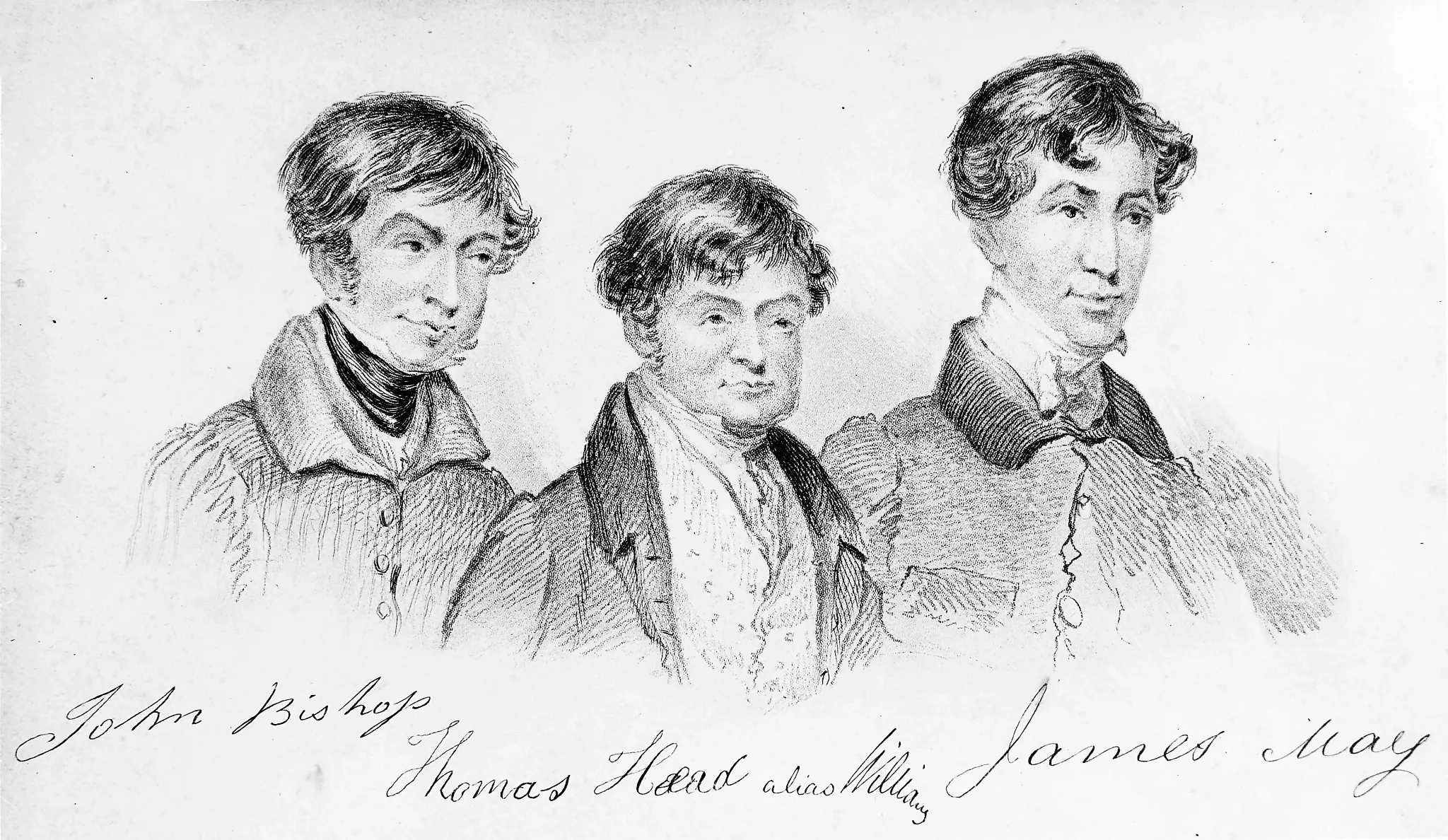
The name usually refers to three men who stood trial for murder in December 1831:
- John Bishop was an experienced resurrectionist who supplied bodies to anatomy schools. He used a house at Nova Scotia Gardens in East London.
- Thomas Williams, also known as Thomas Head, worked with Bishop. He later signed a confession confirming Bishop’s account of the killings.
- James May was another body dealer. He helped bring the corpse to market, but Bishop later said May had not taken part in the murder.
A fourth man, Michael Shields, was arrested after carrying the body to King’s College. He worked as a porter, but was not tried for murder with the other three.
These distinctions matter. The men were connected through the corpse trade, but that does not mean each had the same role in the killing.
Why Were They Called “Burkers”?
The nickname came from William Burke and William Hare, whose murders in Edinburgh were exposed in 1828. They killed people and sold the bodies to an anatomy teacher rather than stealing corpses from graves.
Most resurrectionists practiced body snatching instead. They dug up people who were already dead and sold the bodies for dissection. You can read more about those ordinary body sellers in our article on resurrectionists.
The London case raised the same frightening possibility as the Edinburgh murders: when a dead body had a price, someone might decide to create one instead of finding one.
The Body That Raised Suspicions at King’s College
On November 5, 1831, four men delivered the body of a boy, thought to be about fourteen, to the anatomy rooms at King’s College London. They had already tried unsuccessfully to sell it to Guy’s Hospital.
According to an account published in 1832, the sellers first asked for twelve guineas. The college offered nine, and the men agreed. But the staff did not treat the body as an ordinary subject taken from a grave.
William Hill, a porter at King’s College, noticed that the body was unusually fresh and told Richard Partridge, a demonstrator of anatomy. Partridge examined the body. Its condition raised doubts about how the boy had died and whether he had ever been buried.
The staff delayed payment by saying they needed to change a banknote. While the men waited, the police were called. Testimony later showed that the boy’s teeth had been removed, adding another disturbing detail to the case. An attempt to sell a corpse had turned into a murder investigation.
Was the Victim Really Carlo Ferrari?
At the time, witnesses believed the dead boy was Carlo Ferrari, a young Italian who had earned money on London streets. People remembered a boy carrying a small cage with white mice. Clothing and a cap also became important clues.
Some witnesses were confident about the identification. Others could not be sure because the face was disfigured and the teeth were missing. Even the 1832 account, which printed Carlo Ferrari’s name on its title page, raised doubts about the identification.
After the trial, Bishop gave a different story. He said the boy he and Williams had killed was not Carlo Ferrari but a young cattle drover who had come from Lincolnshire. Williams signed a statement agreeing with Bishop’s account.
The confessions are important evidence, but they do not settle the question on their own. The witnesses and the convicted men gave conflicting accounts, and the surviving records do not provide a firm answer to the boy’s identity.
That uncertainty is one of the case’s most revealing parts. The jury convicted the three men of murder, but the name attached to the young victim remained in doubt.
What Did Bishop and Williams Confess?
In his confession, Bishop said that he and Williams promised the boy work, took him home, and gave him rum containing laudanum, a powerful drug made from opium. Bishop said they then drowned him in a well behind the house.
Bishop and Williams also confessed to killing a woman later identified as Frances “Fanny” Pigburn and a boy who gave his name as Cunningham. These were claims made after conviction, not separate murder verdicts returned by the jury.
Bishop also claimed that he had supplied between 500 and 1,000 bodies over twelve years. That gives a sense of the trade’s possible scale, but the number was his estimate, not an independently verified total.
The difference between proof and confession is important here. We know what the men were convicted of. We also know what they later claimed. Those are not always the same thing.
What Happened at the Old Bailey Trial?
John Bishop, Thomas Williams, and James May were tried at the Old Bailey in early December 1831. All three were found guilty of the murder for which the body had been offered for sale.
Bishop and Williams were hanged outside Newgate Prison on December 5, 1831. May was also sentenced to death, but his sentence was commuted to transportation for life.
May’s later fate reminds us to check old stories against records. Some published histories say he died aboard a prison ship before leaving Britain. But British transportation records list a James May, a butcher convicted of murder in London in 1831, who sailed to Van Diemen’s Land in 1832. Tasmanian convict notes link him directly to Bishop and Williams and record his death at Port Arthur in 1834. The accounts conflict, but the detailed transport records suggest May reached Australia.
The case attracted enormous public attention. An ordinary trade in stolen corpses was already unpopular. The thought that someone could be murdered to keep an anatomy school supplied was far more alarming.
The punishment for grave robbing was a different legal matter from the murder convictions in this case.
What Happened to the Murderers’ Bodies?
The ending carried a grim twist. After the executions, the bodies of Bishop and Williams were handed over for anatomical examination.
The Royal College of Surgeons reports that William Clift dissected Bishop and Williams and sketched their heads. Janet Philp’s research records that their bodies were then sent to anatomy schools: Bishop’s to King’s College and Williams’s to Great Windmill Street.
The men had made money delivering bodies to dissection rooms. After they were executed, their own bodies entered that same world.
Did the London Burkers Help Change the Law?
Yes, but they did not start the debate. Parliament had been investigating the shortage of legal bodies for anatomy teaching since before the London murders. Burke and Hare had already shown the danger of a market that paid for human remains.
The London Burkers scandal made that danger impossible to ignore. The Anatomy Act of 1832 then opened new, regulated ways for medical schools to obtain bodies, including certain unclaimed bodies from institutions.
The change weakened the market for grave robbers. It did not solve every problem. Poor people were more likely to have their bodies used without the kind of choice families would expect today.
The lesson of the London Burkers case is not that learning anatomy was wrong. It is that a medical system that needed bodies, with too few lawful ways to obtain them, helped create a dangerous trade.
The Short Version
The London Burkers were body sellers caught in an 1831 murder-for-dissection scandal. John Bishop and Thomas Williams were convicted and executed. James May was convicted too, but his death sentence was commuted to transportation for life. Staff at King’s College helped expose the crime when they questioned an unusually fresh corpse.
The boy was named in court as Carlo Ferrari, although Bishop later claimed he was an unnamed cattle drover from Lincolnshire. That dispute remains a warning about treating every detail in an old crime report as settled fact.
We hope you enjoyed our little trip down the rabbit hole.
We’ll keep digging, and you keep reading.

Keep digging into more Body Snatching & Resurrectionists stories.
Sources and Further Reading
- The History of the London Burkers (1832), Project Gutenberg
- The Trial, Sentence and Confessions of Bishop, Williams, and May (1831), Wellcome Collection
- The National Archives, Home Office record HO 17/46/122 (1831 confessions)
- The National Archives, Body Snatchers: The Murder (confession transcript)
- Janet Philp, Bodies and Bureaucracy: The Demise of the Body Snatchers in 19th Century Britain, The Anatomical Record
- King’s College London, Richard Partridge: Surgeon Who Turned in London Body Snatchers
- Royal College of Surgeons of England, Dissection and the Resurrectionists in the College Archives
- Convict Records, James May (indexes Home Office transportation records and transcribes Tasmanian convict notes)