
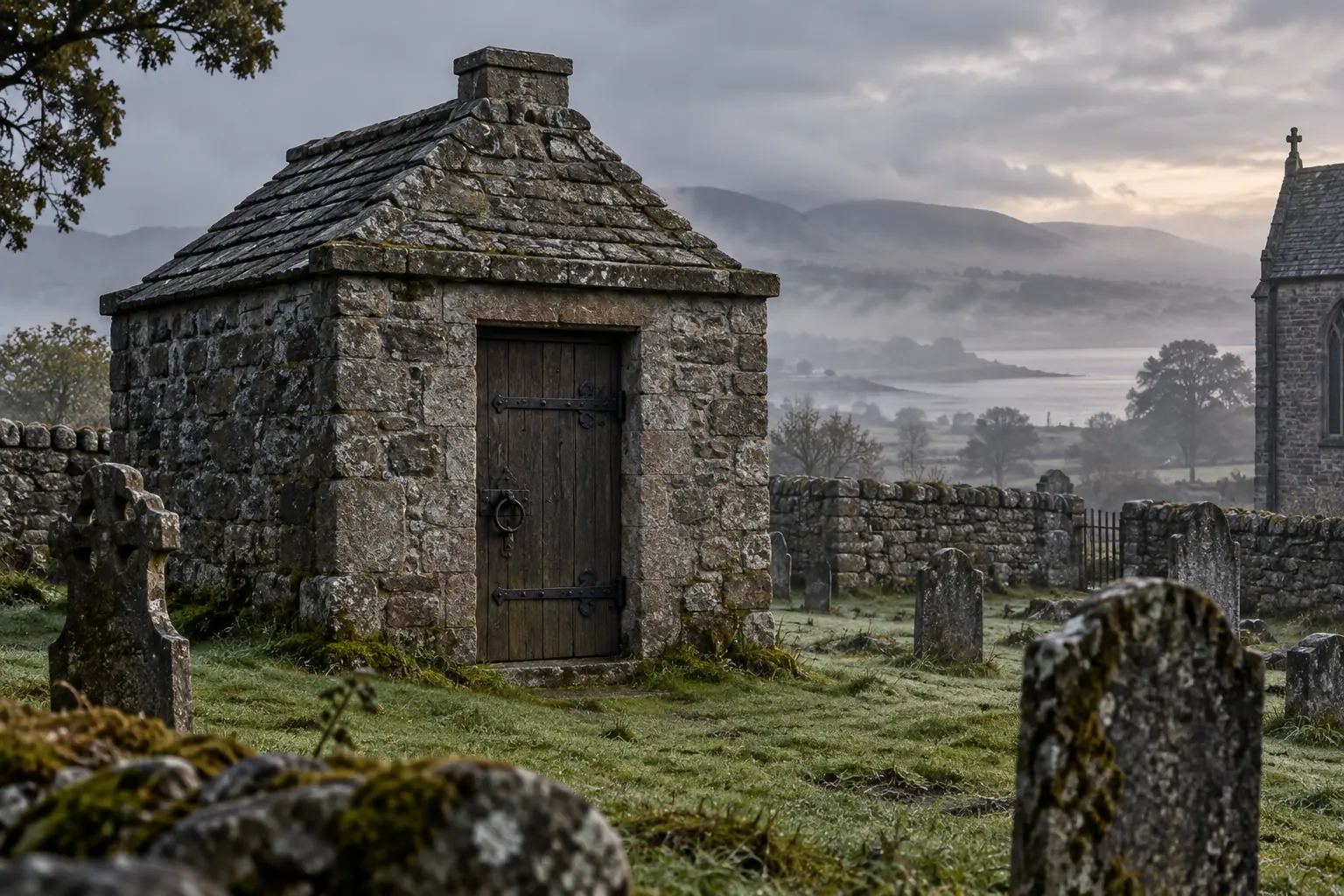
A mort house was a locked building where coffins could be kept safe from body snatchers before burial. In parts of Scotland during the early 1800s, families used these secure stone buildings to protect the recently dead until their remains were no longer useful to people selling bodies to anatomy schools.
Instead of guarding a fresh grave every night, a community could lock the coffin away and bury it later. One surviving mort house even has a revolving platform inside. That unusual feature shows how seriously people took the threat of body snatching.
What Was a Mort House?
A mort house, also written as morthouse or mort-house, was a secure storehouse for coffins. It was usually built in or beside a churchyard. Families used it for a limited time, before placing the coffin in its final grave.
It was not a mausoleum meant to hold a family permanently. Nor was it the same as a modern morgue, where bodies may be kept for identification or examination. Its special job was to keep body snatchers away during the weeks when a newly dead body could bring money.
Why Were Mort Houses Built?
In the late 1700s and early 1800s, anatomy teachers needed human bodies so medical students could learn how the body worked. The lawful supply was limited. Some people known as resurrectionists met the demand by stealing corpses from fresh graves and selling them for dissection.
Families and churches tried many ways to stop them. Some hired guards or organized a grave watch. Others used heavy stones, iron mortsafes, or strong locks on burial grounds. In some Scottish communities, a mort house offered another solution: delay burial until there was little reason for a thief to steal the remains.
How Did a Mort House Protect the Dead?
After a death, a coffin could be placed inside the mort house instead of being buried at once. Its thick walls and secured entrance kept the coffin out of reach. When enough time had passed, the coffin was removed and buried in the churchyard.
The idea depended on a grim fact. Body snatchers generally wanted bodies fresh enough to sell for medical dissection. A body that had naturally decomposed was far less valuable to them.
The building was not meant to stop decay. It relied on it. The waiting period was not the same everywhere, and we should not mistake the rules of one churchyard for a law followed throughout Scotland.
The Crail Dead House: A Building Paid for by Neighbors
Crail Parish Church in Fife still has a dead house, another name for a mort house, built by public subscription in 1826. It is a square stone building with a battlement-like top. Above the entrance is an inscription that includes the words “Erected for securing the dead.”
The church explains that coffins could remain there for up to six weeks in summer or three months in winter before burial. Those were local arrangements, not a standard waiting period for every mort house.
The most striking part may be the funding. People pooled their money to build a place where their dead could wait safely. That says a great deal about the fear of grave robbing at the time.
Udny Mort House: Why Did It Have a Revolving Platform?
In Aberdeenshire, the mort house at Udny Green had a much less ordinary design. Historic Environment Scotland records a circular granite building with a slate roof, a heavy oak door, and a metal bar protecting its keyhole. It dates the design to 1832.
Inside was a revolving platform about three feet above the floor. Coffins could be placed on the platform and moved around as more were added. Archaeology Scotland explains the idea: by the time a coffin had made a complete circuit, enough time should have passed for it to be buried with less risk of theft.
This was not some mechanical device that preserved the bodies. It was a practical way to organize temporary storage. And it was an unusual feature, not something found in every mort house.
Was a Mort House the Same as a Mortsafe?
No. The names sound similar, but the defenses worked in different ways.
A mort house stored coffins in a locked building before burial. A mortsafe was a heavy stone or iron structure placed over or around a coffin to protect a grave after burial. A watch-house sheltered people who stood guard over graves at night.
All three were responses to the same problem, but they should not be confused. If you have seen an iron cage over an old grave, you were probably looking at a mortsafe, not a mort house.
Can You Still See Mort Houses Today?
Yes. The dead house at Crail remains part of the churchyard, and the unusual circular building at Udny is a protected historic structure. Historic Environment Scotland also records an early nineteenth-century mort house at Rosyth Old Kirk in Fife.
Without knowing the history, a visitor might mistake one of these sturdy stone structures for a store shed or a small chapel. Their real purpose was far stranger: protecting a coffin so it could finally be buried.
Why Did Mort Houses Fall Out of Use?
The Anatomy Act of 1832 changed how anatomy schools in Britain could obtain bodies. It widened lawful access to certain unclaimed remains under a regulated system, reducing the demand for corpses stolen from graves.
The change did not happen overnight. Archaeology Scotland notes that communities continued to invest in grave defenses for a time after the law passed. But as the body-snatching trade declined, the need to store coffins behind fortified doors declined with it.
The surviving buildings are reminders of a time when families had to think not only about burial, but about keeping the dead from being stolen.
The Short Version
A mort house was a secure, temporary home for coffins before burial. Scottish communities used these buildings to deny body snatchers access to freshly dead bodies. Crail had a stone dead house with seasonal waiting periods, while Udny used a remarkable revolving coffin platform.
The idea was simple, even if the reason was disturbing: let time do what a lock alone could not.
We hope you enjoyed our little trip down the rabbit hole.
We’ll keep digging, and you keep reading.

Keep digging into more Body Snatching & Resurrectionists stories.
Sources and Further Reading
- James Ritchie, “An Account of the Watch-houses, Mortsafes, and Public Vaults in Aberdeenshire Churchyards, formerly used for the Protection of the Dead from the Resurrectionists” (1912), Proceedings of the Society of Antiquaries of Scotland
- Archaeology Scotland, “An Introduction to Graveyard Recording” (2006), pages 5-6
- Crail Parish Church, “Dead House”
- Historic Environment Scotland, “Udny Mort-House” (listed-building record LB15951)
- Scottish Church Heritage Research, “Udny Church Morthouse”
- Historic Environment Scotland, "Rosyth Old Kirk, Burial Ground, Mort House" (record LB3752)
- Wellcome Collection, “Beating the Bodysnatchers”