
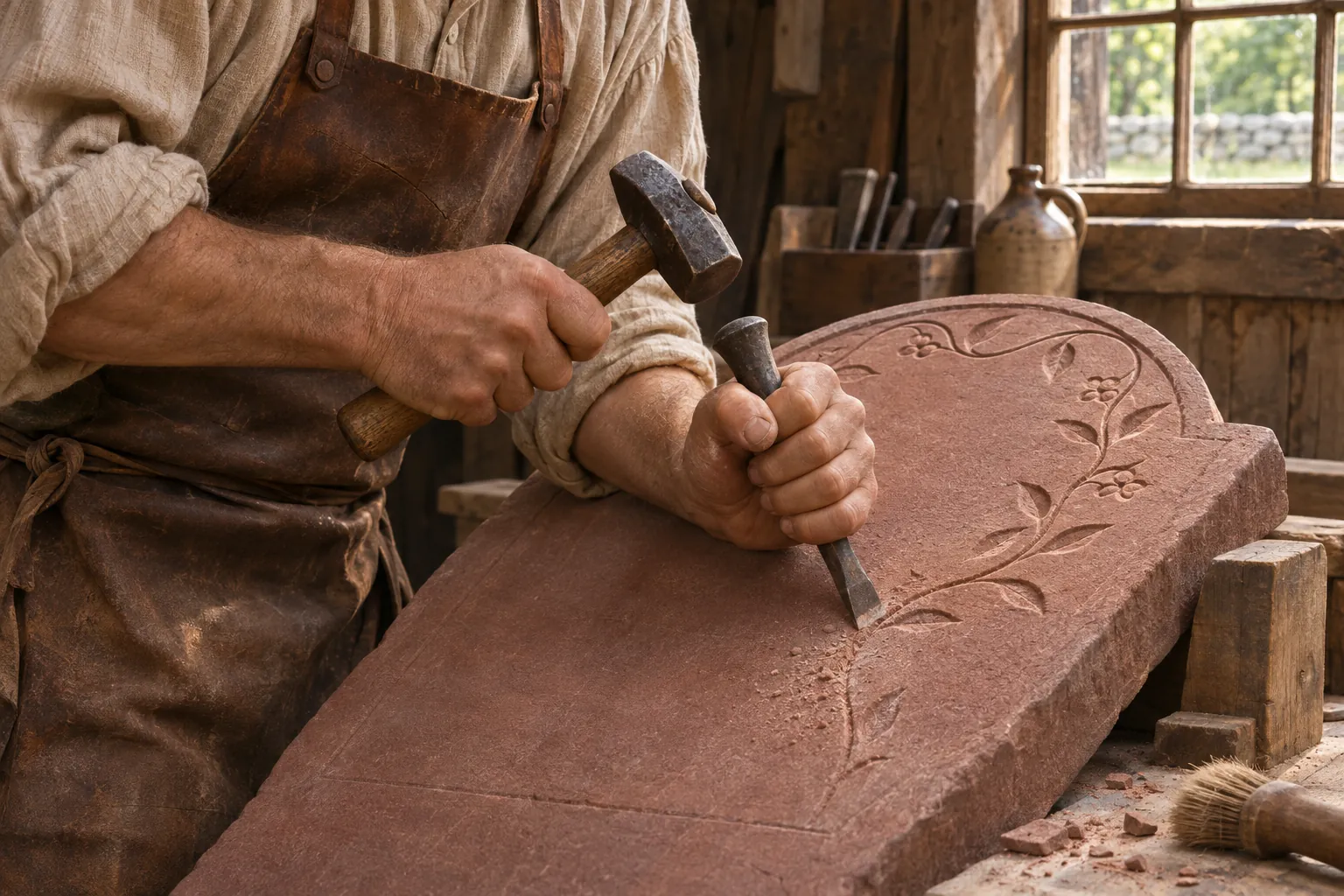
Colonial gravestone carvers can sometimes be identified by a signature, a payment record, or a pattern of distinctive work. Historians compare those clues to connect a memorial with its maker. The person buried beneath a stone usually gets the introduction. The person who shaped it may take longer to find.
Look past the name and dates for a moment. Someone decided how a leaf should curl, where a line of lettering should end, and how much room a face needed above the inscription. Those decisions can preserve traces of another life: the working life of the craftsperson.
Peter Buckland Leaves His Name in Stone
One maker made himself unusually easy to find. The sandstone marker for Deacon Daniel House, dated 1762, in East Glastonbury, Connecticut, carries the words “MAD:BY:PETER:BUCKLAND” beneath its carved upper design.
Jessie Lie Farber discusses this signature in her introduction to the American Antiquarian Society’s gravestone collection. New Haven Museum’s finding aid for Allan I. Ludwig’s gravestone photographs independently catalogs the House marker as signed by Peter Buckland. It lists a detail photograph immediately afterward.
The missing E in “MAD” has not prevented the message from reaching us. Here is a maker’s name placed where later readers could find it, alongside the work itself.
That changes the encounter. Daniel House is the person commemorated. Peter Buckland is the person claiming the work. One memorial brings both names into view.
Three Clues With Different Jobs
Farber describes three main routes to identifying a carver. Each answers a slightly different question:
- A signature connects a name or initials with the object. It may be prominent, as on the House marker, or much less noticeable.
- A payment record connects a person or business with a transaction. Its wording matters: does it actually identify the gravestone, or merely record money paid?
- A stylistic match connects the work with other carvings. Letter shapes, borders, layout, and ornament can build a case when compared with securely identified examples.
These clues become more useful together. A similar face suggests a comparison. A signed example gives that comparison a name. A relevant account may connect the maker with the family ordering the memorial.
What an Old Payment Record Can Tell Us
Peter’s brother William Buckland provides a useful example of the paperwork problem. In a study published in the Connecticut Historical Society Bulletin in 1976, Ernest Caulfield reported estate payments to William in 1760 and 1761. The records did not specify that the payments were for gravestones.
Caulfield therefore compared related surviving markers, including stones for family members, with William’s signed work. He argued that the payments and the close similarities strengthened each other. The entries were supporting evidence, rather than itemized receipts proving exactly what William had supplied.
An entry naming payment for a particular headstone is stronger evidence than an unexplained payment to a known carver. The difference may be only a few words, but those words determine how closely the account can be tied to the object.
A family settling an estate had practical business to finish. Centuries later, a line in that paperwork may help recover the person whose labor made the memorial possible.
Even a Signature Can Leave a Question
Return to Daniel House’s signed marker. In the same 1976 study, its photograph caption points to the curved crossbar of the letter H. That detail suggested that William might have cut the inscription on a stone signed by Peter.
The caption presents a possibility, not an established division of labor. Peter’s signature remains direct evidence of his connection with the marker; it does not necessarily tell us who cut every letter.
Farber explains the broader difficulty: workers in a shop could divide decoration and lettering, while apprentices copied their teachers. A carver could also change styles. Similar work might identify a workshop or a shared tradition more confidently than one pair of hands.
Most of us read an H to reach the next word. An attribution researcher stops to consider how its crossbar was shaped.
The Maker May Have Lived Somewhere Else
A cemetery’s location offers a starting point, but the stone may have traveled. The National Park Service describes how families at St. Paul’s Church in Eastchester obtained finished sandstone markers from skilled carvers in New York City or New Haven. Orders used the Post Road connection; completed stones arrived by boat.
That account gives the memorial another history before its life in the churchyard: an order, a workshop, and a journey. Looking only for a craftsperson in the town where the stone stands could miss that connection.
Repeated designs also need their manufacturing context. Later white bronze grave markers used cast components and catalog choices. Matching one of those patterns involves a different production system from identifying the habits of a colonial stonecarver.
Follow a Clue Without Losing Its Source
Start with the person’s name, the recorded date, and the cemetery. Photograph the visible carving and keep the whole marker in your record as well as its details. Existing surveys and archival photographs may show a signature that is no longer visible.
The American Antiquarian Society’s Farber collection offers thousands of photographs, largely of early northeastern American gravestones. A collection record can lead you toward comparable examples or an existing attribution. Keep the record’s wording with your notes.
New Haven Museum’s Ludwig finding aid makes the distinction especially clear. Its Daniel House entry says the stone is signed by Peter Buckland. A nearby entry for the Reverend Isaac Chalker marker says it is attributed to him. The catalog is telling you two different things about the evidence.
When you compare examples, look for several connected features: the same treatment of letters, a similar border, and a comparable arrangement of the design. Record the differences too. A mismatch may be the detail that sends the research in a better direction.
The Other Person a Gravestone Can Remember
A maker’s identity adds a human presence that is easy to overlook. Someone earned a living shaping these letters and images. Their work passed into the keeping of a family and then into a cemetery’s long history.
You may finish with a name, a workshop, or an attribution that remains open. Even then, the stone has become more than an old design. It is something made by someone, and the small decisions left on its surface are still capable of getting our attention.
We hope you enjoyed our little trip down the rabbit hole.
We’ll keep digging, and you keep reading.

Keep digging into more Gravestone Symbols and Epitaphs stories.
Sources and Further Reading
- Jessie Lie Farber: Early American Gravestones, Especially Printed Pages 23–25 (PDF)
- New Haven Museum: Allan I. Ludwig Gravestone Photograph Collection, Entries 385–387 (PDF)
- Ernest Caulfield, Edited by Peter Benes: Connecticut Gravestones XIV (1976), Printed Pages 36 and 48, in a Rutland Historical Society Compilation (Large PDF)
- National Park Service: Historic Cemetery at Saint Paul’s Church
- American Antiquarian Society: About the Farber Gravestone Collection