
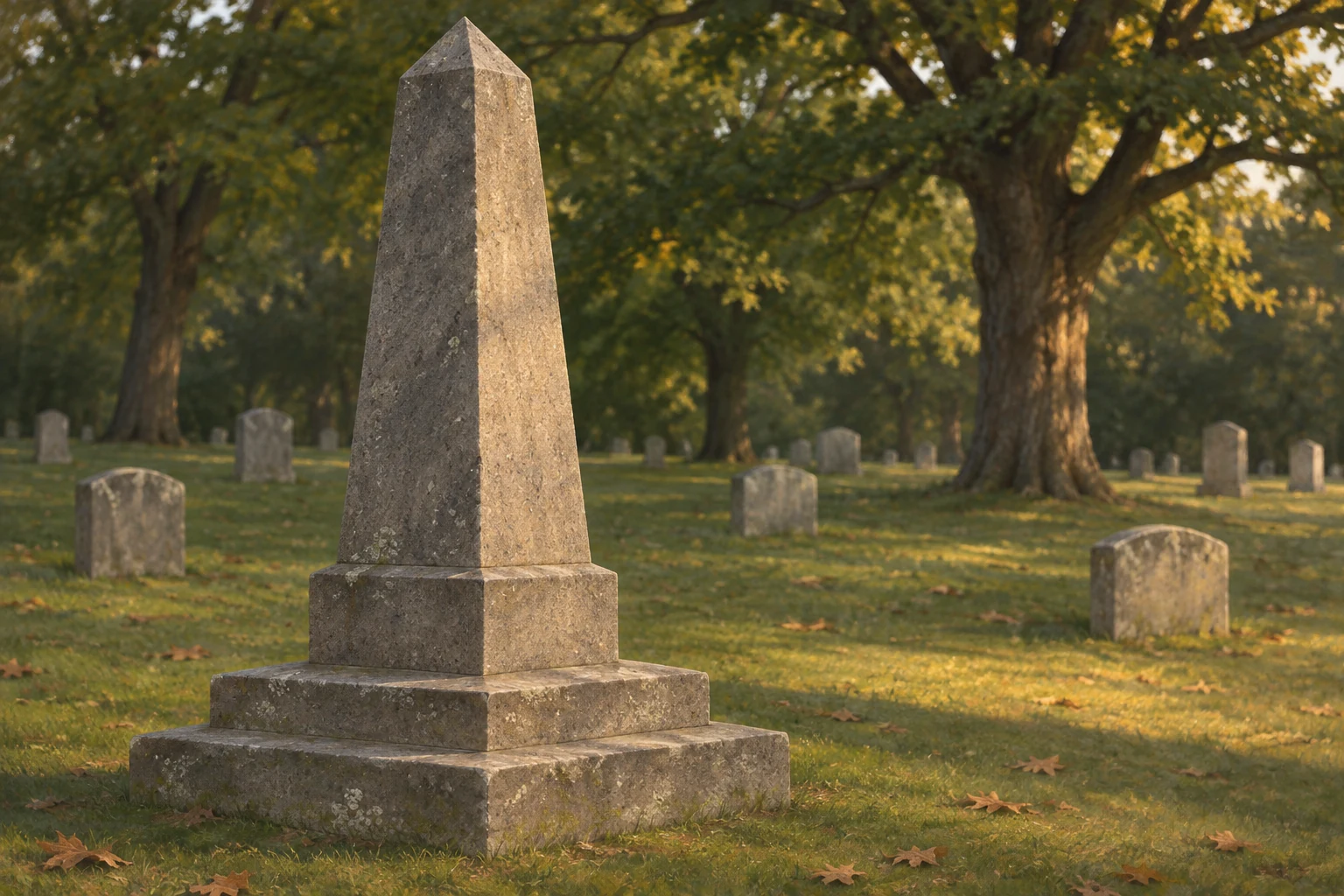
Obelisk gravestones became popular in the nineteenth-century United States because they combined an ancient, impressive shape with practical advantages. Their narrow form suited relatively small spaces, and they could cost less than elaborate sculpted monuments. The result was a memorial that drew the eye upward without needing a carved angel or a life-size figure.
That familiar pointed outline can feel almost ordinary after you have seen enough cemeteries. Then you stop beside one. A name comes into focus, followed by the decisions behind it: what to remember, how much to spend, and how to make a life remain visible after its owner was gone.
An Ancient Shape in a New Setting
An obelisk has four sides that narrow as they rise, ending in a small pyramidal point. Its flat faces distinguish it from a round column. In a cemetery, the shaft often stands on a broader pedestal or stepped base.
Some obelisk-shaped monuments are metal. Our guide to white bronze grave markers explains how cast zinc was made to resemble stone.
The form began in ancient Egypt, but its journey into American graveyards was far from direct. As art historian Therese O’Malley explains in the National Gallery of Art’s landscape history, obelisks also became prominent in Rome and later appeared in European gardens and public spaces.
By the time American monument makers adopted the shape, it carried layers of historical association. Napoleon’s invasion of Egypt in 1798 helped renew interest in Egyptian styles, adding to an older tradition of borrowing ancient forms.
You can see another version of that borrowing in a willow and urn gravestone. There, an ancient vessel becomes part of a carved mourning scene. With an obelisk, the borrowed form becomes the whole monument.
Why the Shape Made Sense
The Association for Gravestone Studies identifies several reasons for the obelisk’s appeal: its restrained appearance, associations with the ancient world, economical use of space, and lower cost compared with large, elaborate sculpture.
That combination mattered. A memorial could look substantial without turning into a crowded group of figures. Its plain surfaces also left room for lettering.
Picture an obelisk among rows of low tablet stones. Your eye finds the point before you can read the name. The shape gives the monument a presence at a distance; the inscription gives you a reason to come closer.
The cost comparison is relative. A towering stone still involved material and skilled work. The useful point is that visual impact did not require the most complicated carving.
A Franklin Monument—with a Different Story
In Boston’s Granary Burying Ground, a tall obelisk marks the tomb of Benjamin Franklin’s parents. The city describes it as 25 feet tall. It is a striking reminder that a large monument can commemorate a family connection as well as an individual life.
Boston’s Historic Burying Grounds Initiative records that architect Solomon Willard designed the monument, which was built in 1827. A stone-laying ceremony took place on June 15, with speeches and celebration. The project was among the improvements supported by public subscription.
Pause over that scene: people gathering in a burial ground to celebrate the installation of a stone. A memorial that now seems part of the permanent scenery once had a first day, an audience, and people willing to pay for it.
This was remembrance with a public life. The obelisk’s size made the family monument a landmark within the burial ground. Its history tells us who helped give that familiar shape a particular purpose.
Jefferson’s Carefully Planned Memory
Thomas Jefferson took a more personal approach. He drew an obelisk for his own grave and specified the achievements to be inscribed on it: the Declaration of Independence, Virginia’s statute for religious freedom, and the University of Virginia.
His instruction was firm: “& not a word more.” The presidency did not make his list.
He also requested “coarse stone,” hoping its lack of material value would discourage anyone from destroying it. The first documented marker was erected at Monticello in 1833. Visitors chipped pieces off anyway, taking souvenirs.
They wanted the stone because of whose stone it was.
Monticello’s history records that a replacement granite monument was erected in 1883, following congressional funding. The original obelisk eventually went to the University of Missouri.
The story holds two different ideas of remembrance. Jefferson tried to choose the words that would represent his life. Visitors wanted a piece of the object itself. A carefully planned memorial acquired a history its designer had hoped to prevent.
One Monument for a Family
An obelisk could also gather several lives around one central marker. At Saint Paul’s Church National Historic Site in Mount Vernon, New York, the National Park Service describes family plots with a large monument, often an obelisk, accompanied by smaller individual stones.
The park interprets that arrangement as an expression of family unity and continuity. The tall marker gives the group a common center, while the smaller stones identify the individuals.
That is a different use from Jefferson’s carefully selected account of his own achievements. Here, the larger story is the family. Look from the central monument to the smaller markers and you begin to see how the arrangement works: one shared presence, several separate names.
For a visitor following a family history, the imposing stone may be the easiest landmark to spot. The quieter stones around it may hold the names they actually came to find.
The Point Is Only the Beginning
Does an obelisk mean the person was a Freemason? The shape alone does not establish that. The Association for Gravestone Studies places Freemasonry within the wider culture of the revival, rather than treating it as the reason obelisks became so widespread.
The examples tell a richer story. A public subscription, a written instruction, or a group of family markers can explain what a particular monument was doing.
So let the point catch your eye. Then look for the people who gave the stone its place. The outline may have traveled through centuries. The decision to put it here belonged to someone.
We hope you enjoyed our little trip down the rabbit hole.
We’ll keep digging, and you keep reading.

Keep digging into more Gravestone Symbols and Epitaphs stories.
Sources and Further Reading
- Association for Gravestone Studies — Symbolism on Gravestones (The Obelisk section).
- National Gallery of Art, Therese O’Malley — Obelisk (History of Early American Landscape Design).
- Boston Parks and Recreation — Granary Burying Ground.
- Boston Historic Burying Grounds Initiative — Summer 2011 newsletter (page 7, Franklin monument and public subscription).
- Thomas Jefferson Foundation — Jefferson’s Grave and Tombstone (includes his drawing and instructions).
- National Park Service — Historic Cemetery at Saint Paul’s Church (Enclosing the Family section).