
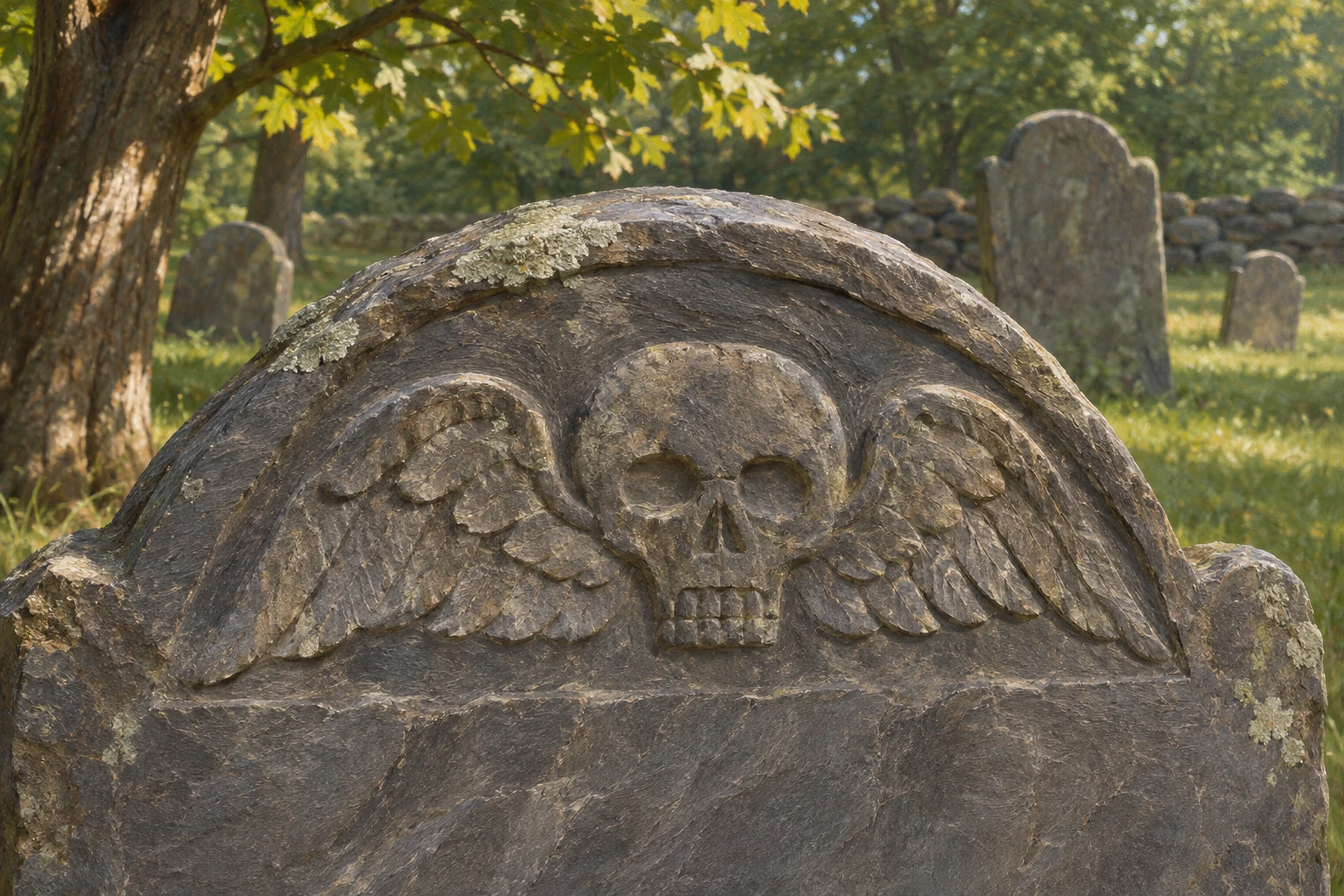
Cemetery symbols offer clues about identity, belief, and remembrance. To understand a carving, read it alongside the name, dates, inscription, and local history. A symbol guide can suggest a meaning, but the whole stone gives you a better chance of getting it right.
A skull with wings certainly catches the eye. So does a pair of hands carved into stone. The interesting question is what those images meant to the people who chose them. That takes a little more digging than matching a shape to a definition.
Why a Symbol Is Only the Starting Point
Gravestone symbols are often presented as a neat code: see this shape, read this meaning. Real memorials can be less cooperative.
Writing for the Association for Gravestone Studies, Jessie Lie Farber warns that even scholars disagree about the meaning of some designs. She recommends studying the stones, their carvers, and the period in which they were made.
That gives us a useful rule: describe what you can see before deciding what it means. “Two hands joined together” is an observation. “A husband saying goodbye to his wife” is an interpretation that needs more evidence.
The examples below come mainly from American burial grounds. They are a starting point for comparison, not a dictionary for every country, religion, or period.
A Face, a Name, and a Carver
At St. Paul’s Church in Mount Vernon, New York, the sandstone marker for Elezebeth Clements, who died in 1762, carries a winged face. The National Park Service identifies it as a soul effigy carved by John Zuricher.
The park interprets this kind of image as an expression of hope for salvation. Knowing the name and date turns a floating symbol into part of a particular memorial. Knowing the carver adds another person to the story.
The park’s history also describes sandstone markers ordered from skilled carvers in New York City and New Haven and brought to Eastchester by boat. Behind the finished stone were customers, tools, trade routes, and work. A cemetery can preserve the history of the people who made the memorials as well as those named on them.
How to Read Cemetery Symbols in Context
1. Record the Whole Stone
If photography is allowed, take a view of the complete marker before taking a close-up of the carving. Note the cemetery, location of the grave, name, and dates. Copy the inscription as it appears, including unusual spellings. Mark anything you cannot read instead of filling in the gap.
Discovering England’s Burial Spaces recommends recording a memorial’s shape, material, decoration, and inscription together. The surrounding details help keep a photograph of an interesting carving connected to an identifiable grave.
2. Read the Words Beside the Image
Look for an age, family relationship, religious verse, organization name, or initials. Ask what those words actually establish.
On U.S. government markers, military headstone symbols sit beside service details and personal inscriptions. Reading those parts separately can reveal how much one small stone holds.
A carved lamb beside an infant’s name and dates gives you more to work with than a cropped picture of the lamb alone. Mammoth Cave National Park’s guide illustrates an infant’s marker with a lamb and discusses its association with innocence.
That does not make every lamb a reliable age marker. Read the dates before building the person’s story around the carving.
3. Compare Nearby Stones From the Same Period
Do similar faces, lettering, or borders appear on other markers? A repeated design may lead you toward a local carving style rather than a message unique to one family.
Boston’s Parks and Recreation Department describes how researchers use carvers’ styles alongside signed stones and written records to identify their work. It also cautions against a simple story in which winged faces replaced skulls: both designs remained in use in Boston into the late 1700s.
A familiar shape can help you ask better questions. It should not be used as a date stamp by itself.
4. Look for a Source That Explains This Particular Clue
A cemetery’s own records, a museum collection, or research on a named carver may be more useful than a general list of meanings. For an organizational emblem, check the organization’s explanation.
For example, Plymouth’s Odd Fellows lodge identifies three linked rings bearing F, L, and T as its fraternity’s emblem. The letters stand for Friendship, Love, and Truth. Those details give you a firmer lead than a vague resemblance to a chain. A lodge record could help establish the individual connection.
A similar caution applies to tree stump gravestones: the tree shape alone does not establish a Woodmen of the World connection.
A Few Common Motifs—and What to Check
- Winged skull: Often called a death’s head. Boston’s guide discusses it as imagery connected with mortality. Check the surrounding inscription and local carving tradition before assigning a more specific message.
- Willow and urn: Boston’s guide places this pairing in the mourning art of the late 1700s and early 1800s. A carved urn alone does not establish that the person was cremated; that would require evidence about the burial.
- Clasped hands: Mammoth Cave’s guide offers several associations, including farewell, marriage, and community ties. Names and relationship words can help narrow the possibilities.
- Flowers carved on gravestones: Roses, lilies, buds, and broken stems can express love, hope, or a life cut short. Their shape is part of the clue; the inscription connects it to a person.
- Lamb: Often associated with innocence and found on children’s memorials. Look at the person’s recorded age and any religious wording rather than treating the animal as a complete biography.
- Broken column: A shortened pillar may be an intentional memorial design. Compare older photographs and records before assuming that its top was lost through damage.
These are useful leads, not automatic verdicts. The next step is to test a possible meaning against the rest of the memorial.
Keep the Uncertain Parts Uncertain
A useful set of notes separates what is visible from what is suggested. For instance: “The stone shows clasped hands. The inscription names a husband and wife. The carving may refer to their bond.” That is clearer than presenting an attractive guess as a fact.
If worn lettering prevents an answer, leave room for it. A photograph from another angle or in different natural light may help. The burial-space recording guide notes that light falling across a stone can reveal details that are hard to see head-on. For this kind of visit, looking and photographing are enough; leave the stone’s surface alone and follow the cemetery’s rules.
Plain markers deserve attention too. The National Park Service describes fieldstone grave markers at Mammoth Cave that preserve little or no identifying information. The absence of a carving does not make a grave less worthy of notice. Sometimes the surviving stone can tell us very little about the person beneath it.
Follow the Clue Back to a Person
Start with the carving, then bring back the name, date, words, and place. Compare what you find with reliable local evidence. Be willing to leave a question open.
The reward is more than a label for an unusual shape. It is a closer look at how people chose to remember someone—and at the hands that cut that memory into stone.
We hope you enjoyed our little trip down the rabbit hole.
We’ll keep digging, and you keep reading.

Keep digging into more Gravestone Symbols and Epitaphs stories.
Sources and Further Reading
- Association for Gravestone Studies, Jessie Lie Farber, “Symbolism on Gravestones”
- National Park Service, “St. Paul’s Church Cemetery”
- Discovering England’s Burial Spaces, “Recording the Memorials,” adapted from Harold Mytum and the Council for British Archaeology
- Boston Parks and Recreation, “Iconography of Gravestones at Burying Grounds”
- National Park Service, “Echoes Written in Stone”
- Plymouth Odd Fellows, Tonquish Lodge No. 32, “IOOF Symbols”